California Housing Market Update, November 5, 2026: Rates Fall to 7.18%, Prop 37 Passes, Buyers Still Scarce

The Freddie Mac 30-year fixed rate fell to 7.18% on November 5, 2026, the third straight weekly decline from the 7.40% peak of early October and the lowest reading since September 24, but still 0.96 points above a year ago. Lower rates have not yet brought buyers back: purchase mortgage applications are 19% below last year, California closed 6.5% fewer homes in September than a year earlier, and pending sales in Los Angeles and San Diego are running about 16% behind 2025. The week's two other events were Prop 37 passing with 61% of the vote and the new UAD 3.6 appraisal format becoming mandatory for conventional loans. Here is where the California market stands.
Where are mortgage rates this week?
Freddie Mac's survey put the 30-year at 7.18% and the 15-year at 6.57%, down from 7.24% and 6.60% the week before; a year ago they were 6.22% and 5.50%. Freddie's comment: rates "continued their downward trajectory this week, improving the environment for prospective homebuyers against a backdrop of strong economic growth." Mortgage News Daily's daily index closed Wednesday at 7.22%, down 8 basis points on the day, after peaking at 7.61% in early October. The Mortgage Bankers Association's weekly survey for the week ending October 30 showed a 7.30% conforming rate, purchase applications down 2% for the week and 19% from a year ago, a refinance share of 39.8%, and an adjustable-rate share of 11.4%, the highest since September 2025, with the 5/1 ARM at 6.29%.
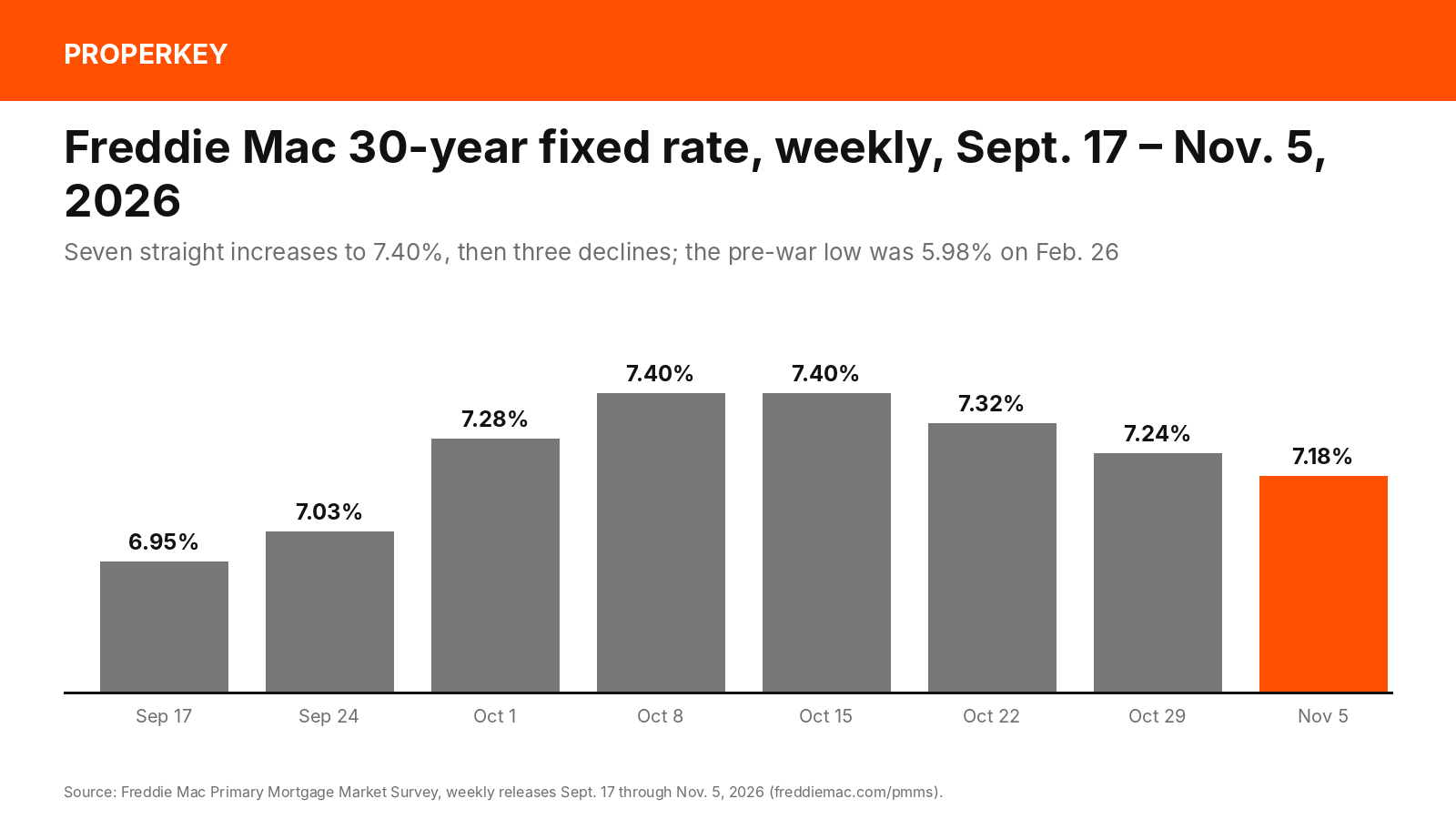
The decline is coming from the bond market, not from inflation. The Federal Reserve held its target range at 3.75% to 4.00% on October 28 in a 10–2 vote, with both dissenters preferring a quarter-point increase, and described inflation as "elevated." The next day the Bureau of Economic Analysis reported September PCE inflation at 3.6% and core at 3.1%, and third-quarter GDP growth of 3.4%. Futures priced a December 8–9 rate increase at roughly 77% at the start of the week; ADP reported 86,000 private jobs added in October on Wednesday, and the official October jobs report arrives Friday. The forecasts have not moved: Fannie Mae expects 7.5% in every quarter of 2027, the MBA expects rates above 7% through 2027, and C.A.R.'s 2027 forecast assumes 6.6%.
How is the California market doing?
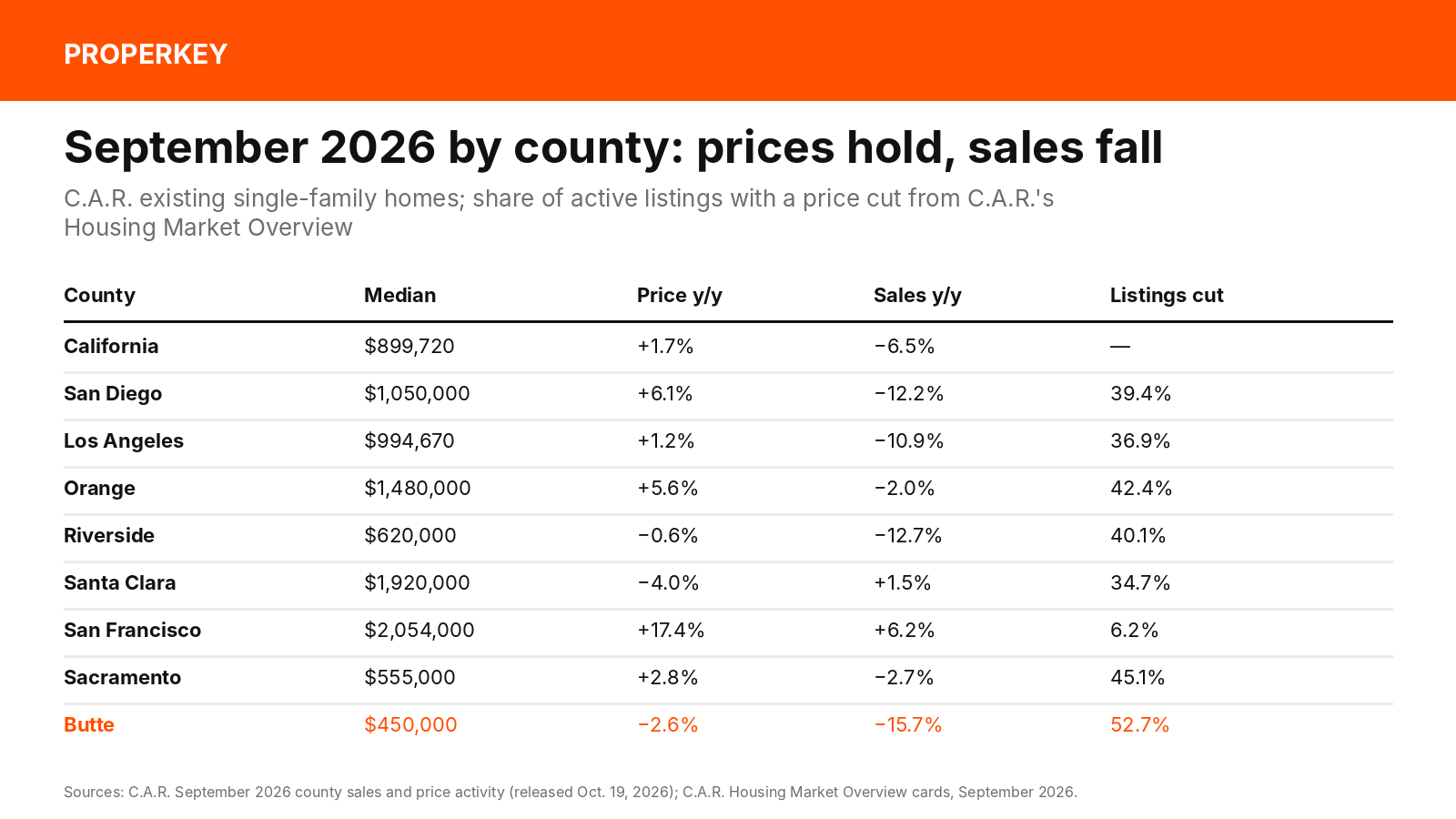
C.A.R.'s September report, the latest, showed sales at an annualized 260,410, down 3.4% from August and 6.5% from a year earlier, the 48th straight month below 300,000. The statewide median was $899,720, up 1.7% from a year ago and essentially flat from August, held up by the $1 million-plus share of sales rising to 35.9%. Homes that sold took a median 29 days and went for 98.8% of list. Unsold inventory was 3.7 months, and active listings rose 0.5% from a year earlier, the first annual increase in eight months, because sales slowed rather than because new listings arrived. Sales fell from a year earlier in 33 of the 53 counties C.A.R. tracks.
Affordability did not improve. C.A.R.'s third-quarter Housing Affordability Index, released October 30, found that 19% of California households could afford the $894,630 median-priced home, which required $228,000 of income for a $5,700 monthly payment at a 6.80% effective rate. San Diego County was at 16%, Los Angeles and Orange at 15%, Butte at 28%. The condo figure was 31% on a $640,000 median. The required income has topped $200,000 in 15 of the last 16 quarters.
What happened in the big counties?
From C.A.R.'s September county table: San Diego's median fell 3.7% in a month to $1,050,000, still up 6.1% from a year ago, on sales down 12.2%. Los Angeles was $994,670, up 1.2%, with sales down 10.9%. Orange County was $1,480,000, up 5.6%, sales down 2.0%. Riverside was $620,000, down 0.6%, sales down 12.7%. Santa Clara was $1,920,000, down 4.0%, the only large county with falling prices and rising sales. San Francisco was the outlier at $2,054,000, up 17.4%, with sales up 6.2%. Butte County was $450,000, down 2.6%, with sales down 15.7% and months of supply up from 4.0 to 4.7. C.A.R.'s Housing Market Overview cards show how many active listings have already cut price: 52.7% in Butte County and 56.3% in Chico, 39.4% in San Diego County, 36.9% in Los Angeles County, and 6.2% in San Francisco, where the typical home sold for 128.8% of list.
The forward indicators are weaker than the closed sales. Redfin's September report had pending sales down 16% from a year ago in Los Angeles, 15.8% in San Diego and 15.5% in Anaheim, three of the four largest declines among the 50 biggest U.S. metros, with 14.5% of contracts nationally falling through. NAR's pending home sales index for September was 66.0, the lowest reading since the series began in 2001, and the West fell 15% from a year earlier, the worst region.
What is happening nationally?
Sellers outnumber buyers. Redfin counted 62.6% more sellers than buyers in September, the widest gap since its records began in 2013, with 41 of the 50 largest metros rated buyer's markets. Realtor.com reported that 20.8% of listings cut price in September, the highest share for any month since October 2022, and 22.8% in the West. NAR's 2026 Profile of Home Buyers and Sellers, released this week, put the first-time buyer share at 22%, one point above last year's record low, with a median buyer age of 58, a first-time buyer median age of 40, and a record 12-year median seller tenure; 30% of repeat buyers paid cash.
What changed in policy this week?
Prop 37 passed. The Associated Press called the middle-income homebuyer loan measure on election night; as of the latest count it stood at 61.2% yes. It authorizes CalHFA to issue up to $25 billion in revenue bonds to fund fixed-rate state second mortgages of up to 17% of the price for buyers putting at least 3% down on newly built homes priced under 125% of the county conforming limit. CalHFA has up to a year after the law takes effect to stand the program up and has not announced a start date, so the honest status is approved, not yet available. Prop 1, the veterans and affordable housing bond, passed with 59.6%; Props 42, 43 and 45 had not been called as of Thursday morning. Properkey's Prop 37 explainer covers eligibility and the timeline. HousingWire's read of the midterms is that a Democratic Congress and a Republican White House leave a narrow runway for federal mortgage-cost legislation; the executive-branch items, from the FHFA mortgage-insurance pilot to FHA premium cuts, do not need Congress.
New appraisal format. UAD 3.6 became mandatory on November 2 for appraisals on Fannie Mae and Freddie Mac loans. The valuation method is unchanged; the report is a structured data file that records each area of the home separately and retires the familiar 1004 form. Sellers should expect more questions and prepare a dated list of improvements. Properkey's guide to the new appraisal rules explains the timeline, the lender exception running into 2027, appraisal waivers and what to do with a low appraisal.
Insurance. The FAIR Plan's 29.1% average rate increase took effect October 15, and the SB 876 reforms phase in through 2028. Properkey's home-insurance guide has the numbers; buyers in wildfire areas should bind coverage before contingencies expire, and can compare carriers through Properkey's insurance desk.
What should sellers do?
Price to the buyer who is actually there. Statewide sales are 6.5% below a year ago, pendings in Los Angeles and San Diego are down about 16%, and more than a third of active listings in Southern California have already reduced price. A listing that has gone 30 days without an offer is priced for a buyer pool that left when rates crossed 7%. The market is paying concessions, such as seller-paid rate buydowns and closing costs, more readily than it is cutting list prices, and a buydown can cost a seller less than the equivalent price reduction. Properkey lists for a $0 listing fee with full MLS exposure, professional photos and a 3D tour, and puts every listing on the MLS and every portal on day one.
What should buyers do?
Use the leverage while it lasts. With sellers outnumbering buyers by the widest margin on record and one in five listings cut, buyers are negotiating price, repairs and closing costs at the same time, and November and December are typically the quietest months for competing offers. Rates at 7.18% are the lowest in six weeks but no forecaster expects them below 7% soon, so a buyer waiting for 6% is waiting for an event no one has scheduled. Have the file priced with more than one lender, including an ARM comparison, through Properkey's finance desk, and keep the appraisal and loan contingencies.
Questions people ask
Are California home prices falling? Statewide, no: the September median was up 1.7% from a year ago. But the gain is a mix effect from more $1 million-plus sales, San Diego's median fell $40,000 in one month, Santa Clara and Riverside are down from a year ago, and half of Butte County's listings have cut price. Expect flat to slightly lower prices in most of the state through the winter.
Will mortgage rates keep falling? The three-week decline has come from money moving into bonds, not from lower inflation; September PCE was 3.6% and the Fed is more likely to raise than cut in December. Fannie Mae and the MBA both expect rates above 7% through 2027.
When can a buyer use Prop 37? Not yet. The law takes effect in mid-December once the Secretary of State certifies the vote, CalHFA then has up to a year to implement it, and no application date has been published. It applies only to newly built homes.
Is now a bad time to sell? It is a slower time, not a bad one. Homes priced correctly still sold in 29 days at 98.8% of list in September. The sellers struggling are the ones anchored to spring prices in a market with 63% more sellers than buyers.
This update summarizes published data as of November 5, 2026; it is market information, not investment, legal or lending advice.
Sources: Freddie Mac PMMS, Nov. 5, 2026; Mortgage News Daily; MBA weekly survey via RISMedia; FOMC statement, Oct. 28, 2026; BEA, Personal Income and Outlays, September 2026; HousingWire on FedWatch; ADP National Employment Report, October 2026; Fannie Mae October forecast via HousingWire; MBA forecast via MPA; C.A.R. 2027 forecast; C.A.R. September 2026 sales report; C.A.R. Q3 2026 Housing Affordability Index; C.A.R. county sales activity; C.A.R. Housing Market Overview; Redfin September 2026 report; NAR Pending Home Sales via HousingWire; Redfin buyers vs. sellers via NMP; Realtor.com September 2026 report; NAR 2026 Profile of Home Buyers and Sellers via HousingWire; KQED/AP Prop 37 results; KQED/AP Prop 1 results; HousingWire on the midterms; Freddie Mac UAD 3.6 FAQ.
Written by Keyro, Properkey's AI. Properkey, DRE #01979718.



