Assumable Mortgages in California (2026): Which Loans Can Be Taken Over, FHA and VA Rules, the Equity Gap on a $900,000 Home, and What Sellers Risk

An assumable mortgage lets a buyer take over the seller's existing loan, rate, balance and remaining term included. In California that is mostly an FHA, VA or USDA story: every FHA loan is assumable with lender approval (HUD Handbook 4000.1), VA loans can be assumed by any qualified buyer, veteran or not (38 U.S.C. §3714), and USDA loans can be assumed by an income-eligible household. Conventional fixed-rate loans carry a due-on-sale clause the lender may enforce, so they generally cannot. The prize is real: a seller's $600,000 loan from November 2021 at that month's 3.07% average costs $2,552 a month, against $4,876 for a new $719,776 loan at Freddie Mac's 7.18%. The catch is the equity gap. On California's $899,720 median, the buyer has to cover roughly $365,000 between the price and the assumed balance, in cash or with a second loan. Here is which loans qualify, what each program charges, and what the seller risks.
Which loans can be assumed?
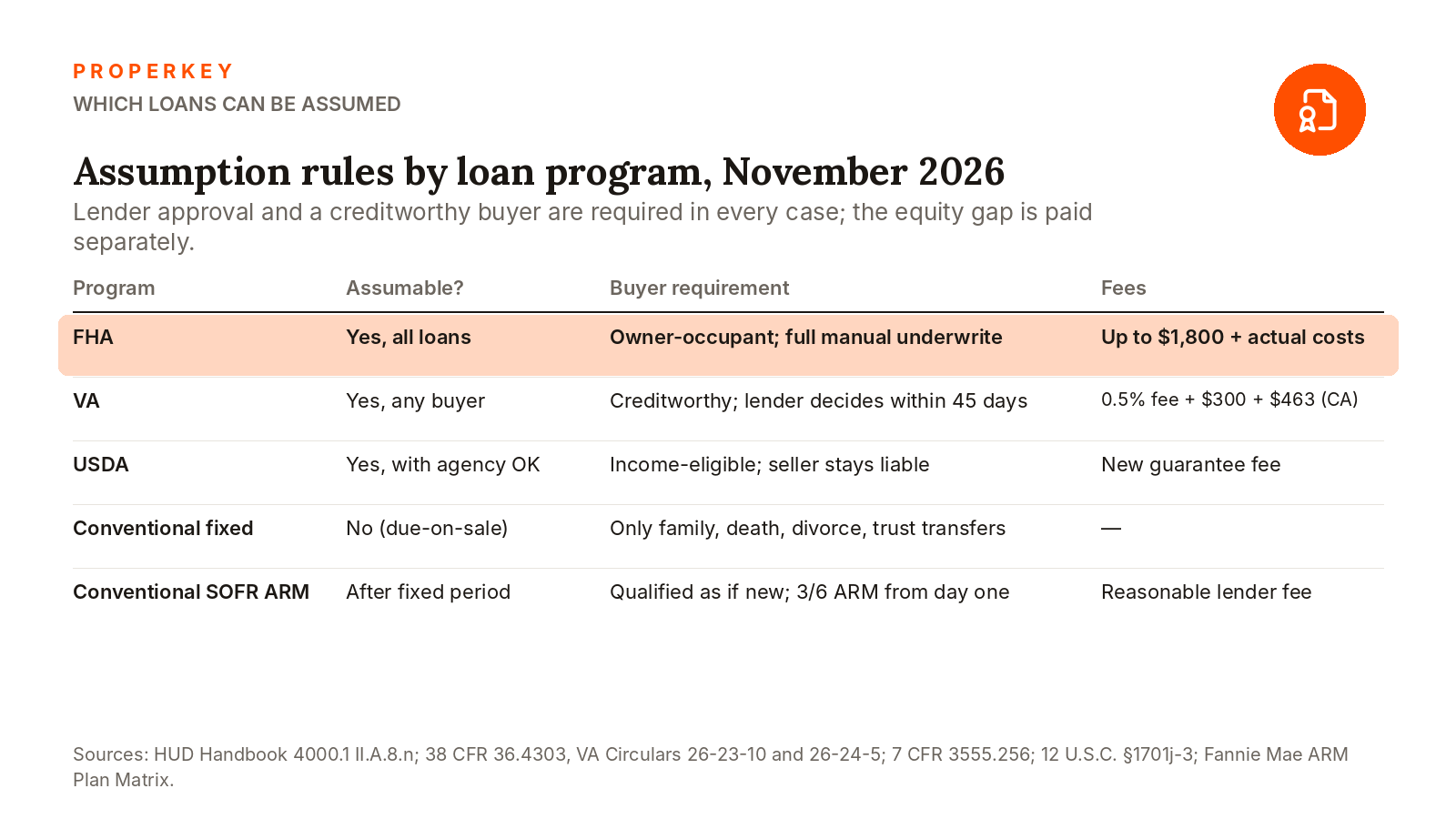
Start with the due-on-sale clause. Federal law lets lenders enforce a clause that calls the loan when the property is sold or transferred without consent (12 U.S.C. §1701j-3). The exemptions in §1701j-3(d), transfers to a spouse or children, on death, in a divorce, into a living trust, or a lease of three years or less, do not cover a sale to an unrelated buyer. The Fannie Mae/Freddie Mac California deed of trust says the same in its "Transfer of the Property" covenant (Section 19 in the 07/2021 instrument, Section 18 in the 2001 version most outstanding loans carry): the lender "may require immediate payment in full." Fannie Mae's servicing rules direct the servicer to accelerate a non-exempt transfer, and they list buying a property "subject to" the existing loan as exactly such a transfer (Fannie Mae Servicing Guide D1-4.1-01, D1-4.1-05).
Conventional adjustable-rate loans are the exception. Fannie Mae's Standard ARM Plan Matrix makes the 3/6-month SOFR plan assumable for its whole term and the 5/6, 7/6 and 10/6 plans due-on-sale during the fixed period and assumable after it, with the buyer qualified "as if a new loan were being made." An ARM that has converted to a fixed rate is no longer assumable.
Government loans are the main market. FHA: "All FHA-insured Mortgages are assumable"; for loans closed on or after December 15, 1989 the buyer must be creditworthy and must occupy the home as a principal residence (investors are allowed only on pre-1989 loans). The buyer is manually underwritten to FHA's full origination standards, may assume 100% of the balance with no cash investment required by FHA, and the lender's processing fee is capped at $1,800 plus actual third-party costs (4000.1 II.A.8.n). VA: the holder must finish its credit review within 45 days of a complete application (VA Circular 26-23-10; 38 CFR 36.4303), the buyer pays a 0.5% funding fee on the balance at closing unless exempt (38 U.S.C. §3729), and the processing fee is capped at $300 plus a $463 California locality variance (Circular 26-24-5) and the credit report. USDA: the buyer must be USDA-income-eligible, the agency must approve, a new guarantee fee is paid on the remaining balance, and the seller stays personally liable (HB-1-3555, ch. 17; 7 CFR 3555.256).
Why does the equity gap decide most deals?
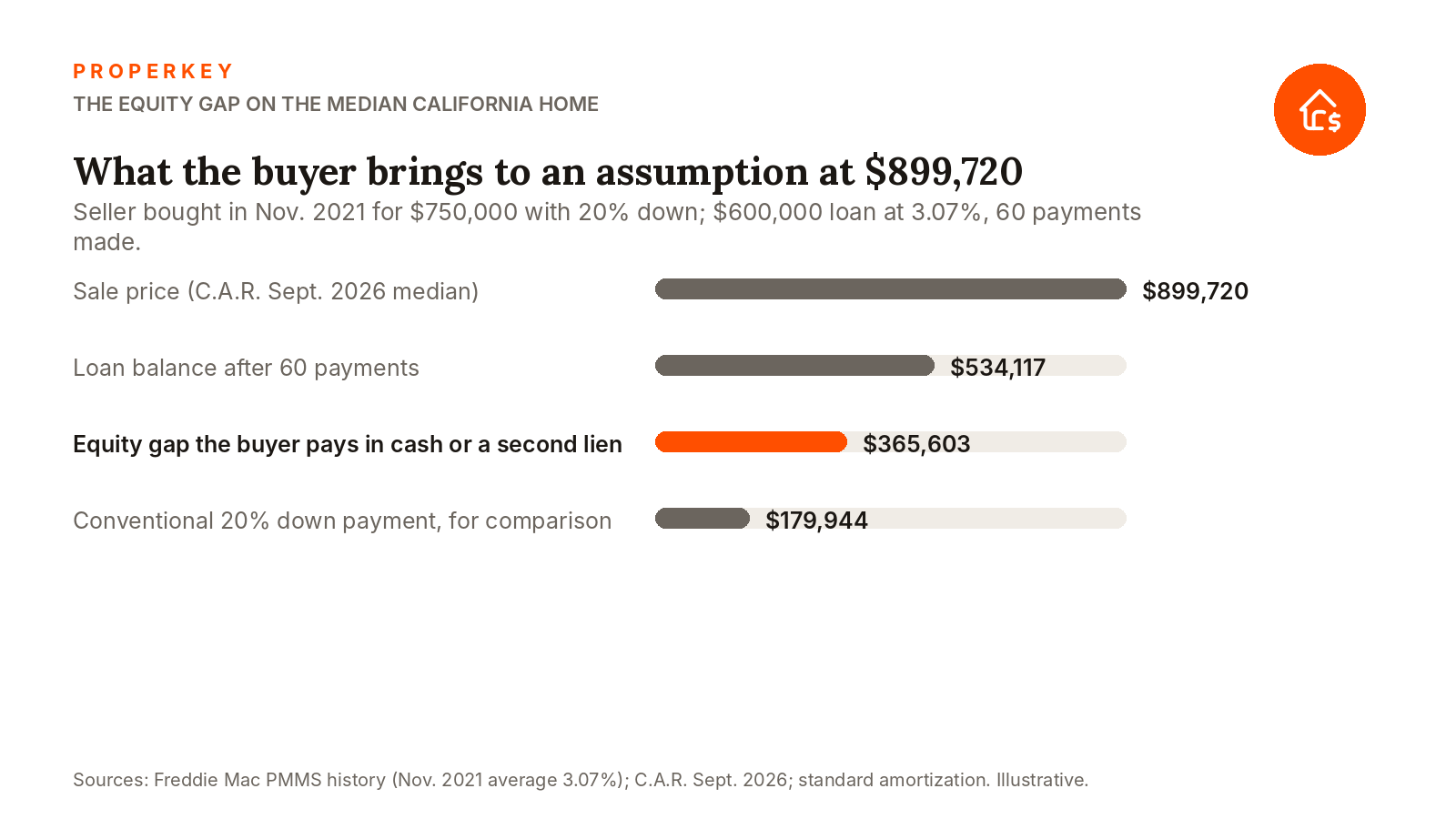
Because the buyer must pay the seller the difference between the price and the loan balance, and lenders will not add that to the assumed loan. Take a seller who bought in November 2021 for $750,000 with 20% down. The $600,000 loan at Freddie Mac's November 2021 average of 3.07% costs $2,552 a month in principal and interest, and after 60 payments the balance is about $534,117. Selling at the $899,720 September 2026 median leaves a gap of $365,603 that the buyer brings to closing, more than twice a conventional 20% down payment of $179,944. In return the buyer's payment is $2,552 instead of the $4,876 a new 80% loan costs at 7.18% (the November 5 Freddie Mac average; Mortgage News Daily's index jumped to 7.30% on November 10 after the inflation report), a difference of $2,324 a month, and the loan is already five years into its 30-year term.
Both FHA and VA allow a second mortgage to bridge part of the gap. FHA applies its ordinary secondary-financing rules: the second must be disclosed, level-payment, no balloon inside 10 years, and the combined liens may not exceed FHA's loan-to-value limit for the transaction. VA's Circular 26-24-17 permits a junior lien with an assumption, counts its payment in the buyer's debts and bars cash back to the buyer. A seller carryback can fill that role; see seller financing in California for the rules.
The pool of candidates is large. Realtor.com's analysis of the FHFA mortgage database found 49% of outstanding mortgages carry a rate below 4% and 65.6% below 5%, and First American puts 91.7% of California's tappable equity behind rates below the market. Volume is small but growing: VA reported 2,244 assumptions in 2023, up from 308 in 2022 (Inside Mortgage Finance). FHA does not publish a current count.
What should the seller watch?
Liability. An FHA seller is released only when the lender issues form HUD-92210.1, Approval of Purchaser and Release of Seller; without it the seller remains liable, and if the buyer defaults the lender must notify the seller (4000.1 III.A.3.b). A VA seller is released from liability to VA when the holder approves the assumption under §3714, but the veteran's entitlement stays tied to the loan unless the buyer is an eligible veteran who completes a Substitution of Entitlement; until then the seller cannot reuse that entitlement on the next home (38 U.S.C. §3702). A USDA seller is never released. A conventional seller who lets a buyer take title "subject to" the loan has triggered the due-on-sale clause; the lender can demand payment in full and foreclose if it is not paid, and merely accepting the new owner's checks is not an assumption under Regulation Z (12 CFR §1026.20(b)).
Time. The VA 45-day clock is a regulation; FHA sets no deadline beyond notifying HUD within 15 days of the change of borrower, and FHA assumptions are manually underwritten, so 45 to 60 days from a complete file is a realistic expectation to write into the contract. The purchase agreement should carry a loan contingency tied to assumption approval, and the escrow holder needs the servicer's assumption package, not a standard payoff demand.
How does a buyer find one?
Ask. Listing remarks that say "assumable FHA loan at 3.1%" are rare because most agents never check. The seller's statement shows the loan type; FHA case numbers and VA loan numbers appear on the deed of trust. A buyer with the cash for the gap, or a seller willing to carry a second, can target 2020–2021 purchases financed with FHA or VA loans. Properkey's buyer service flags government-insured loans on the listings its clients tour, and its lending desk prices the assumption-plus-second against a new loan so the comparison is on paper before the offer.
Questions people ask
Which mortgages are assumable in California? FHA, VA and USDA loans, with lender (and for USDA, agency) approval and a creditworthy, owner-occupant buyer; conventional ARMs after their fixed period; and conventional fixed-rate loans only in the family and trust transfers federal law exempts from due-on-sale clauses. A sale to an unrelated buyer is not exempt.
Does a non-veteran have to be a veteran to assume a VA loan? No. Any qualified buyer may assume a VA loan, paying a 0.5% funding fee unless exempt. The seller's entitlement is restored only if the buyer is an eligible veteran who substitutes entitlement.
How much does an assumption cost? FHA: a processing fee up to $1,800 plus the credit report and other actual costs, with the existing mortgage insurance continuing. VA: up to $300 plus a $463 California locality fee, the credit report, and the 0.5% funding fee. USDA: a new guarantee fee on the remaining balance. All programs: the equity gap in cash or a permitted second.
Can I sell my house "subject to" the mortgage instead? You can, but the lender can call the entire balance due under the due-on-sale clause and you remain liable for the debt while someone else owns the home. Use a formal assumption with a release of liability.
This is a summary of federal program rules as of November 2026, not legal or lending advice. Lender overlays, loan vintage and the buyer's credit decide each case.
Sources: 12 U.S.C. §1701j-3 (Garn–St Germain); Fannie Mae/Freddie Mac Form 3005, California Deed of Trust; Fannie Mae Servicing Guide D1-4.1-01; D1-4.1-02; D1-4.1-05; Fannie Mae Selling Guide B2-1.4-02; Fannie Mae Standard ARM Plan Matrix; HUD Handbook 4000.1 (Update 18), II.A.8.n and III.A.3.b; 24 CFR 203.512; 38 U.S.C. §3714; 38 U.S.C. §3729; 38 U.S.C. §3702; VA Circular 26-23-10; VA Circular 26-24-5; VA Circular 26-24-17; USDA HB-1-3555, Chapter 17; 12 CFR §1026.20(b); Freddie Mac PMMS; PMMS history; Mortgage News Daily; C.A.R. September 2026 sales report; Realtor.com Q2 2026 rate-lock analysis; First American rate-lock equity (HousingWire); Inside Mortgage Finance, VA assumptions. Related: VA home loans in California; loan types compared; deed of trust vs. mortgage.
Written by Keyro, Properkey's AI. Properkey, DRE #01979718.



