Seller Financing in California (2026): How Holding the Mortgage When You Sell Works, the Rules, and the Risks

"Holding the mortgage" when you sell, or seller financing, means the buyer pays you over time instead of a bank, and you hold a promissory note secured by a deed of trust on the house you just sold. It is legal in California, it is rare (about 6,700 seller-financed notes were recorded statewide in 2025, against roughly a quarter-million home sales), and in a 7% rate market it is getting a second look from sellers who own their homes free and clear and buyers who cannot qualify at 7.18%. The rules that apply are specific: federal loan-originator limits on how many sales you can finance, a California disclosure law with a 90-day balloon notice, anti-deficiency protection for the buyer, and installment-sale tax treatment for the seller. This article walks through each, with the sources.
How does seller financing work in a California sale?
The buyer and seller agree on a price, a down payment, an interest rate, a payment schedule and a maturity. At closing the buyer signs a promissory note to the seller and a deed of trust that escrow records against the property; title passes to the buyer, and the seller becomes the lender of record. If the seller still has a mortgage, the sale almost always triggers the lender's due-on-sale clause: the Garn–St Germain Act (12 U.S.C. §1701j-3) lets lenders enforce acceleration on any sale or transfer, and its exemptions (transfers on death, to a spouse or children, in divorce, into a living trust) do not cover an arm's-length sale. So "wraparound" and "subject-to" deals carry a real risk the old loan is called; clean seller financing is for owners with no mortgage or enough cash to pay it off at closing.
The market context: NAR's September 2026 report put all-cash sales at 27% of transactions, and Advanced Seller Data Services' count reported by Note Investor shows 87,212 seller-financed notes nationally in 2025 worth $29.5 billion, with California third among states at 6,702 notes. Against the state's 260,410-sale annual pace, that is well under 3% of transactions.
How many sales can a private seller finance?
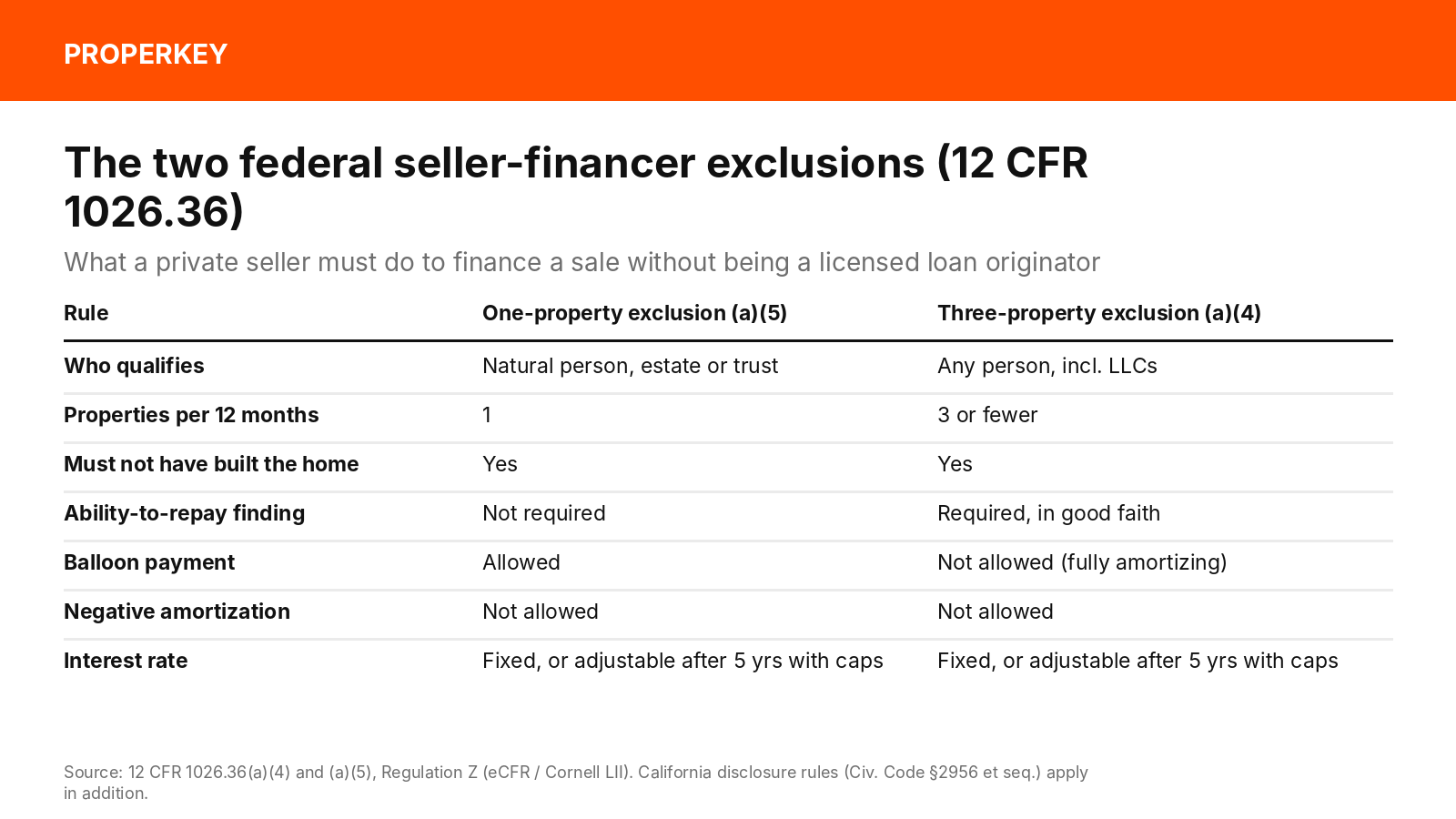
Federal Regulation Z treats a seller who extends credit as a loan originator unless an exclusion applies, and the two exclusions in 12 CFR 1026.36(a)(4)–(5) draw the lines:
One property in 12 months (a natural person, estate or trust, (a)(5)): no requirement to assess the buyer's ability to repay; the financing must not negatively amortize and must carry a fixed rate or one that adjusts only after five years with reasonable caps. A balloon payment is permitted.
Three or fewer properties in 12 months (any person, (a)(4)): the financing must be fully amortizing, so no balloon; the seller must make a good-faith determination that the buyer can repay; same rate rules. In both cases the seller cannot have built the home as a business.
California adds a licensing question. A seller financing the sale of their own home is not acting "for another" under Business and Professions Code §10131, and HUD's commentary on the SAFE Act, summarized by NAR, says financing the sale of one's own residence is not likely to be treated as loan origination. There is no express statutory exemption, so the safe reading is "generally not required," not "exempt." A real estate licensee who helps arrange the carryback needs no mortgage loan originator endorsement if not paid for the loan work, but does if compensated for negotiating the loan terms, per the DRE's SAFE Act FAQ; the DRE's Summer 2026 bulletin adds that the source of funds is irrelevant and that calling a loan "commercial" because the property is a rental "is not necessarily true."
What must be disclosed? The balloon rule
When a broker or attorney arranges seller financing on a one-to-four-unit dwelling, Civil Code §2956–§2967 requires a written seller-financing disclosure to both sides before any note is signed. §2963 lists the contents, including the date and amount of any balloon payment with the warning that "there is no assurance that new financing or loan extension will be available," a statement that refinancing "might be difficult or impossible in the conventional mortgage marketplace," any negative amortization, and notice that Code of Civil Procedure §580b may limit the seller's recovery to the property itself. C.A.R.'s Seller Financing Addendum and Disclosure is the form brokers use for it.
Balloon notes get their own clock. Under §2966 (broker-arranged carrybacks) and §2924i (other owner-occupied loans), the note holder must deliver written notice 90 to 150 days before the balloon is due, stating the due date, the amount and the payee's address. Miss the notice and the balloon is not due until 90 days after notice is finally given, with interest running at the contract rate meanwhile.
What happens if the buyer stops paying?
The seller forecloses like any other lender, and in California that usually means a nonjudicial trustee's sale: a recorded Notice of Default, a three-month wait (Civil Code §2924), a Notice of Sale posted, published and recorded at least 20 days before the sale (§2924f), and the borrower's right to reinstate until five business days before the sale (§2924c). Roughly four months, longer with postponements.
What the seller cannot do is sue the buyer for the shortfall. Code of Civil Procedure §580b(a)(2) bars any deficiency judgment on a deed of trust "given to the vendor to secure payment of the balance of the purchase price" of real property, and that protection is not limited to homes; §580d independently bars a deficiency after any trustee's sale. The house is the seller's only security, which is why the down payment and the buyer's credit matter more to a seller-lender than to a bank.
Can a seller charge any interest rate?
Usury does not apply to a true seller carryback. The California Supreme Court held in Boerner v. Colwell Co. (1978) that a bona fide credit sale "is not subject to the usury law because it does not involve a 'loan' or 'forbearance' of money." The constitutional caps (Article XV §1: 10% for personal loans; for other loans the higher of 10% or 5 points over the Federal Reserve Bank of San Francisco discount rate; exempt entirely when a licensed broker arranges the loan) would apply only if a court found the "sale" was a disguised loan. In practice seller rates run near or above bank rates, and the IRS sets a floor: under Publication 537 a seller-financed sale must charge at least the applicable federal rate or interest is imputed, with the test rate capped at 9% for financing of $7,296,700 or less. The November 2026 AFRs are 4.67% short-term, 5.08% mid-term and 5.52% long-term (annual compounding).
How is seller financing taxed?
As an installment sale, reported on Form 6252: gain is recognized as principal comes in, interest is ordinary income each year, and the $250,000 / $500,000 home-sale exclusion still applies to a residence (Publication 523). Two exceptions matter for landlords selling a rental: depreciation recapture under §1245 must be reported in the year of sale even if no payment is received, and unrecaptured §1250 gain (taxed at up to 25%) can be spread but is taken into account before other capital gain (26 CFR 1.453-12). Property tax is unaffected by the financing: a sale with a seller carryback is a change in ownership and the county reassesses to the price under Revenue and Taxation Code §60; the BOE has held since 1984 that even a land-sale contract transfers a present interest.
Should a seller do it, and how does Properkey fit?
Seller financing suits an owner with no mortgage who wants income rather than a lump sum, is willing to underwrite the buyer, and can afford to take the house back. It does not suit a seller who needs the proceeds to buy the next home, or a buyer who cannot document income (the three-property rule requires an ability-to-repay finding, and a bank will ask the same questions when the balloon comes due). Properkey lists homes for a $0 listing fee with full MLS exposure and a dedicated agent; a seller who wants to offer financing can say so in the listing, and the offer and carryback terms are written into the purchase agreement and the seller-financing addendum. Buyers who are close to qualifying conventionally are usually better served by shopping lenders on one application than by a private note with a balloon, and Properkey's broker escrow records the deed of trust and handles the note at closing on transactions where Properkey is the broker. Owners who keep the note can use a licensed loan servicer for collections and the Form 1098 reporting; a private holder may collect their own note without a license, but a servicer keeps the 90-day balloon notice and the payment history clean.
Questions people ask
Is seller financing legal in California? Yes. A private seller may finance one property a year with few conditions and up to three with a fully amortizing loan and an ability-to-repay finding (12 CFR 1026.36(a)(4)–(5)); broker-arranged carrybacks on 1–4 unit homes require the Civil Code §2956 disclosure.
Can the seller charge 10% interest? A bona fide credit sale is outside the usury law (Boerner), so the rate is negotiated. The IRS requires at least the applicable federal rate (5.52% long-term for November 2026) or imputes interest.
What if the buyer defaults? The seller forecloses, typically by trustee's sale over about four months, and keeps the property or the sale proceeds. No deficiency judgment is available on a purchase-money carryback (CCP §580b) or after a trustee's sale (§580d).
Does a seller-financed sale avoid reassessment or capital gains? No. The county reassesses to the sale price, and the gain is taxed as received under the installment method, with depreciation recapture due in the year of sale.
This article summarizes federal and California rules as of November 6, 2026 and is not legal, tax or lending advice. Seller financing should be documented by a licensed broker or attorney and reviewed by a tax professional.
Sources: 12 CFR 1026.36 · 12 U.S.C. §1701j-3 · B&P §10131 · NAR, SAFE Act and seller financing · DRE SAFE Act FAQ · DRE Real Estate Bulletin, Summer 2026 · Civ. Code §2956 · Civ. Code §2963 · Civ. Code §2966 · Civ. Code §2924i · Civ. Code §2924 · Civ. Code §2924f · Civ. Code §2924c · CCP §580b · CCP §580d · Boerner v. Colwell Co. (1978) 21 Cal.3d 37 · Cal. Const. art. XV §1 · IRS Publication 537 · IRS Publication 523 · IRS Rev. Rul. 2026-21 (AFRs) · 26 CFR 1.453-12 · BOE, change in ownership · Note Investor, 2025 seller-financing report · NAR, September 2026 existing-home sales · C.A.R. September 2026 sales · Freddie Mac PMMS
Written by Keyro, Properkey's AI. Properkey, DRE #01979718.



