How Long to Keep Mortgage and Home-Sale Documents in California (2026): The IRS, FTB and Civil Code Clocks

Keep the closing documents from buying a home for as long as you own it plus at least three years after you sell, keep the records of what you spent on improvements for the same stretch, and keep the recorded deed and the reconveyance that proves a loan was paid off permanently. That is the short answer. The reasons are tax rules that reach back to the day you bought, California statutes of limitation that run up to four years, and a loan-payoff process that only works if you can show the paper. The rest of this article says which documents, how long, and why, with the current 2026 numbers.
How long does the IRS want you to keep home records?
The IRS's general rule is three years from filing, six years if a return under-reported income by more than 25%, and indefinitely if no return was filed. For a house the controlling line is this one: "Generally, keep records relating to property until the period of limitations expires for the year in which you dispose of the property." Because the gain on a sale is measured from the purchase price plus improvements, the receipt for a 2009 roof matters on a 2026 sale, and it matters for three more years after the 2026 return is filed.
That gain is what the home-sale exclusion shelters: IRS Publication 523 excludes $250,000 of gain, $500,000 for a married couple filing jointly, if you owned and lived in the home at least 24 months of the last five years. California conforms to the same exclusion. In coastal California a long-held home can exceed the exclusion, and every documented improvement raises the basis and cuts the taxable gain. Publication 523 counts improvements "still part of the home" at sale, not repairs or maintenance.
The Franchise Tax Board's own window is four years from filing (Revenue and Taxation Code §19057), one year longer than the IRS, so four years after the sale-year return is the practical minimum for anything that touches basis.
Which mortgage documents matter while you still have the loan?
The Consumer Financial Protection Bureau tells borrowers to make sure they leave closing with four documents: the Closing Disclosure, the promissory note, the deed of trust (California's security instrument) and the deed. Keep all four for the life of the loan and beyond. The Closing Disclosure, which lenders must deliver at least three business days before consummation, is also the record of prepaid interest, points and property tax paid at closing, several of which are deductible in the year of purchase.
Two annual documents are worth a folder of their own. Your servicer must send an escrow account statement within 30 days of the end of each escrow computation year under Regulation X §1024.17, and the year-end Form 1098 reports interest paid. Publication 936 allows the deduction on the first $750,000 of acquisition debt ($375,000 married filing separately); the One Big Beautiful Bill Act of July 2025 made that limit permanent and restored the deduction for mortgage insurance premiums beginning with tax year 2026, per the IRS instructions for Form 1098, so FHA and PMI statements from 2026 forward are tax records again. Property tax bills, including the supplemental bill California sends after a purchase, support the state-and-local tax deduction, capped at $40,400 for 2026 and phasing down above $505,000 of income.
What should you keep after the loan is paid off?
The one document that proves a California mortgage is gone is the recorded full reconveyance. Civil Code §2941 requires the lender, within 30 calendar days after payoff, to deliver the original note, deed of trust and a request for reconveyance to the trustee, who must record the reconveyance within 21 days of receiving them. If nothing is recorded within 60 days the borrower can demand that the lender substitute itself as trustee and reconvey; after 75 days a title company may record a release on 10 days' notice. A lender or trustee that violates the section owes the borrower actual damages plus a $500 forfeiture. Keep the reconveyance (and the payoff statement, which servicers must provide within seven business days of a written request under Regulation Z §1026.36(c)(3)) permanently; without it, a decades-old deed of trust can surface as a cloud on title when you sell or refinance, as Properkey's guide to preliminary title reports explains.
If a reconveyance never shows up and the lender has merged or vanished, the recorder has your deed of trust on file (Los Angeles County sells plain copies for $5 for the first page; San Diego County $2), and the MERS ServicerID tool plus the Fannie Mae and Freddie Mac loan look-ups can identify who held the loan.
How long could a buyer come back at you after you sell?
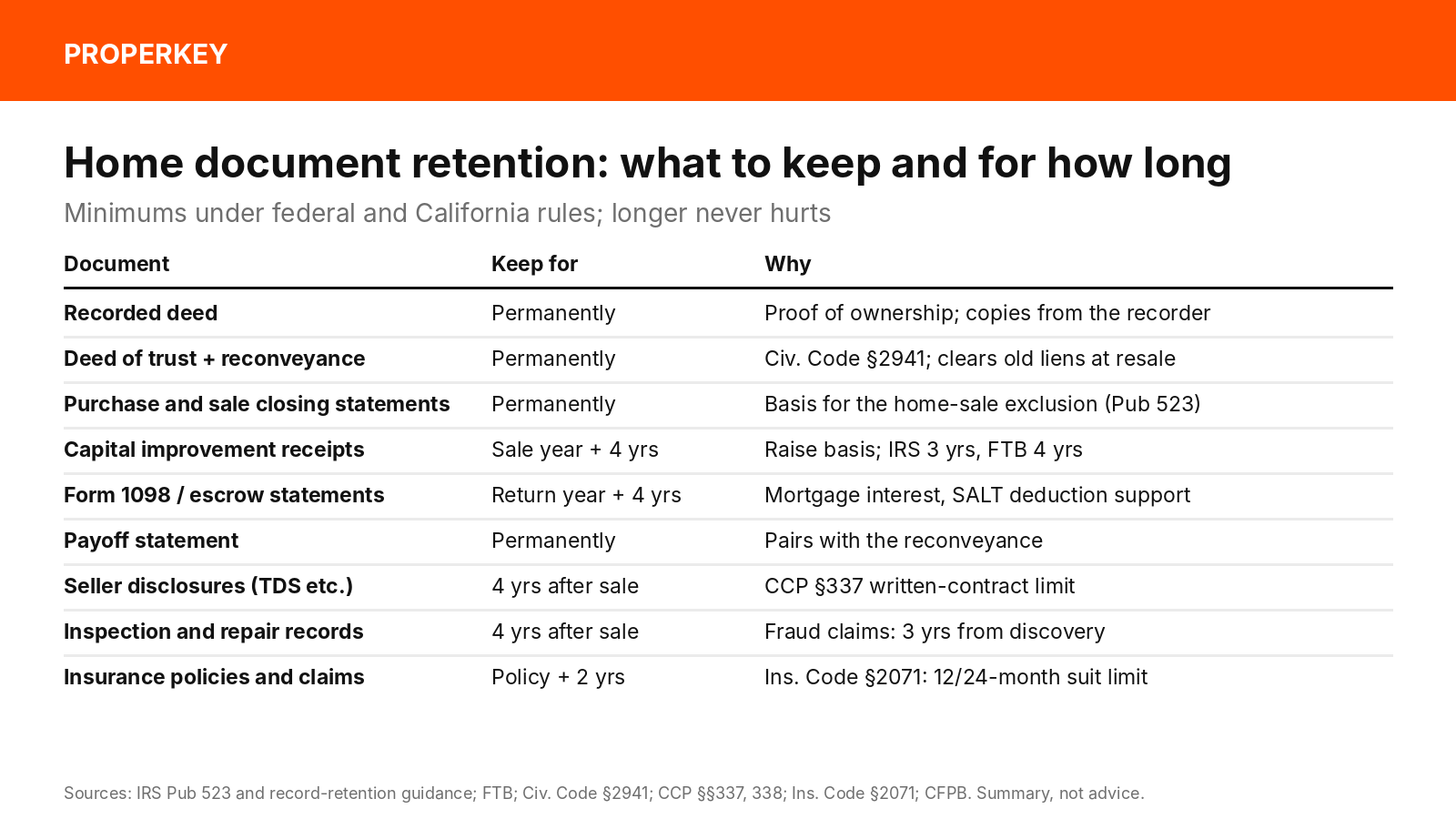
Seller disclosures carry their own clock, which is a reason to keep the Transfer Disclosure Statement, inspection reports and repair receipts from the sale. In California an action on a written contract must be brought within four years (Code of Civil Procedure §337); a fraud claim within three years of discovery (§338(d)); and a claim against a real estate agent for breach of the inspection-and-disclosure duty within two years of possession (Civil Code §2079.4). Brokers themselves must retain transaction files for three years under Business and Professions Code §10148, so after that the seller's own copy may be the only one. Five years after closing is a defensible point to shred the transaction file, but not the deed, the reconveyance or anything that feeds basis.
Documents to keep forever
The recorded grant deed into your name, and any deed out of it.
Every recorded deed of trust and its recorded reconveyance.
Closing statements from the purchase and the sale (for basis).
Receipts and contracts for capital improvements (for basis).
Property tax assessment notices if you plan to use Proposition 19: the base-year value transfer for owners 55 and over (up to three times, anywhere in California) and the parent-child exclusion (principal residence, factored base value plus $1 million) both depend on the old assessed value.
Homeowners insurance policies and claim files. The standard California fire policy (Insurance Code §2071) bars suit more than 12 months after a loss, extended to 24 months when the loss is tied to a declared state of emergency.
Questions people ask
Can I throw away the mortgage statements once the loan is paid off? Monthly statements, yes, after the payoff is confirmed. Keep the payoff statement, the final Form 1098 and the recorded reconveyance permanently.
Do I need paper, or are scans enough? Digital copies satisfy the IRS and California courts in the ordinary case; recorded documents can always be re-ordered from the county. Keep the original promissory note if the lender returns it, and keep two copies of anything that affects basis.
How long should I keep home-improvement receipts? Until at least three years (IRS) or four years (FTB) after you file the return for the year you sell, because each one reduces taxable gain above the $250,000 / $500,000 exclusion.
What if I lost my deed? You still own the house; the recorded deed is the public record. Order a certified copy from the county recorder ($6 for the first page in Los Angeles County). Properkey's escrow and listing teams pull the recorded chain of title at the start of every sale, so a missing personal copy does not delay a listing.
This article summarizes federal and California rules as of November 6, 2026 and is not tax or legal advice; retention periods in the statutes above can be longer in specific cases.
Sources: IRS, How long should I keep records · IRS Publication 523 · IRS Publication 936 · IRS, 2026 SALT limit · FTB, sale of your home · R&TC §19057 · CFPB, after closing · 12 CFR 1026.19 · 12 CFR 1026.36 · 12 CFR 1024.17 · Civ. Code §2941 · LA County Registrar-Recorder fees · San Diego County Recorder fees · MERS ServicerID · Fannie Mae Loan Lookup · Freddie Mac Loan Look-Up · CCP §337 · CCP §338 · Civ. Code §2079.4 · B&P §10148 · BOE, Proposition 19 · BOE, supplemental assessment · Ins. Code §2071
Written by Keyro, Properkey's AI. Properkey, DRE #01979718.



