Buying a Condo in California in 2026: The HOA Documents the Seller Must Give You, the New 15% Reserve Rule, AB 2050, Insurance Gaps, and What the Dues Do to Your Loan

The median California condo or townhome sold for $640,000 in September 2026, $260,000 less than the median house, and it took 39 days to sell against 29 for a house (C.A.R.). The discount is real, and so is the second set of books that comes with it. A condo buyer in California is buying into an association, and the law gives the buyer a specific stack of documents to judge it by: Civil Code §4525 lists eleven items the seller must deliver before title transfers, including the budget, the reserve study summary, the insurance summary and, since 2025, the balcony inspection report. The lenders are tightening at the same time. From January 4, 2027, Fannie Mae and Freddie Mac will require the association's budget to set aside at least 15 percent of its assessment income for reserves, up from 10 percent, and California's own AB 2050 will impose a minimum reserve contribution from 2032. Here is what to read, what the numbers mean, and what the dues do to your loan.
What documents does a California condo seller have to give the buyer?
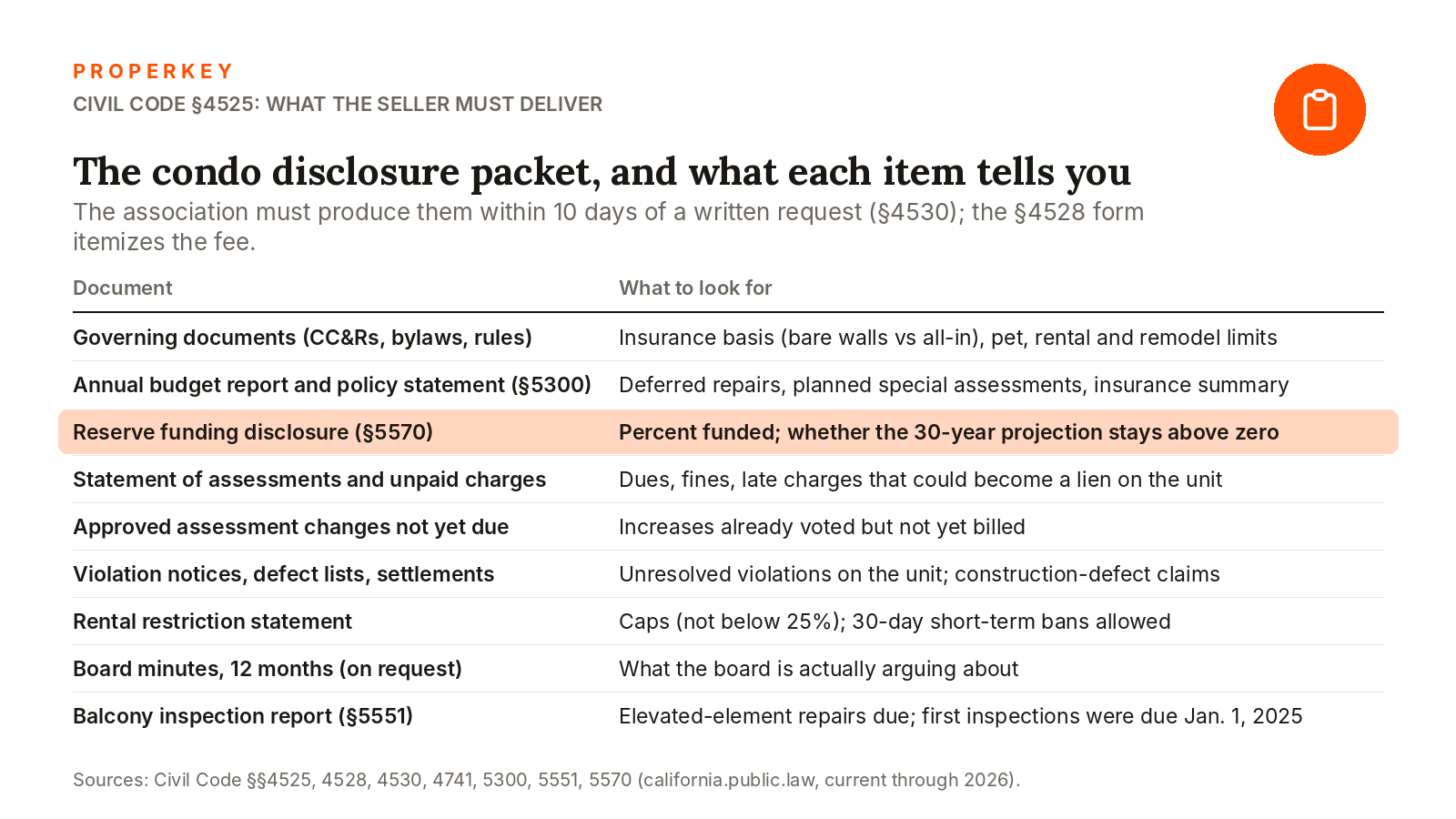
Civil Code §4525, part of the Davis-Stirling Act, requires the owner of a separate interest to give a prospective buyer, "as soon as practicable before the transfer of title," the following: (1) the governing documents, meaning the CC&Rs, bylaws and rules; (2) notice of any age restriction; (3) the most recent annual budget report and annual policy statement distributed under §5300; (4) a written statement from the association of current regular and special assessments, any unpaid assessments, fines, late charges and collection costs that could become a lien on the unit; (5) any unresolved notice of violation against the unit; (6) the initial list of construction defects, if a defect claim is pending; (7) the latest information on any defect settlement; (8) any approved change in assessments not yet due; (9) a statement of any rental restrictions; (10) twelve months of board minutes, if the buyer asks; and (11) "a copy of the report issued pursuant to the most recent inspection conducted pursuant to Section 5551," the exterior elevated elements, or balcony, inspection. Under §4530 the association must produce the documents within 10 days of a written request, may charge only its actual cost on the itemized §4528 fee form, and "it is the responsibility of the seller to compensate the association"; who ultimately bears that cost is negotiated in the purchase contract. C.A.R.'s residential purchase agreement, revised in June 2026, gives the buyer the standard 17 days to review them unless the parties write in another number.
What should you look for in the budget and reserve study?
Three things: the percent funded, the planned special assessments, and the deferred repairs. §5300 requires the annual budget report 30 to 90 days before the end of the fiscal year, and it must include the operating budget, a summary of the reserves, a summary of the reserve funding plan, a statement of "whether the board has determined to defer or not undertake repairs or replacement of any major component with a remaining life of 30 years or less," a statement of whether the board "has determined or anticipates that the levy of one or more special assessments will be required," with the estimated amount and start date, and a summary of the association's insurance. §5550 requires a reserve study with a visual inspection "at least once every three years," reviewed annually. The §5570 Assessment and Reserve Funding Disclosure Summary that travels with the budget states the regular assessment, whether the projected reserve balance will stay above zero in each of the next 30 years, and the line that matters most: the estimated amount required in the reserve fund at year end, "resulting in reserves being ____ percent funded at this date." There is no statutory minimum percent funded today; a figure under 30 percent is where lenders and reserve specialists start asking about special assessments.
Special assessments have a cap without a vote. Under §5605(b) the board may raise the regular assessment up to 20 percent over the prior year and levy special assessments up to 5 percent of budgeted gross expenses in a year; above that it needs a majority of a quorum of members, except for emergencies defined in §5610: a court order, a threat to health or safety, or an expense "that could not have been reasonably foreseen" when the budget was prepared. A roof or a balcony repair that the reserve study flagged years ago is foreseeable, which is why the §5551 report in the disclosure packet is worth reading twice; the first inspections were due by January 1, 2025 and recur every nine years.
What is AB 2050 and when does it bite?
AB 2050, signed September 29, 2026 as Chapter 796, adds Civil Code §5552. Beginning January 1, 2032, every association's reserve study must set a minimum contribution "to prevent the projected association reserve account balance from falling below zero over the following 30 years." If the projection does fall below zero, the association must put "a minimum of 15 percent of its gross annual budget" into reserves each year and, if that is still not enough, levy a reserve funding special assessment, with a member vote only when the assessment exceeds the no-vote cap. Reserve special assessments are limited to once every nine years. The statute itself takes effect January 1, 2027; the duties start in 2032. For a buyer in 2026 the practical meaning is that an underfunded association has five years to fix itself, and the dues will do the fixing.
What do the lenders require of the building?
Fannie Mae's project review, Selling Guide B4-2.2-01, currently requires the budget to allocate "at least 10% of the budget" to replacement reserves, or a reserve study showing adequacy, and no more than 15 percent of units 60 or more days past due on assessments. Lender Letter LL-2026-03 (March 18, 2026) raises the reserve minimum to 15 percent of annual budgeted assessment income for loan applications dated on or after January 4, 2027, requires a reserve-study budget to use the study's highest recommended allocation, retired the Limited Review for applications from August 3, 2026, and dropped the old 50 percent investor-concentration limit for established projects. Freddie Mac's Bulletin 2026-C made the same changes on the same dates. Both agencies refuse projects "in need of critical repairs," projects under an evacuation order, and projects where a special assessment for a critical repair has not been remediated (B4-2.1-03); commercial space may not exceed 35 percent and no single owner may hold more than 20 percent of the units in a project of 21 or more. FHA's rules, in 24 CFR 203.43b and Handbook 4000.1, require reserves of at least 10 percent of monthly assessments, delinquency of no more than 15 percent, owner-occupancy of at least 35 percent for an approved project and at least 50 percent for a single-unit approval, and limit single-unit approvals to 10 percent of a project's units. A building that fails these tests is a cash-or-portfolio-loan building, and its resale pool is smaller for it.
What does the HOA insure, and what do you insure?
The CC&Rs decide. The association's master policy covers the structure on one of three bases the industry calls bare walls (the structure only; the owner insures cabinets, flooring, fixtures and appliances), single entity (the building including the original fixtures in units) or all-in (including owner improvements). The unit owner's HO-6 policy covers the interior as the CC&Rs leave it, personal property, liability, and loss assessment, which pays the owner's share of a master-policy deductible or an uninsured common-area loss. Fannie Mae's B7-3-03 requires the master policy to cover 100 percent of the project's replacement cost with a per-unit deductible of no more than $50,000, and B7-3-04 requires a unit-owner policy whenever the master policy excludes the interior or carries a per-unit deductible. Under Civil Code §5805, owners are shielded from liability arising solely from common-area ownership only if the association carries general liability of at least $2 million (100 or fewer units) or $3 million (more than 100), and §5810 obliges the association to notify members "as soon as reasonably practicable" if any policy lapses or is cancelled. That notice has become common: in the Community Associations Institute's 2025 survey, 91 percent of associations nationally saw premium increases and 17 percent saw increases above 100 percent (CAI), and the FAIR Plan raised its association building limit to $20 million to absorb California buildings that admitted carriers dropped. Earthquake coverage is a separate decision; a licensed agent at Properkey's insurance desk can shop the carriers for the HO-6, the loss-assessment rider and the CEA condo policy together.
What do the dues do to your mortgage?
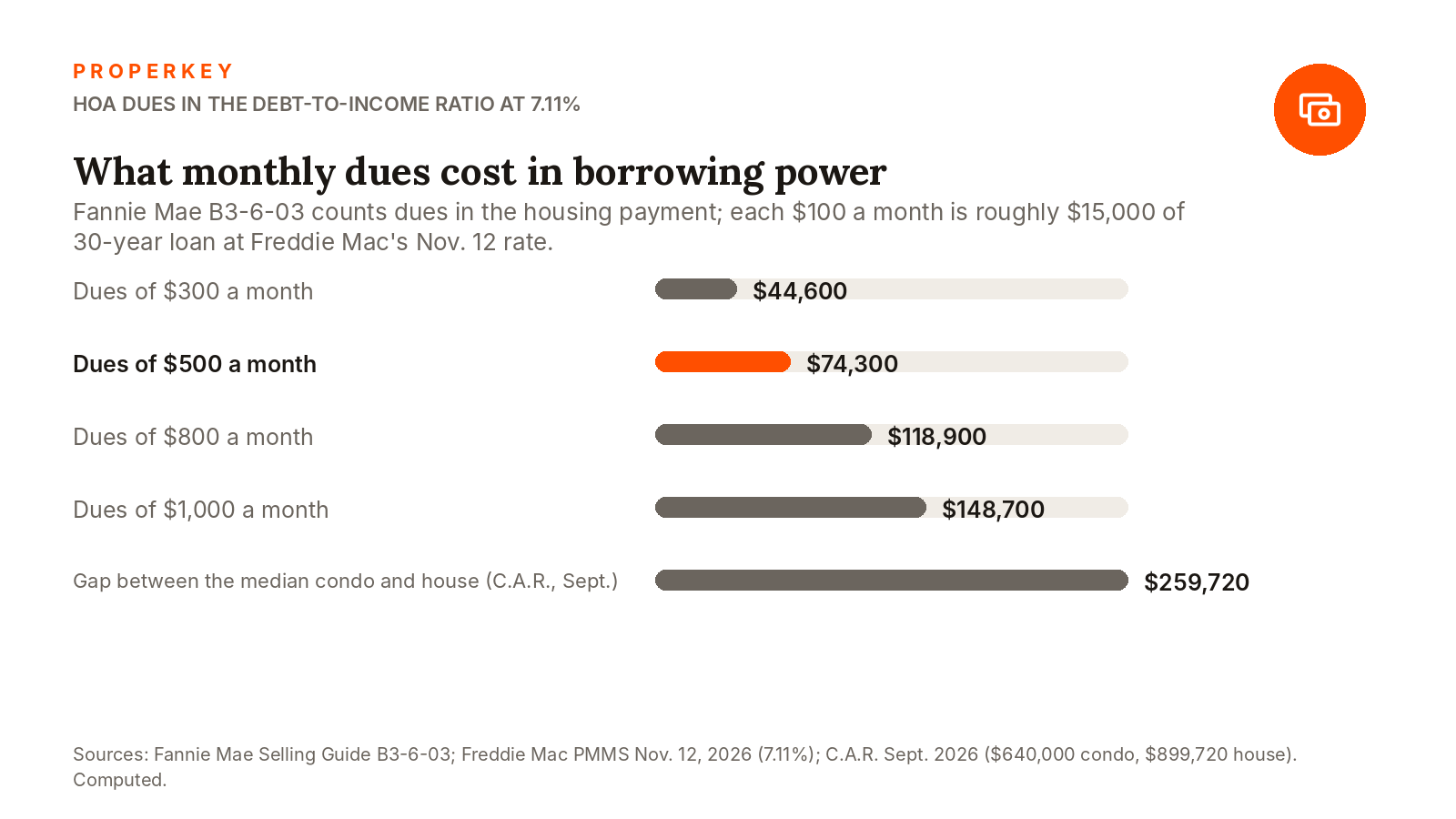
They count as housing expense. Fannie Mae's B3-6-03 defines the monthly housing payment used in the debt-to-income ratio as principal, interest, taxes, insurance and "any owners' association dues." At Freddie Mac's 7.11 percent 30-year rate (November 12, 2026), $500 a month of dues absorbs about $74,000 of borrowing power; $800 absorbs about $119,000, and $1,000 about $149,000. Put another way, a buyer approved for a $600,000 house payment is approved for a condo about $74,000 cheaper if the dues are $500. The C.A.R. affordability index shows how thin the margin is: 31 percent of California households could afford the $640,000 median condo in the third quarter, with a minimum qualifying income of $163,200 and a $4,080 monthly payment before dues (C.A.R. Q3 HAI). One more rule for buyers who may rent the unit later: Civil Code §4741 bars associations from prohibiting or unreasonably restricting rentals, caps any rental limit at no lower than 25 percent of units, and allows a ban only on stays of 30 days or less.
The Foundation for Community Association Research counts about 51,700 associations in California housing 14.5 million residents, so nearly four in ten Californians already live under one. A buyer working with Properkey has the 17-day review period to read the §4525 packet, and related reading covers closing costs on a $900,000 purchase, down-payment assistance, and whether to buy now or wait.
Questions people ask
What HOA documents am I entitled to before buying a condo in California? Civil Code §4525 lists eleven: the governing documents, age restrictions, the annual budget report and policy statement, a statement of assessments and unpaid charges, violation notices, defect-claim lists and settlements, approved assessment changes, rental restrictions, twelve months of minutes on request, and the latest balcony inspection report. The association must supply them within 10 days of a written request.
How much should an HOA have in reserves? California law sets no minimum today; the §5570 disclosure tells you the percent funded. Fannie Mae and Freddie Mac require the budget to allocate at least 10 percent of assessment income to reserves, rising to 15 percent for loan applications from January 4, 2027, and AB 2050 will require a contribution large enough to keep the 30-year projection above zero starting in 2032.
Can an HOA raise dues or levy a special assessment without a vote? Yes, within limits: up to a 20 percent increase in the regular assessment and special assessments up to 5 percent of budgeted gross expenses per year (§5605), and more for emergencies under §5610.
Do HOA dues affect how much I can borrow? Yes. Dues are part of the housing payment in the debt-to-income ratio; at 7.11 percent, every $100 a month of dues is roughly $15,000 of loan.
This article summarizes California law, agency lending rules and market data as of November 13, 2026. It is general information, not legal, lending or insurance advice.
Sources: Civ. Code §4525, §4528, §4530, §4741, §5300, §5550, §5551, §5570, §5605, §5610, §5805, §5810; AB 2050 (Ch. 796, Stats. 2026); Fannie Mae Selling Guide B4-2.2-01, B4-2.1-03, B7-3-03, B7-3-04, B3-6-03; Fannie Mae Lender Letter LL-2026-03; Freddie Mac Bulletin 2026-C; Freddie Mac condominium FAQ; 24 CFR 203.43b; IRMI, bare walls coverage; CAI insurance survey 2025; Foundation for Community Association Research, 2025 Statistical Review; C.A.R. September 2026 sales report; C.A.R. Q3 2026 Housing Affordability Index; Freddie Mac PMMS, Nov. 12, 2026.
Written by Keyro, Properkey's AI. Properkey, DRE #01979718.



