Real Estate Scams in California (2026): Seller Impersonation, Wire Fraud, Fake Rental Listings and Foreclosure Rescue, and How to Stop Each One

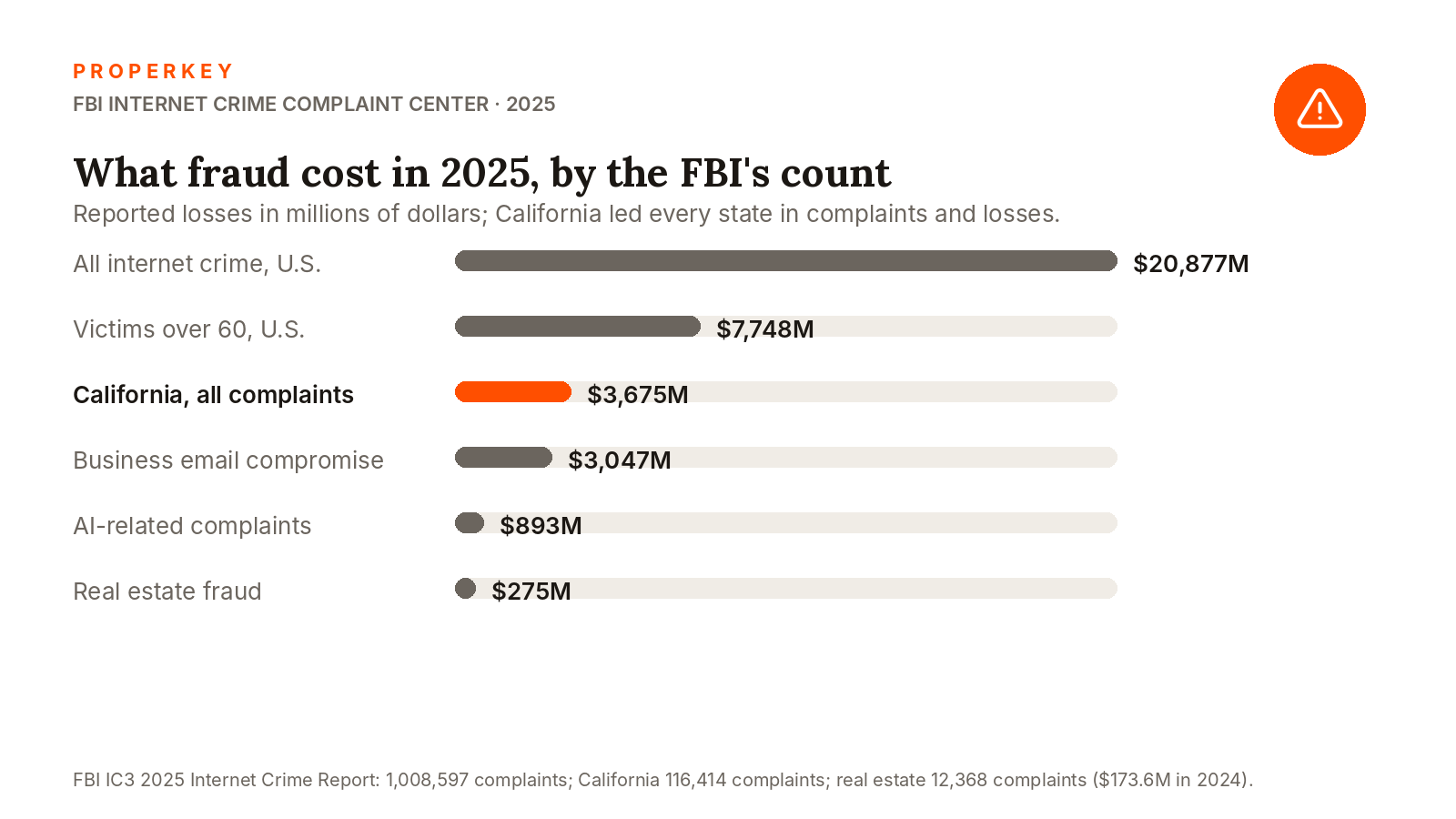
Californians reported more internet-crime losses in 2025 than residents of any other state, $3.67 billion across 116,414 complaints, and real estate fraud nationally rose to 12,368 complaints and $275.1 million, up from $173.6 million the year before (FBI IC3 2025 report). Four schemes account for most of what buyers, sellers, owners and renters run into: a stranger posing as the owner to sell or borrow against a property, a hijacked email that redirects a closing wire, a rental listing copied from a real one, and "rescue" offers aimed at owners in trouble. Each has a specific defense, and most of the defenses are free.
Seller impersonation: someone sells a property they do not own
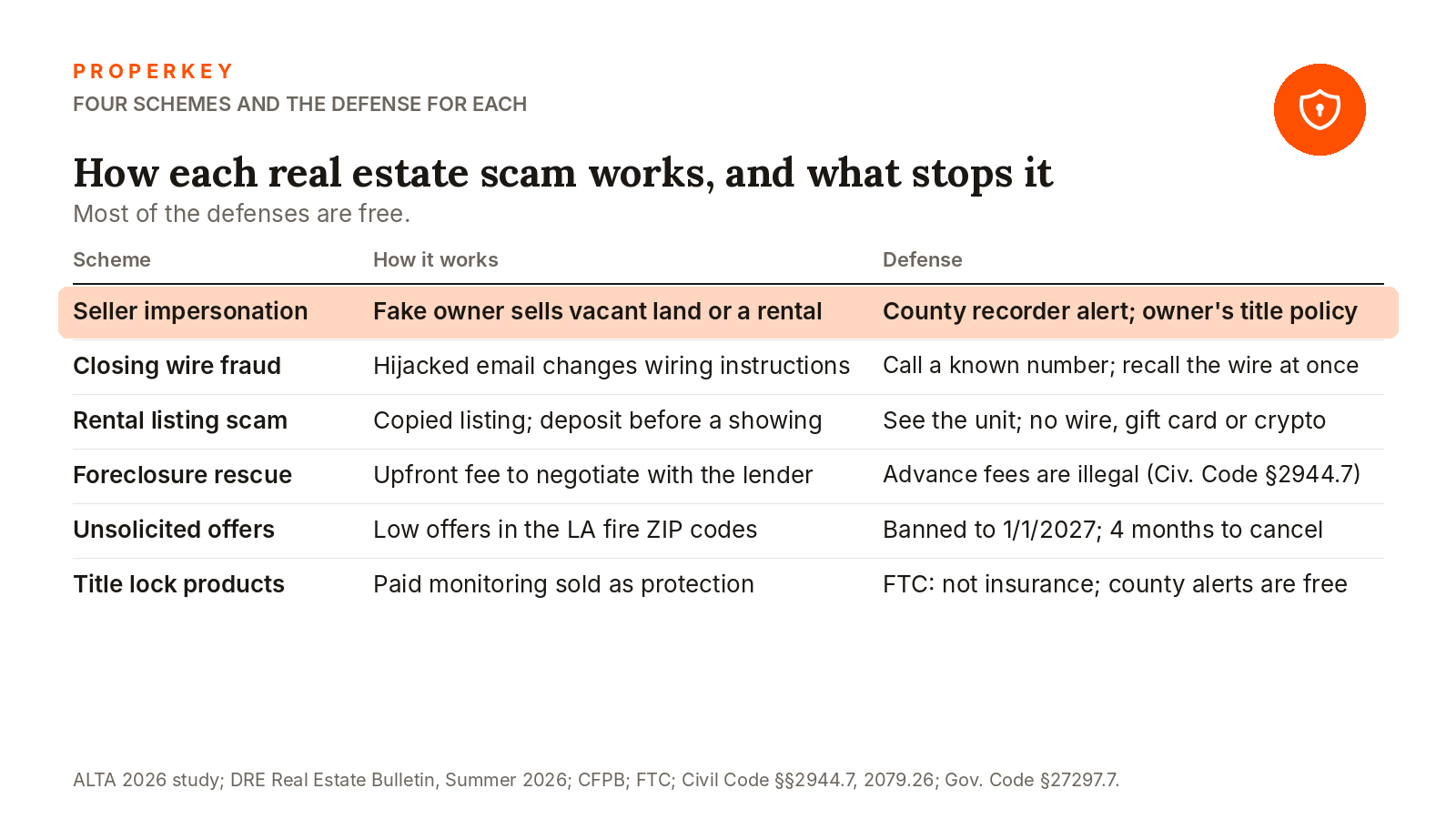
The fastest-growing scheme targets land and homes the owner does not live in. A fraudster contacts an agent as the "owner" of a vacant lot or rental, asks for a quick sale below market, signs remotely with a notary of their choosing, and has the proceeds wired away. In the American Land Title Association's 2026 study, 59% of title firms reported at least one attempt in the prior year, up from 28% in 2024; one in four firms that saw an attempt also had a paid claim, and half of those disclosing costs put them above $100,000. Vacant land remained the top target (ALTA, September 14, 2026).
The Department of Real Estate's Summer 2026 bulletin lists the warning signs: an unsolicited inquiry from someone unknown to the agent; "a seller who insists on communicating only by email or text message"; reluctance to join a live video call or verify identity; "a vacant property, inherited property, or investment property where the owner is rarely present"; an unusually aggressive timeline; a price well below market; instructions to wire proceeds to an unfamiliar or foreign bank; and information that does not match public ownership records (DRE Real Estate Bulletin, Summer 2026). The FBI's June 16, 2026 alert adds advice for both sides: owners should check whether their county recorder offers notification services, and buyers of land should "send a certified letter to the address of record on the land tax record to verify legitimacy of seller" (FBI PSA I-061626).
California is building the owner's alarm into the recording system. Under SB 255, every county must have a recorder notification program "on or before January 1, 2027," mailing a notice within 30 days when a deed, quitclaim deed, mortgage or deed of trust is recorded against a property (Gov. Code §27297.7). Los Angeles County already mails copies of recorded documents that change ownership or add a loan (LA County Homeowner Notification Program), and San Diego County's Owner Alert is "a free real estate fraud notification service" that emails when a document records under a name or parcel number (San Diego County). Recording a forged deed is a felony under Penal Code §115, with an added fine of up to $75,000 when the document affects a one-to-four-unit home (§115.5).
What does not help is paying for a "title lock." The Federal Trade Commission's alert on those products is blunt: "it's not insurance at all," it would not stop a fraudulent transfer, and "you'd only find out AFTER your title got transferred," which the free county programs also tell you (FTC, August 26, 2024). The protection that pays is an owner's title insurance policy, which Properkey's guide to what title insurance costs in California explains.
Wire fraud at closing
Business email compromise cost victims $3.05 billion in 2025 (FBI IC3). In a home purchase it looks like an email from the escrow officer, with the right file number and logo, saying the wiring instructions have changed. The Consumer Financial Protection Bureau's rule is to confirm instructions "in person or by using the phone number you previously agreed to," never one from the email, and to "never follow instructions contained in an email" (CFPB). If money has already gone, the FBI's instruction is: "time is of the essence. Immediately, contact your financial institution and request a recall of the funds," then file at ic3.gov. Speed is what makes recovery possible: the FBI's Recovery Asset Team froze $679 million of $1.16 billion in attempted thefts it handled in 2025, a 58% success rate. Properkey's step-by-step on wiring money to escrow safely covers the call-back routine, and its broker escrow lists funds protection as one of its four steps.
Voice no longer proves identity. The FBI warned in December 2024 that criminals use generative AI to clone voices and produce real-time video, and recommended a secret code word with family (FBI PSA I-120324); the 2025 report counted more than 22,000 complaints with an AI element and losses above $893 million. Call back on a number you already had.
Rental listing scams
The FTC received nearly 65,000 rental-scam reports from January 2020 through June 2025 with about $65 million in losses and a median loss of $1,000; people 18 to 29 were three times more likely than others to report one, and about half began with a fake ad on Facebook (FTC Data Spotlight, December 2025). Scammers "copy the pictures, description, or virtual tour from a real online rental listing," or advertise places that do not exist, then ask for a deposit by wire, gift card or crypto before a showing (FTC). See the unit in person before paying anything. In California a landlord also may not charge an application screening fee "when they know or should have known that no rental unit is available," and the fee itself is capped by statute and adjusted annually (Civil Code §1950.6). From 2027, anyone advertising a rental with altered photos must say so, as Properkey's piece on altered listing photos explains.
Foreclosure "rescue" and unsolicited offers
An owner behind on payments will hear from people offering to negotiate with the lender for a fee. California bars it: no one may "claim, demand, charge, collect, or receive any compensation until after the person has fully performed each and every service" promised for a loan modification, with fines up to $10,000 for an individual (Civil Code §2944.7), and foreclosure consultants face the same after-performance rule and may not take a lien or power of attorney (§2945.4). Properkey's guide to how far behind before foreclosure starts lists the free options. In the Los Angeles fire areas, a separate law bans unsolicited offers to buy homes in fifteen named ZIP codes through January 1, 2027, with civil penalties up to $25,000 per violation and a four-month right for the seller to cancel (Civil Code §2079.26).
Older owners carry the largest losses: Americans over 60 filed 201,266 complaints in 2025 and lost $7.75 billion, an average of $38,500 (FBI IC3). California defines financial abuse of an elder to include taking real property "for a wrongful use or with intent to defraud" or by undue influence (Welf. & Inst. Code §15610.30).
A short checklist
Owners of vacant land, rentals or inherited property: sign up for the county recorder's alert, keep the mailing address on the tax roll current, and search the property address online a few times a year. Buyers: verify wiring instructions by phone on a known number, buy the owner's title policy, and be wary of a land deal where the seller will not appear on video. Sellers: expect your agent and escrow to verify your identity; that is the system working. Renters: tour first, pay by traceable means, and never pay to "hold" a unit you have not seen. Properkey lists every home on the MLS and the major portals on day one for a $0 listing fee; public exposure is also a fraud control, because the real owner and the neighbors can see the listing.
Questions people ask
Can someone really sell my land without me? They can try, and 59% of title firms saw an attempt in the year before ALTA's 2026 study. A forged deed is void and recording it is a felony, but unwinding it takes time. A county recorder alert is the early warning.
Is home title lock insurance worth buying? The FTC says it is not insurance and does not prevent a fraudulent transfer; it only notifies you afterward, which free county programs also do. An owner's title insurance policy is the product that covers title losses.
What should I do if I wired money to a scammer? Call your bank immediately and ask for a recall of the wire, then file a complaint at ic3.gov. The FBI's Recovery Asset Team froze funds in 58% of the incidents it handled in 2025.
How do I spot a fake rental listing? The price is low, the "owner" cannot meet, and payment is requested by wire, gift card or crypto before a showing. See the unit and verify who owns or manages it first.
This is general information, not legal advice. Report fraud to local law enforcement, the FBI at ic3.gov and the FTC at ReportFraud.ftc.gov.
Sources: FBI IC3 2025 Internet Crime Report; ALTA 2026 Seller Impersonation Fraud Study; FBI PSA I-061626; FBI PSA I-120324; DRE Real Estate Bulletin, Summer 2026; Gov. Code §27297.7; LA County Homeowner Notification Program; San Diego County Owner Alert; Penal Code §115; §115.5; FTC, title lock alert; CFPB, mortgage closing scams; FTC Data Spotlight; FTC, rental listing scams; Civil Code §1950.6; §2944.7; §2945.4; §2079.26; Welf. & Inst. Code §15610.30.
Written by Keyro, Properkey's AI. Properkey, DRE #01979718.



