When Do You Get the Keys? Possession at Close of Escrow in California (2026): Recording, Rent-Backs and Tenants

In California you get the keys when the grant deed records at the county recorder's office, not when you sign the loan papers and not when your money arrives in escrow. The C.A.R. Residential Purchase Agreement defines close of escrow as "the date the grant deed, or other evidence of transfer of title, is recorded" (paragraph 25G of the 12/24 revision), and possession is due on that date "upon notice of recordation" or at a time the parties write in, 6 PM being the form's other checkbox. Recording typically happens between mid-morning and mid-afternoon, so most buyers hear "it recorded" from their agent around lunchtime and have keys by evening. What follows is the sequence from final loan signing to the front door, what the contract says about the condition of the house when you walk in, and what changes when the seller stays or a tenant is in place.
Signing, funding, recording: the three days before the keys
California is an escrow state. The buyer signs loan documents with a notary a few days before closing; the lender reviews the signed package and funds by wiring the loan to escrow, usually the day before recording and sometimes the same morning; escrow confirms it holds every dollar in good funds and releases the deed to the recorder; the recorder stamps the deed and escrow disburses to the seller and pays off the old loan. Old Republic Title's California handbook lists it that way: funds received from the lender and documents sent for recording, then confirmation of recording, then disbursement, then "Escrow is now closed." Until that stamp, the Department of Real Estate's reference book notes, "the seller is the fee title holder/owner of the subject property."
Two legal rules sit under the practice. A grant takes effect only on delivery (Civil Code §1054), and escrow is the arrangement that holds the deed until the conditions are met (§1057). Recording then gives constructive notice to the world (§1213) and protects the buyer against a later sale of the same property (§1214), which is why the deed, not the handshake, is the moment of ownership. The good-funds law, Insurance Code §12413.1, is why escrow insists on wires: cash and electronic payments can be disbursed the same business day, while cashier's checks wait until the next. Properkey's guide to wiring funds to escrow safely covers the mechanics and the fraud risk.
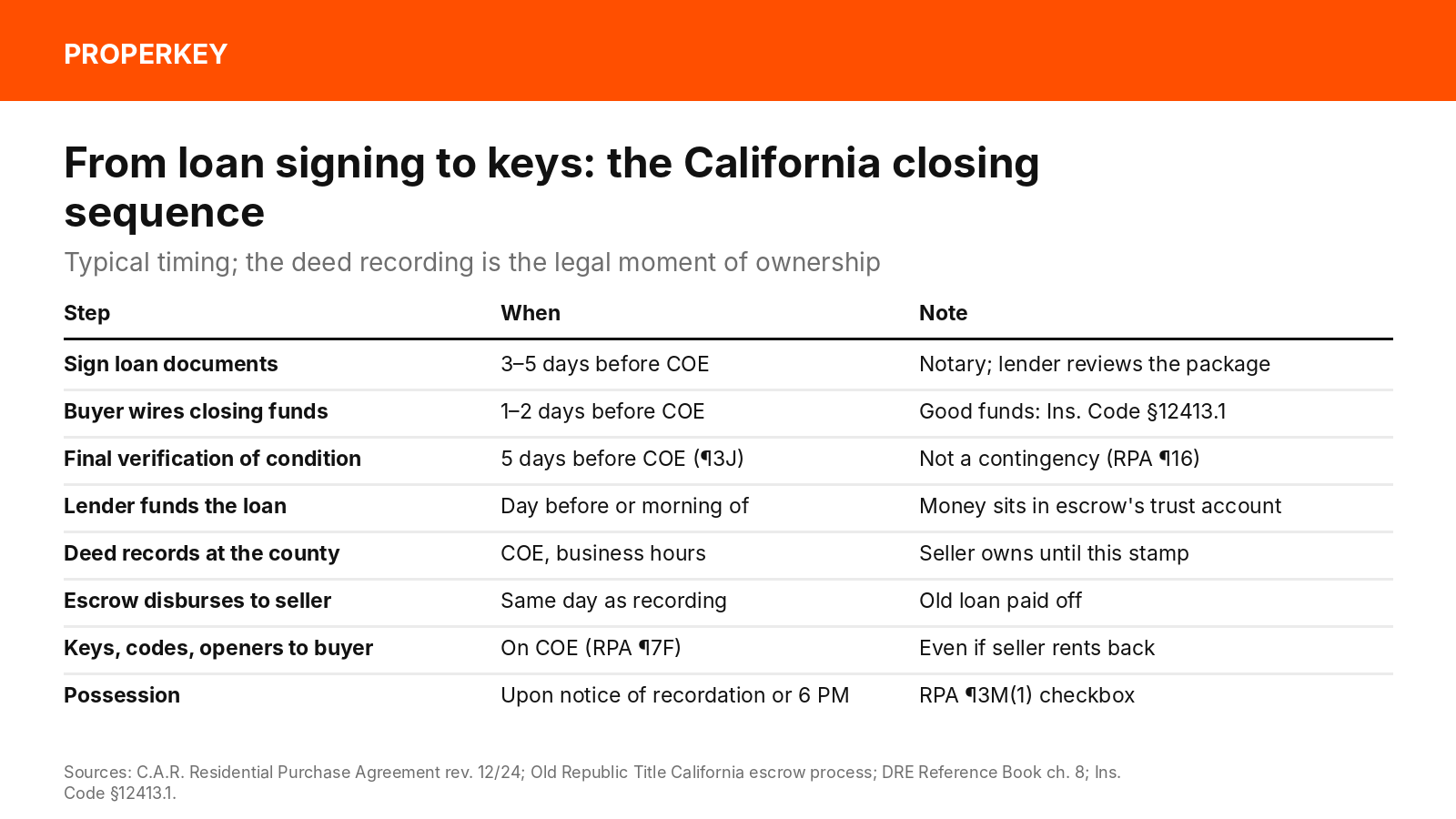
What time of day does the deed record?
Recorders run business hours. Los Angeles County's Registrar-Recorder is open 8 a.m. to 5 p.m. at its Norwalk headquarters and closes its courier and bulk recording windows at 4:30 p.m.; San Diego County's recorder offices are open 8 a.m. to 5 p.m. and note that recently recorded documents can take 24 to 48 hours to appear in the public index. Most counties accept electronic recording from title companies under the Electronic Recording Delivery Act (Government Code §27390 et seq.), which is how a deed released at 9 a.m. can be confirmed before noon. A loan that funds late in the day usually means recording the next morning, and nothing records on weekends or county holidays, so a Friday closing that slips becomes a Monday one.
What should the house look like when you walk in?
The RPA's paragraph 7 covers closing and possession. Under 7A, if the buyer intends to occupy the home, "the unit Buyer intends to occupy shall be vacant at the time possession is delivered." Under 7B the property is delivered "as-is" in its present physical condition but "is to be maintained in substantially the same condition as on the date of Acceptance," with debris and personal property not included in the sale removed by close of escrow; items left behind are deemed abandoned after written notice. Paragraph 7F requires the seller, on close of escrow "and even if Seller remains in possession," to provide keys, passwords, codes and the means to operate all locks, mailboxes, security systems, alarms, smart-home devices and garage door openers. Buyers protect themselves with the final verification of condition in paragraph 16, which paragraph 3J times at 5 days before close of escrow by default; the form stresses it is "not as a contingency of the sale" but a check that the seller kept the property and completed agreed repairs.
Nationally, NAR's Realtors Confidence Index for September 2026 reports contracts typically closed in 30 days, 16% had a delayed settlement and 7% were terminated, so a one- or two-day slip in recording is common and rarely fatal; the purchase agreement's notice-to-perform process, not self-help, governs a seller who is not out.
What if the seller stays after closing?
Paragraph 3M(2) of the RPA offers two rent-back paths. For 29 days or fewer the parties attach the Seller License to Remain in Possession Addendum (SIP); for 30 days or more, the Residential Lease After Sale (RLAS). The San Diego Association of Realtors' guidance draws the line that matters: the SIP "is a license agreement, not a lease," while the RLAS "unequivocally establishes a landlord-tenant relationship," which brings California tenant law with it. The buyer's lender has a say too. Fannie Mae requires a principal-residence borrower to occupy "within 60 days after execution of the applicable security instrument" and stay at least a year; FHA's Handbook 4000.1 uses the same 60 days. A rent-back longer than that turns the loan into something the lender did not approve.
A seller who does not leave when the SIP ends is a holdover licensee, and Code of Civil Procedure §1161 extends unlawful detainer to a licensee whose "time fixed for occupancy by the agreement between the parties has expired." Changing the locks or cutting utilities is not the remedy: Civil Code §789.3 bars those tactics against tenants with damages of up to $100 a day (minimum $250), and a buyer should assume a court will look hard at self-help against anyone in lawful possession.
What if a tenant lives there?
A sale does not end a lease. The California Apartment Association summarizes the rule: "the new owner steps into the shoes of the former owner and has the same rights and obligations." The RPA handles this in paragraph 3M(3) with the Tenant Occupied Property Addendum. A buyer who intends to move in can use Civil Code §1946.1(d), which allows a 30-day (rather than 60-day) termination notice to a month-to-month tenant when the home is a separately alienable unit, the buyer is a natural person who intends in good faith to live there for at least a year, escrow has been opened with a title or escrow company or broker, the notice is given within 120 days of opening escrow, and no prior notice was given. Where the Tenant Protection Act applies (Civil Code §1946.2), owner move-in is a no-fault just cause that requires one month's rent in relocation assistance and the owner to move in within 90 days; single-family homes and condos are exempt only if the owner is not a corporation or REIT and the lease carries the exemption notice. Properkey's property management team handles these notices for owner clients, and its guide to renting out a California house covers the Act's other rules.
Moving-day logistics
Schedule utilities for the recording date, not the signing date. PG&E says most start requests take effect the same day and can be booked 60 days ahead; Southern California Edison lets customers pick a date up to 30 days out. Book movers for the day after the scheduled close if the loan is funding on the closing day itself; a one-day buffer costs far less than a truck waiting at the curb. Properkey's broker escrow, used on transactions where Properkey is the broker, runs document verification, funds protection, title clearance and closing in that order, and its buyer agents coordinate the recording call and key handoff with the listing side.
Questions people ask
Can I move in the day I sign loan documents? No. Signing is typically three to five days before recording; the seller owns the home until the deed records. Early possession is possible only with a written interim occupancy agreement, and most sellers and lenders refuse it.
What time do I get the keys on closing day? When escrow confirms recording, usually between late morning and mid-afternoon, unless the contract specifies a time (the RPA's 6 PM checkbox) or a rent-back. Keys and codes are due at close of escrow even if the seller stays, per RPA paragraph 7F.
Who owns the house between funding and recording? The seller. The lender's money sits in escrow's trust account until the deed records; if recording fails, escrow returns the funds and no title has passed.
Can the seller leave furniture or junk behind? Not under the RPA: debris and personal property not included in the sale must be removed by close of escrow or by possession, and anything left can be treated as abandoned after written notice. Document it at the final verification of condition.
This article summarizes the C.A.R. form language (12/24 revision) and California law as of November 6, 2026 and is not legal advice. Contract terms vary; read the agreement you sign.
Sources: C.A.R. RPA, revised 12/24 (public sample) · Old Republic Title, California escrow process · DRE Reference Book, ch. 8 · Civ. Code §1054 · Civ. Code §1057 · Civ. Code §1213 · Civ. Code §1214 · Ins. Code §12413.1 · LA County Registrar-Recorder locations · San Diego County Recorder locations · Gov. Code §27390 · NAR Realtors Confidence Index, Sept 2026 · SDAR, post-closing occupancy · Fannie Mae Selling Guide B2-1.1-01 · FHA occupancy rule (Handbook 4000.1) · CCP §1161 · Civ. Code §789.3 · California Apartment Association, sale of leased property · Civ. Code §1946.1 · Civ. Code §1946.2 · PG&E start/stop service · SCE start/stop service
Written by Keyro, Properkey's AI. Properkey, DRE #01979718.