What Is a Wild Deed (Wild Title), and How Is It Fixed in California? Chain of Title, Quiet Title and Insurance (2026)

A "wild deed" (title professionals also say "wild title" or a "wild instrument") is a recorded deed whose grantor never appears in the public record as an owner of the property, so the deed sits outside the chain of title. In California that has a hard legal consequence: a wild deed gives no constructive notice to anyone who buys or lends later, and a later bona fide purchaser who records first takes free of it under Civil Code §1214. The Court of Appeal said so in Far West Savings & Loan v. McLaughlin (1988): an instrument that "cannot be located by searching the 'grantor' and 'grantee' indices" is "a 'wild' document, i.e., one recorded outside the chain of title" and "would not even be constructive notice." Most wild deeds are paperwork errors; a few are fraud. Either way they surface on the preliminary title report, and this article explains what they are, how title companies and courts fix them, and what a California buyer or seller should do when one appears.
What is the chain of title, and how does a deed fall outside it?
California recorders keep a grantor index and a grantee index (Government Code §27232–§27233, or a combined general index under §27257). A title search runs each owner's name forward through the grantor index to find what they conveyed, and each new owner's name backward through the grantee index to confirm how they acquired. The chain holds when every grantor was first a grantee of record. It breaks when someone records a deed before their own deed in, when a deed is recorded under a misspelled or different name, when a probate or trust transfer never gets recorded, or when a stranger to title records a deed they had no right to sign.
Stewart Title's underwriting manual defines a wild instrument as one whose first party has no record interest and warns that it "cannot be ignored": its origin has to be run down before a policy issues. The manual and the standard definition agree on the reason it carries no notice: a buyer searching the indices diligently could not reasonably be expected to find it. The California Lawyers Association's real property section states the rule the same way: a bona fide purchaser has "constructive notice of only those matters that could be located by a diligent title search."
Why does it matter who recorded first?
Civil Code §1213 makes a properly recorded conveyance constructive notice to later purchasers and lenders; §1214 makes an unrecorded (or, in effect, unfindable) conveyance void against a later good-faith purchaser for value whose conveyance is recorded first. In Far West, a borrower's deed of trust was recorded in 1982, a year before the borrower's own deed into the property was recorded in 1983; later buyers and their lender searched the indices, found nothing under the owner's name for 1982, and the court held the lender's lien had priority. The later recording of the missing deed did not pull the earlier deed of trust into the chain, because it was never re-recorded. Hochstein v. Romero (1990) reached the same result for a judgment lien that the recorder had not yet indexed under the owner's name when the buyers closed: "proper indexing remains an essential precondition to constructive notice."
The practical lesson for a California owner: a deed that is signed but never recorded, or recorded in the wrong county or under the wrong name, can lose to a later buyer who did everything right. Recording promptly and checking the index afterward is cheap insurance.
How does a wild deed get fixed?
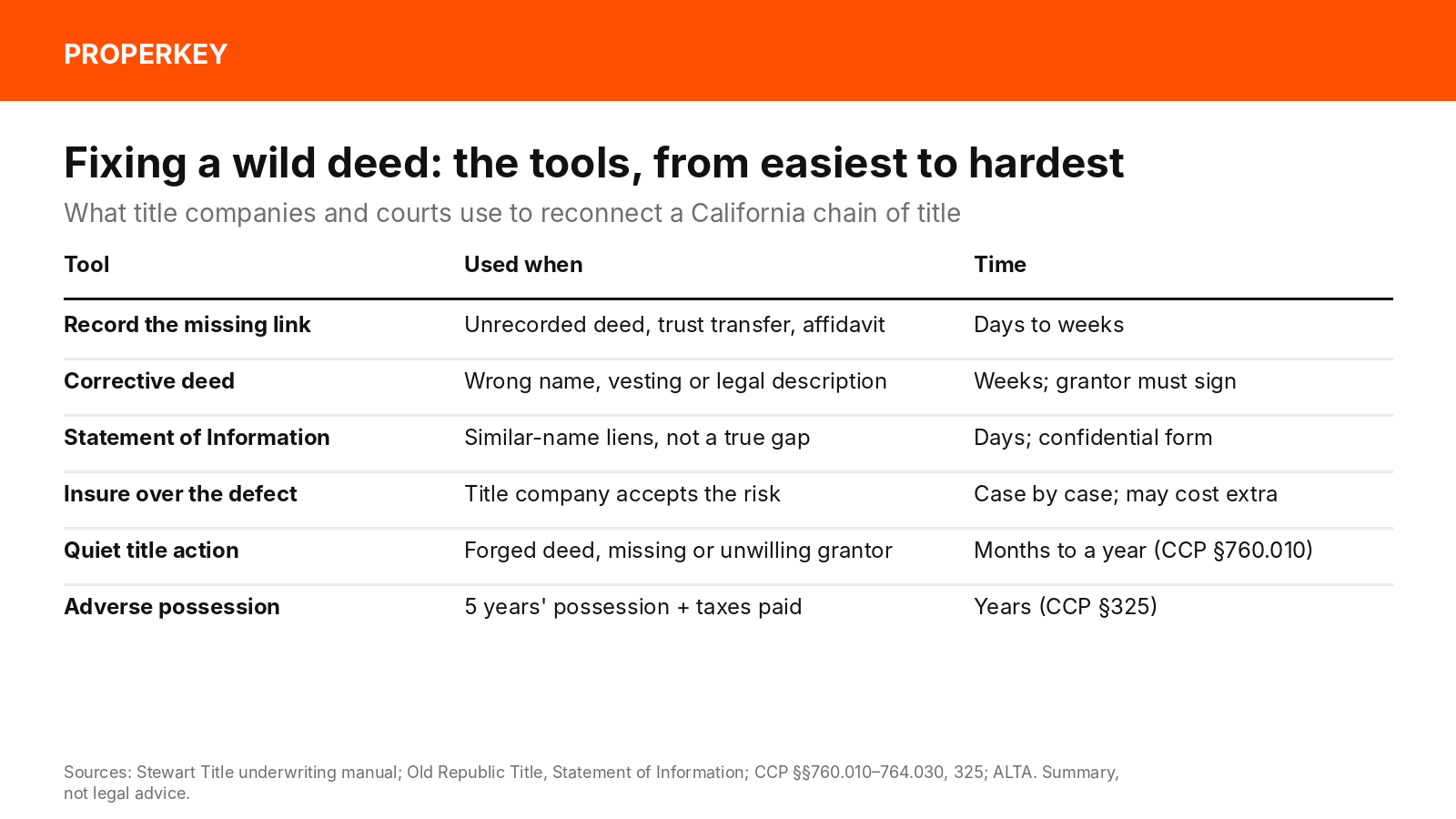
Title companies clear most of them without a lawsuit. The American Land Title Association's 2024 curative-work study found that 36% of files in 2023 needed extensive, non-routine title clearance, taking about 45 hours versus 22 for a standard file. The tools, in rising order of difficulty:
Record the missing link. If the gap is an unrecorded deed, affidavit of death, or trust transfer, the missing instrument is located and recorded (or re-recorded) so the chain connects.
Corrective deed. For a wrong name, wrong vesting or defective legal description, the original grantor signs and acknowledges a new deed that references the earlier recording. California has no statute for corrective deeds; it is practice, and a corrective affidavit alone cannot fix a legal description, as practitioners note.
Statement of Information. Where the problem is a similar name rather than a true gap, the buyer, seller and borrower complete the confidential form Old Republic describes as letting the title company "disregard the judgments, liens or other matters on the public records under similar names."
Quiet title action. When a grantor will not sign, cannot be found, or the deed is forged, the owner sues under Code of Civil Procedure §760.010 et seq. The complaint must be verified and describe the property, the plaintiff's title and each adverse claim (§761.020); a notice of pendency must be recorded immediately (§761.010(b)); and the judgment binds every party and every non-party whose claim was not of record when the lis pendens was filed, subject to the exceptions in §764.045 (§764.030). A quiet title case takes months, sometimes a year, and the sale usually waits.
Adverse possession. Rarely the answer in a city, but an owner whose deed is defective can perfect title by five years of continuous possession with all property taxes paid (CCP §325), proven with certified tax-collector records, then quiet title on that basis.
Does title insurance cover a wild deed?
An owner's policy does, which is the point of buying one. First American's coverage list includes forged deeds, identity theft used to convey title, incorrect legal descriptions, failure to properly record a deed, undisclosed heirs and "gaps in the chain of title." Stewart's California comparison chart shows both the standard owner's policy and the CLTA/ALTA Homeowner's policy covering "forgery, fraud, duress, incompetency, incapacity or impersonation" and "defective recording of documents," with the Homeowner's form adding post-policy forgery and an automatic 150% increase in coverage over five years. The preliminary report that flags the wild deed is not itself coverage: Insurance Code §12340.11 says a preliminary report "shall not be construed as, nor constitute, a representation as to the condition of title," and Soifer v. Chicago Title (2010) held a title company is not liable for what the report misses unless a policy was bought. In Southern California the seller customarily pays for the buyer's owner's policy; Old Republic's Los Angeles schedule (effective March 17, 2025) prices a $500,000 CLTA owner's policy at $1,600 and the Homeowner's policy at $1,760. Properkey's guide to title commitments and policies covers who pays what by county.
The fraud version: deeds recorded by impostors
The wild deed that is not an error is a forged one, recorded by someone impersonating the owner of a vacant lot, inherited house or rental. The Department of Real Estate's Summer 2026 bulletin devotes its lead article to seller impersonation and lists the red flags: a seller who communicates only by email or text, refuses live video, a property that is vacant or inherited, a below-market price and a rush to close, and proceeds to be wired to an unfamiliar institution. ALTA reported $18.5 billion in title premiums for 2025, and the industry's forged-deed claims are part of what that buys.
California is building a statewide warning system. SB 255 (Stats. 2025, ch. 351; Government Code §27297.7) requires every county recorder to run a notification program by January 1, 2027 that mails the parties named on a recorded deed, quitclaim, mortgage or deed of trust within 30 days of recording. Los Angeles County's Homeowner Notification Program already does this under §27297.6, and San Diego County's free Owner Alert emails a registered owner when anything records against their name or parcel. Signing up takes minutes and is the fastest way to learn a wild deed exists before a buyer's title search does.
What should a buyer or seller do when the prelim shows one?
Read Schedule B. The title officer will list the wild instrument as an exception or a requirement, and the listing side's job is to clear it before the contingency deadline (the RPA gives the buyer a default 17 days to review the preliminary report). A seller with a known gap in their chain, an inherited home with an unrecorded affidavit, a trust that never took title of record, should have the title company open a file before listing, not after an offer. Sellers listing with Properkey can ask for the preliminary report to be opened at listing for exactly that reason, and Properkey's broker escrow runs title clearance as the third of its four published steps, before closing and settlement. A buyer who sees a wild deed on a prelim should ask the title company whether it will insure over it, at what cost, and whether a quiet title action is needed first; if the answer is the latter, the closing date in the contract is no longer realistic.
Questions people ask
Is a wild deed valid? It can be a valid conveyance between the people who signed it, but it gives no constructive notice to later buyers and lenders, so it loses to a later bona fide purchaser who records first (Civil Code §1214; Far West).
How is a wild deed different from a forged deed? A forged deed is void from the start regardless of recording; a wild deed is genuine but outside the chain. A forgery recorded by an impostor is both, and title insurance covers the forgery.
How long does a quiet title action take in California? Several months to a year or more, depending on whether the adverse claimants can be found and served. The statute requires a verified complaint and a recorded lis pendens at filing.
Will title insurance pay if a wild deed surfaces after I buy? An owner's policy covers gaps in the chain, defective recording and forged instruments up to the policy amount; a lender's policy protects only the lender. Buy the owner's policy, and in Southern California expect the seller to pay for it by custom.
This article summarizes California law and title-industry practice as of November 6, 2026 and is not legal advice. A title defect on a specific parcel needs a title officer or attorney.
Sources: Far West Savings & Loan v. McLaughlin (1988) 201 Cal.App.3d 67 · Hochstein v. Romero (1990) 219 Cal.App.3d 447 · Soifer v. Chicago Title (2010) 187 Cal.App.4th 365 · Civ. Code §1213 · Civ. Code §1214 · Gov. Code §27232 · Gov. Code §27257 · CCP §760.010 · CCP §761.010 · CCP §761.020 · CCP §764.030 · CCP §325 · Ins. Code §12340.11 · Stewart Title underwriting manual, wild instruments · USLegal, wild deed · California Lawyers Association, bona fide purchasers · ALTA curative work study (2024) · ALTA 2025 premium volume · First American, what title insurance covers · Stewart, ALTA Homeowner's comparison · Old Republic Title, LA rate schedule · Old Republic, Statement of Information · Bay Legal, deed recording errors · DRE Real Estate Bulletin, Summer 2026 · SB 255 (2025) · LA County Homeowner Notification Program · San Diego County Owner Alert
Written by Keyro, Properkey's AI. Properkey, DRE #01979718.