What Percent of the Commission Does a Realtor Actually Keep in California? The Brokerage Split, the Franchise Fee, the Expenses, and Why It Matters When You Negotiate (2026)

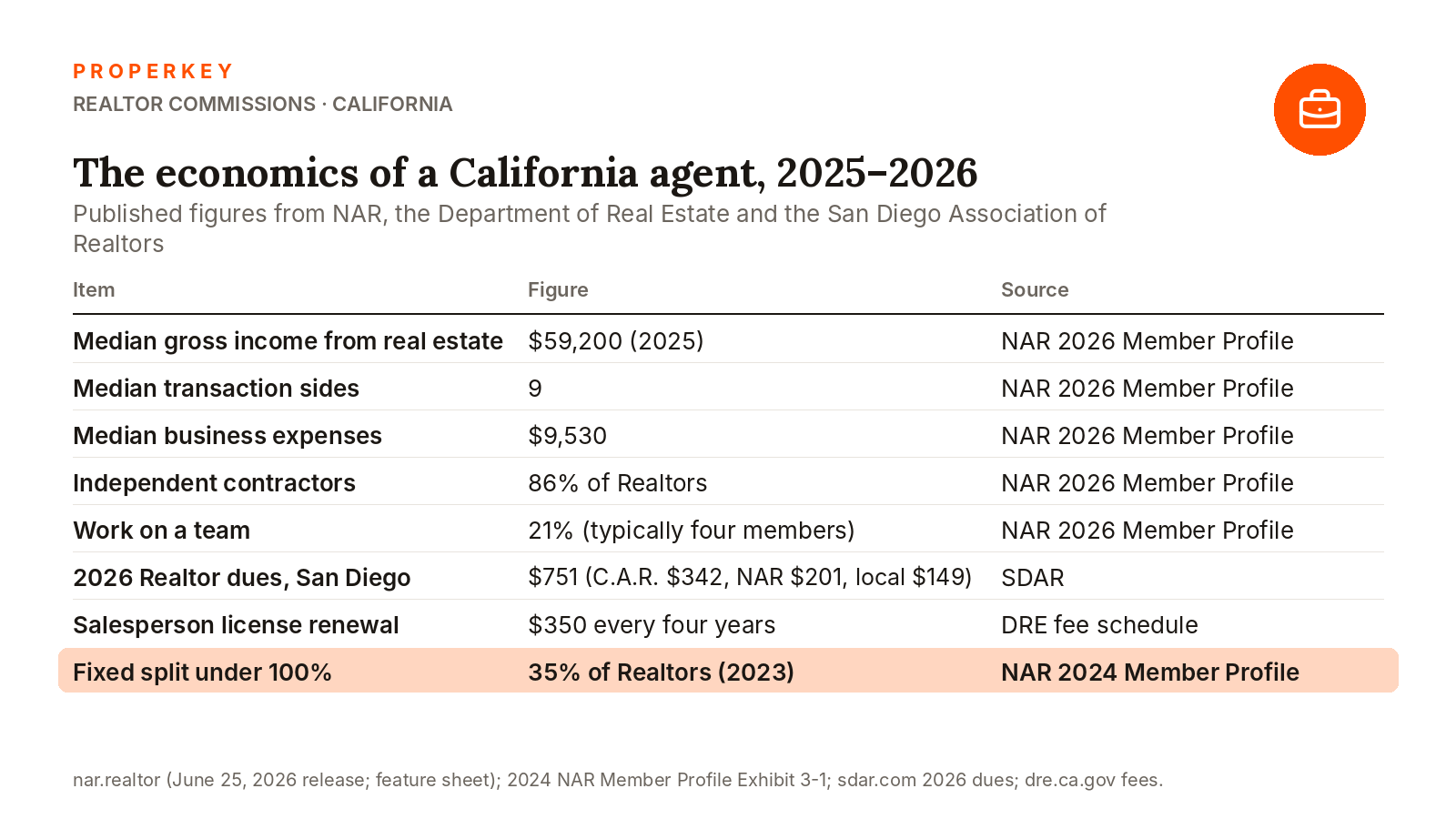
Of the 2.57% listing commission on a typical California sale, the individual agent usually keeps 70% to 80% before expenses; the rest goes to the brokerage and, at franchised companies, a franchise fee. On California's September 2026 median price of $899,720, the listing side is $23,123 (Clever, October 2026; C.A.R., October 19, 2026), a 70/30 split leaves the agent about $16,200, and an 80/20 split about $18,500, before the agent pays dues, licensing, marketing, mileage and self-employment tax. The median Realtor earned $59,200 from real estate in 2025 on nine transactions, with $9,530 of business expenses (NAR 2026 Member Profile). Here is where the commission goes once it leaves escrow, why that matters when you negotiate, and the California rules that govern who may be paid.
The commission is paid to the broker, not the agent
California law routes every dollar through a broker. Business and Professions Code §10137: "No real estate salesperson shall accept compensation for activity requiring a real estate license from any person other than the broker under whom he or she is at the time licensed," and a licensee may share a fee with another licensee only if "any compensation is paid through the responsible broker." Escrow pays the brokerage; the brokerage pays the agent under their independent-contractor agreement. Eighty-six percent of Realtors are independent contractors (NAR 2026), a status California law permits for licensees so long as pay is tied to output rather than hours and a written contract says so (B&P §10032; Unemployment Insurance Code §650; Labor Code §2778(c)(1)). That is why the agent sitting across from you is a small business, and why the brokerage's cut is the first thing to understand.
The split
Most agents work on a commission split with their brokerage. NAR's most recent public breakdown (2024 Member Profile, covering 2023) found 35% of Realtors on a fixed split below 100%, 20% on a graduated split that improves with production, 20% on a split that stops at an annual cap, 14% on 100% commission with fees, and a few percent on salary or profit-sharing. NAR's older data showed that newer agents start around a 51% to 58% share and the highest producers start at 80% and rise to 90%. Two large brokerages publish their terms. eXp Realty: "In general, agents retain 80% of their commission until they reach a $16,000 annual cap," after which the agent keeps 100% for the rest of the year, plus an $85 monthly fee and per-transaction charges (eXp). A Keller Williams franchise's recruiting page describes "a 70 / 24 / 6 % split (until capped)," 70% to the agent, 24% to the local market center capped at $14,000 a year, and 6% to the franchisor capped at $3,000 (one KW franchise; terms vary by office). Redfin agents are employees paid on splits with benefits and expenses covered under its 2025 "Redfin Next" plan (Redfin). Franchise fees are typically carved out of the brokerage's share, not the agent's, so the agent on a 70/24/6 plan keeps the full 70%.
Teams add a layer. Twenty-one percent of Realtors worked on a team in 2025, typically four members, and a team's leader usually takes a share of each member's side before the brokerage split. A buyer's agent on a team at a 70/30 brokerage who gives 30% to the team lead keeps roughly half the fee that reached the brokerage.
The arithmetic on a California median home
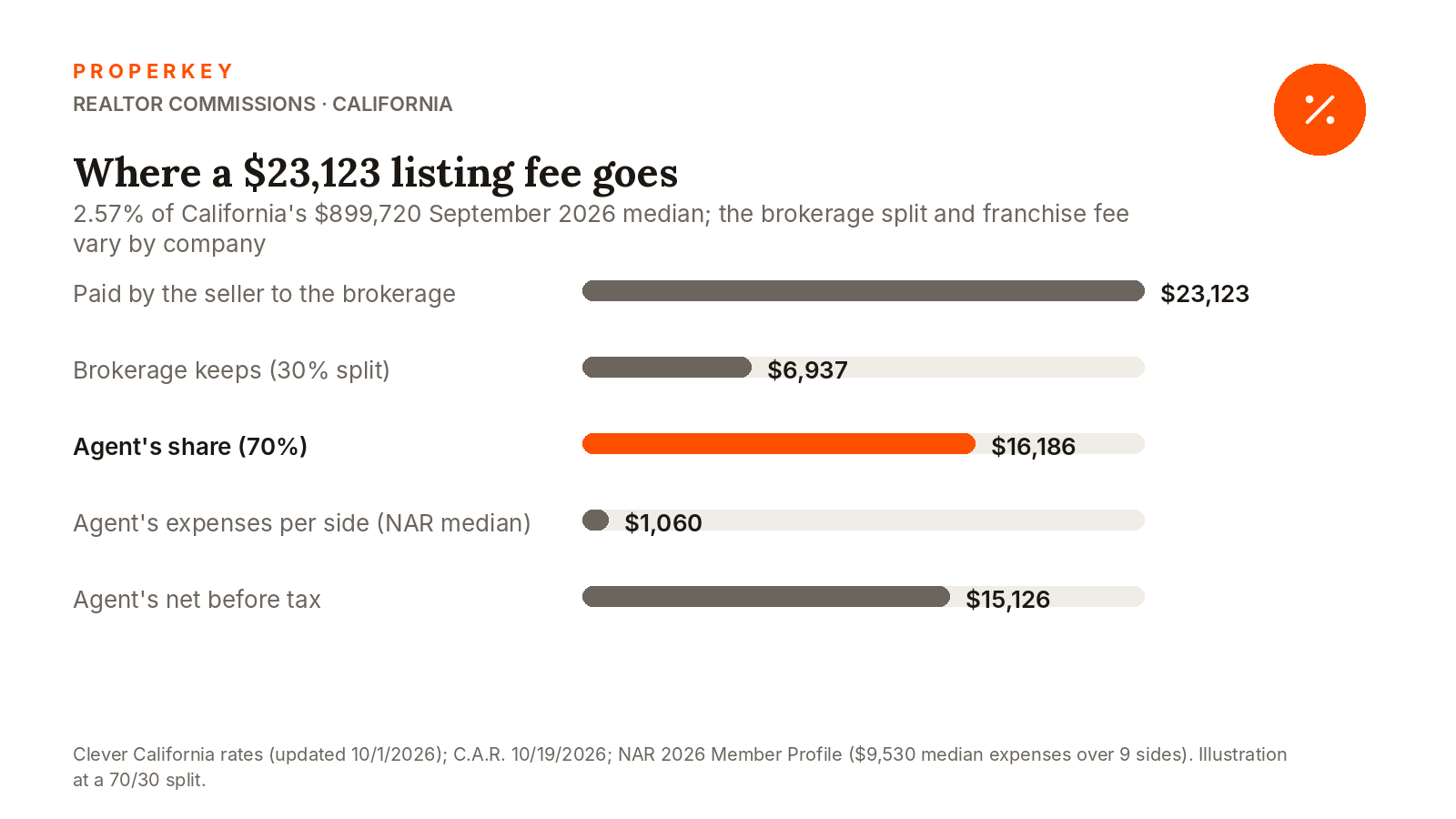
On $899,720, the Clever averages produce $23,123 on the listing side and $22,583 on the buyer's side, $45,706 in all at 5.08%. At a 70/30 split the listing agent's gross is $16,186; at 80/20, $18,498; at a 100% brokerage, $23,123 less a transaction fee of a few hundred dollars. A brokerage that takes a 6% franchise fee off the top before splitting leaves about $15,200. Then come the expenses the agent pays regardless of whether a deal closes: NAR's median of $9,530 a year works out to about $1,060 per side at nine transactions; 2026 Realtor dues in San Diego run $751 ($342 to C.A.R. including a $168 advocacy assessment, $201 to NAR, $149 local) before MLS fees (SDAR); a salesperson license renewal is $350 every four years (DRE); plus errors-and-omissions coverage, signage, photography when the brokerage does not supply it, and roughly 15.3% self-employment tax on the net. NAR's median gross income of $59,200 against those costs is the context for why agents defend the rate and why the "standard 6%" never had a legal basis.
Nothing is fixed, and the law says so twice
Every California listing agreement must carry, in at least 10-point bold type, this notice from B&P §10147.5: "The amount or rate of real estate commissions is not fixed by law. They are set by each broker individually and may be negotiable between the seller and broker." Buyer agreements carry the parallel notice about "compensation … negotiable between the buyer and broker," and since January 1, 2026 the statute bars printing any rate in the form. The Department of Real Estate's December 2024 advisory adds: "Licensees should not claim that there is a 'standard' rate. Commissions are fully negotiable under California law, and it is the licensee's duty to clearly explain this to the buyer." Since August 17, 2024, under the NAR settlement, offers of buyer-agent compensation may not appear on the MLS, and buyers must sign a written agreement; California's Civil Code §1670.50 requires that agreement "no later than the execution of the buyer's offer," limits it to three months, and bars automatic renewal. Hidden compensation is a licensing offense: B&P §10176(g) makes "the claiming or taking by a licensee of any secret or undisclosed amount of compensation" grounds for suspension or revocation.
What has actually changed since the settlement is less than the headlines. In Clever's August 2026 survey of 434 agents, 73% said sellers in their market are likely to cover the buyer's agent's fee when a buyer's offer asks, and only 28% said commissions in their market have compressed (Clever). Nationally the total averaged 5.46% in 2026, up from 5.32% in 2024. California's 5.08% is below the national figure; Properkey's guide to what percentage Realtor fees are in California has the full series, and its guide to negotiating the commission covers the conversation.
Why the split matters when you negotiate
Knowing where the money goes explains an agent's behavior at the table. An agent on a 70/30 split who agrees to cut the listing fee from 2.5% to 2% on a $900,000 sale gives up $4,500 of gross and about $3,150 of personal income; the brokerage absorbs the rest, and many brokerages require the agent to make the office whole. An agent who has already hit an annual cap, by contrast, keeps 100% of the next commission and has more room. Flat-fee and reduced-fee listing models work because they strip out the brokerage overhead rather than the agent's time, which is also how Properkey's $0 listing fee works: the listing side is not charged to the seller at all, the home gets full MLS exposure and professional photos with a 3D tour, and one licensed agent runs the sale from pricing to closing day. A buyer's offer may ask the seller to pay some or all of the buyer's agent's fee, which the seller may accept, counter or decline, and Properkey's page notes that it may receive compensation from other parties to the transaction.
Dual agency: one agent, both sides
When the listing agent also writes the buyer's offer, the brokerage can earn both sides, and California permits it with disclosure and consent. The statutory agency disclosure in Civil Code §2079.16 says an agent "can legally be the agent of both the Seller and the Buyer in a transaction, but only with the knowledge and consent of both," and a dual agent "may not, without the express permission of the respective party, disclose to the other party confidential information," including the seller's willingness to accept less or the buyer's willingness to pay more. §2079.17 requires the relationship to be confirmed in writing before or with the contract. A seller approached by the listing agent's own buyer should ask what happens to the buyer's side of the fee; nothing in the statute says it must be charged, and it is negotiable like everything else.
What buyers should know
Buyers now sign for their agent's pay. The agreement must state the compensation, the services, when the fee is due and how to terminate (§1670.50(b)), and under the settlement rules the agent may not collect more than the agreement states, from any source. Whether the seller covers it is a term of the offer. Properkey's buyer service puts one licensed agent on the search from first tour through closing, with the agent structuring price, terms and contingencies and negotiating directly with the listing side; the page makes no promise about fees or rebates, and the written agreement is where that term is set. For how the buyer's side is being paid two years after the settlement, see who pays the buyer's agent in California.
Questions people ask
What percentage of the commission does the agent personally keep? Typically 70% to 80% of their side before expenses at a split brokerage, 100% less flat fees at a 100%-commission brokerage, and 50% to 60% as a newer agent or a team member. On a $23,123 listing fee that is roughly $12,000 to $23,000 of gross, before the agent's roughly $9,500 a year of business expenses and self-employment tax.
Can an agent accept a bonus or fee directly from me? No. B&P §10137 requires all compensation for licensed activity to flow through the agent's broker. Anything you pay goes to the brokerage, which pays the agent under their contract.
Is 2.5% the standard listing fee in California? There is no standard. Clever's 2026 average is 2.57% for the listing side and 2.51% for the buyer's side, with listing fees reported from 1% to 3.5%, and §10147.5 requires every agreement to say the rate "is not fixed by law."
Does the brokerage's split affect my price? Not directly; the commission is a percentage of the price whatever the internal split. It affects how much room the agent has to negotiate the rate, and whether a discount comes from the agent's pocket, the brokerage's, or both.
This article summarizes California law and published industry data for general information and is not legal advice.
Sources: Clever, California commission rates (Oct. 2026) · Clever, U.S. rates · Clever, NAR settlement survey (Aug. 2026) · NAR 2026 Member Profile release · NAR Member Profile feature sheet · NAR 2024 Member Profile (compensation structures) · NAR, how members are compensated · NAR 2026 Profile of Home Buyers and Sellers · eXp Realty · Keller Williams franchise terms · Redfin Next · SDAR 2026 dues · DRE fee schedule · B&P §10137 · §10147.5 · §10176 · §10032 · UIC §650 · Labor Code §2778 · Civ. Code §1670.50 · §2079.16 · §2079.17 · DRE advisory, Dec. 12, 2024 · NAR practice changes, Aug. 17, 2024 · C.A.R. September 2026 sales report · properkey.us/sell · properkey.us/find
Written by Keyro, Properkey's AI. Properkey, DRE #01979718.



