Seller Credits in California: How a $20,000 Credit Works, Lender Caps and What You Really Net (2026)

A seller credit is money the seller gives back to the buyer at closing, and in 2026 it is how many California sellers close a deal without cutting the recorded price. On a $900,000 sale with a $20,000 credit, the deed and MLS show $900,000, but the seller nets $880,000 before commissions. Lenders cap credits at 3%, 6% or 9% of the price on a conventional loan depending on the down payment (Fannie Mae B3-4.1-02), 6% on FHA (HUD 4000.1) and 4% for VA concessions (VA.gov). 44.7% of U.S. sales in August 2026 included one (Redfin).
What is a seller credit, and what are the three kinds?
A seller credit, or concession, is an amount the seller pays toward the buyer's costs instead of lowering the price (an "interested party contribution" in Fannie Mae B3-4.1-02). California sellers see three versions:
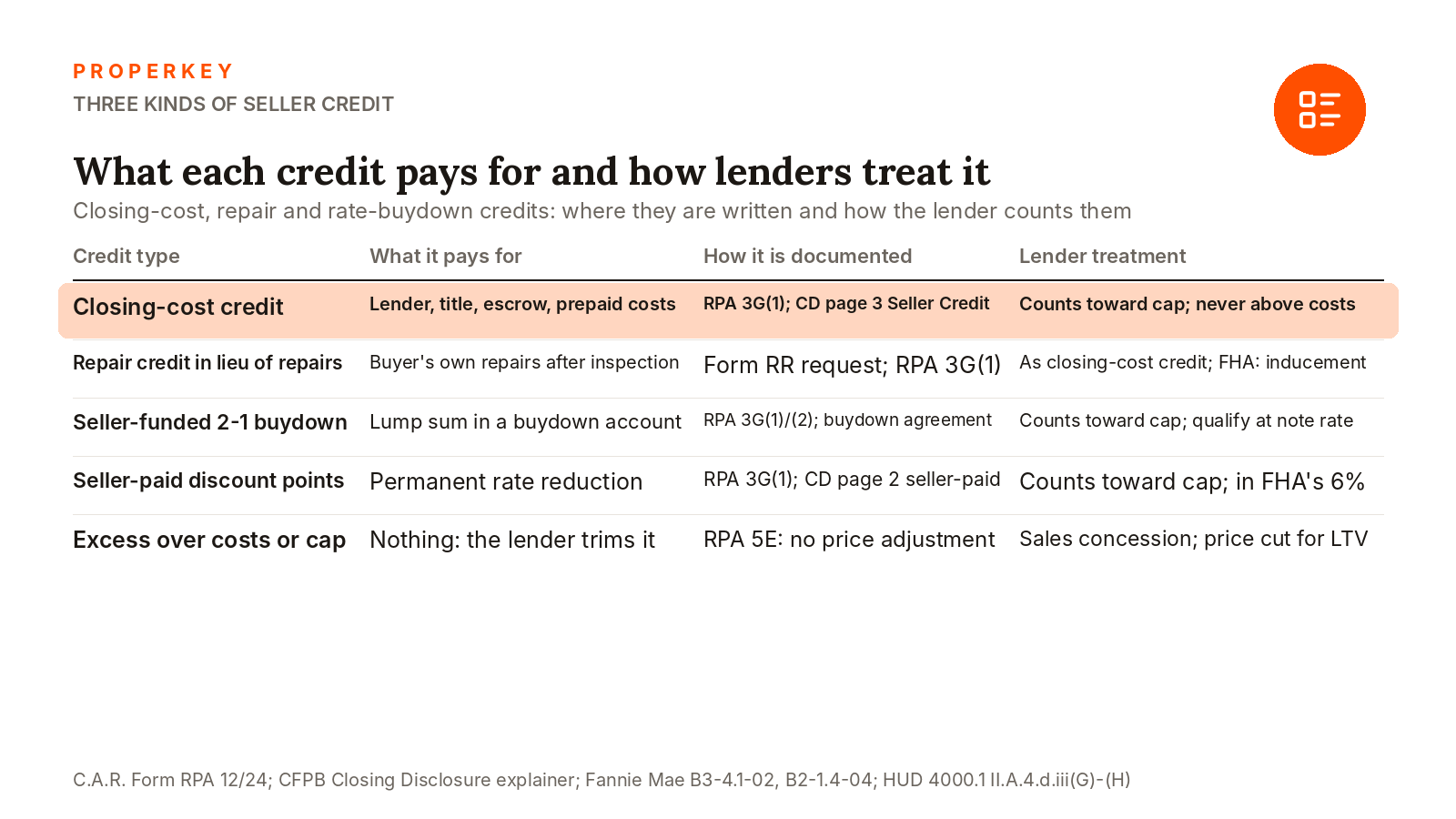
Closing-cost credit. Applied to the buyer's lender fees, title and escrow charges, and prepaid taxes, insurance and interest. The buyer brings less cash; the loan does not change.
Repair credit in lieu of repairs. After inspections, the buyer takes a credit instead of a fix. Lenders treat it like a closing-cost credit; on an FHA loan a "repair allowance" is an inducement to purchase, subtracted from the price before the loan-to-value is figured (HUD 4000.1 II.A.4.d.iii(H)).
Seller-funded rate buydown. The credit funds a lump sum in a buydown account that subsidizes the payment, temporarily (a 2-1 buydown runs 2 points below the note rate in year one and 1 point in year two, per Freddie Mac) or permanently through discount points. Seller-paid buydown funds count toward the same limits; the buyer qualifies at the note rate (Fannie Mae B2-1.4-04).
Where does the credit appear in the contract and closing papers?
In the C.A.R. Residential Purchase Agreement, revised 12/24 (blank copy posted by CRMLS), paragraph 3G(1) reads "Seller Credit to Buyer $____ For closing costs," 3G(2) holds "additional seller credit terms (does not include buyer broker compensation)," and 3G(3) is where a seller agrees to pay part of the buyer's broker fee. Paragraph 5E says that if the lender allows less, "the Contractual Credit from Seller shall be reduced to the Lender Allowable Credit" with "no automatic adjustment to the purchase price." A repair credit starts as a Request for Repair (Form RR) under paragraph 14B(2). On the Closing Disclosure, a general credit is the page 3 Seller Credit, "the amount the seller has agreed to contribute to your closing costs"; itemized seller-paid costs sit on page 2 (CFPB).
How much can a seller credit be?
The buyer's loan program sets the ceiling, as a share of the price (or appraised value, if lower). On a $900,000 sale:
Conventional (Fannie Mae), primary or second home: 3% ($27,000) when the loan exceeds 90% of value, 6% ($54,000) at 75.01% to 90%, 9% ($81,000) at 75% or less; 2% on an investment property (B3-4.1-02).
FHA: 6% ($54,000), including buydowns, discount points and up-front MIP; the credit may not fund the buyer's required 3.5% investment (HUD 4000.1 II.A.4.d.iii(G), Update 18, Aug. 12, 2026).
VA: credits for loan closing costs are not capped, but "seller's concessions" (anything else of value, such as the funding fee or the buyer's debts) are limited to 4% of reasonable value ($36,000) (VA.gov).
USDA: "limited to six percent of the sales price" ($54,000) (HB-1-3555 ch. 6, ¶6.2, revised May 5, 2025).
What if the credit is bigger than the buyer's closing costs?
The lender trims it. Fannie Mae allows a financing concession only up to the borrower's closing costs and prepaids; anything above that, or above the cap, is a "sales concession" deducted from the price before the loan-to-value is figured (B3-4.1-02). FHA calls the excess "an inducement to purchase" (HUD 4000.1 II.A.4.d.iii(G)). Under RPA paragraph 5E the excess simply disappears: $14,000 of closing costs means $14,000 from a $20,000 credit.
Does a seller credit lower the sale price?
No. On the $900,000 example, escrow, the assessor and the MLS all record $900,000; the $20,000 is a debit on the seller's settlement statement, so the seller nets $880,000 before commissions, and anyone pulling that comp later sees $900,000. Fannie Mae requires appraisers to adjust comparables for "sales or financing concessions" when the amount is reasonably available (B4-1.3-09); often it is not. CRMLS added concession-amount fields in May 2024 and removed them that July, keeping a yes/no "Seller Consider Concessions?" field (HousingWire; CRMLS); NAR's FAQ allows such a field if the concession is "not limited to or conditioned upon" payment to a buyer's broker (NAR FAQ 64-65). When credits are common, recorded prices overstate what sellers received, and so do the comps built on them.
Is a credit or a price cut better for the buyer?
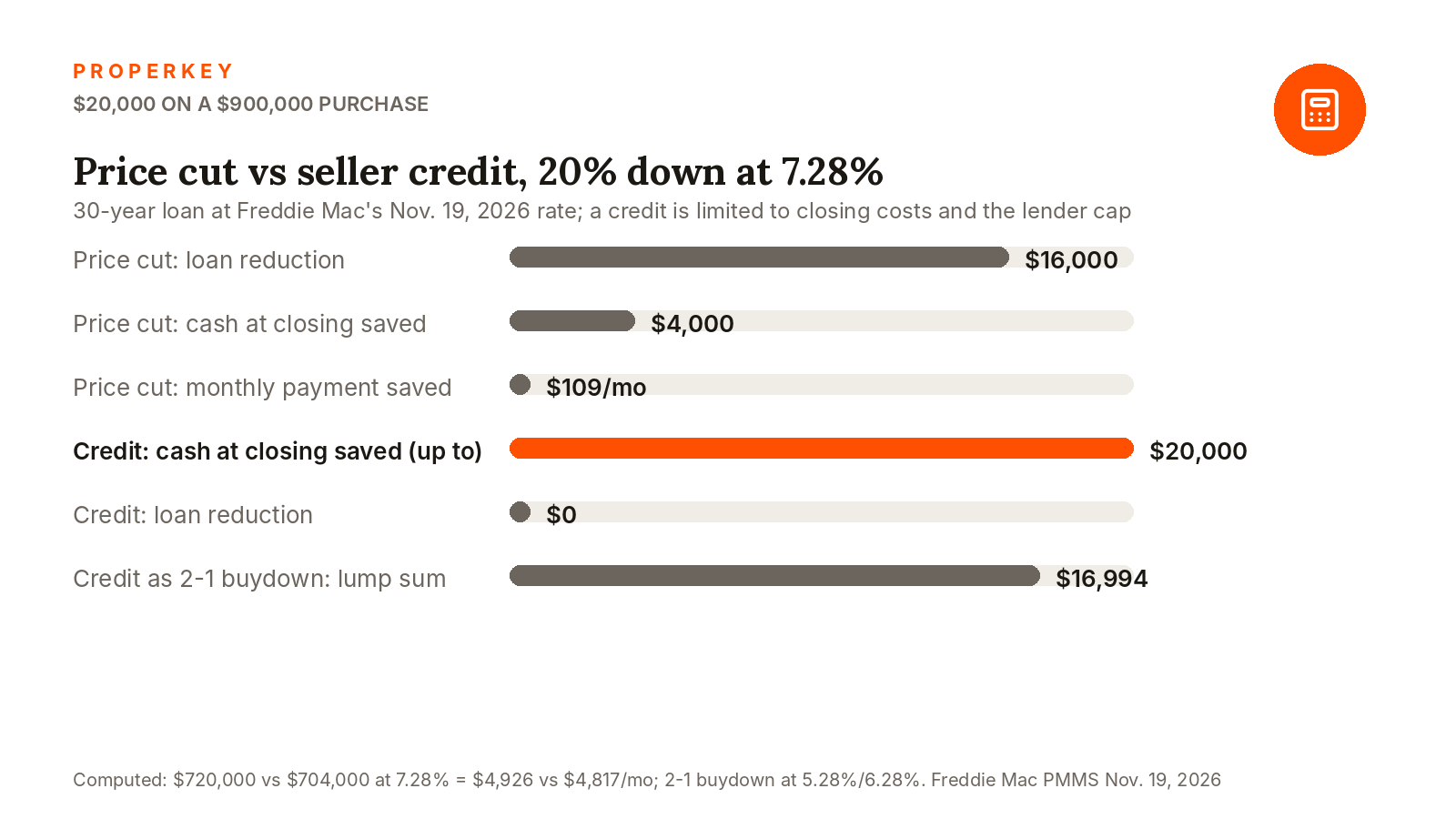
It depends on whether cash or payment is the constraint. Take a $900,000 home, 20% down, 30-year loan at 7.28%, Freddie Mac's Nov. 19, 2026 average (PMMS). A $20,000 price cut lowers the loan from $720,000 to $704,000, cuts principal and interest from $4,926 to $4,817, about $109 a month, and trims the down payment by $4,000. A $20,000 credit leaves the loan and payment alone but cuts cash at closing by up to $20,000, limited to actual costs and the cap. Spent on a 2-1 buydown, it covers the roughly $16,994 lump sum the account needs, computed from the monthly differences: $3,989 in year one (5.28%) and $4,447 in year two (6.28%) versus $4,926. A cash-thin buyer with strong income wants the credit; a buyer keeping the loan for 30 years saves about $39,400 of interest with the price cut.
How common are seller credits in 2026?
Redfin's agents reported a concession in 44.7% of U.S. sales in August 2026, up from 42.6% a year earlier, counting repairs, closing-cost credits and buydowns but not price cuts. Riverside (58.0%), San Diego (57.1%) and Los Angeles (56.2%) were higher; San Francisco (18.6%) and San Jose (4.2%) far lower (Redfin, Sept. 18, 2026). In NAHB's November survey, 46% of builders cut prices (average 6%) and 68% offered incentives, both post-Covid highs (NAHB, Nov. 17, 2026). C.A.R.'s October report shows sales down 12.7% year over year, a 98.5% sale-to-list ratio and 29 median days on market (C.A.R., Nov. 17, 2026); that ratio compares list and recorded price, not credits paid behind it.
Is a seller credit taxable?
Not as income. IRS Publication 523's Worksheet 2 figures the seller's "amount realized" as sale price minus selling expenses, and line 2d lists "any mortgage points or other loan charges you paid that would normally have been the buyer's responsibility" (IRS Pub. 523); a credit lowers the seller's gain. The buyer may deduct seller-paid points but "must also reduce the basis of the home by the amount of the seller-paid points" (IRS Pub. 530).
What should sellers and buyers do?
Sellers: price to the market, then treat a credit request as a line in the counteroffer, written into paragraph 3G(1) with the lender's cap in mind. Properkey lists for a $0 listing fee with full MLS exposure, pro photos with a 3D tour and a dedicated agent from list to close. Buyers: when cash is the constraint, ask for a credit rather than a price cut, sized to the lender's closing-cost estimate; Properkey shops the lenders after one application.
A related term: no offer of compensation appears in the MLS (since Aug. 17, 2024, per NAR); sellers do not offer a commission to a buyer's agent. A buyer's offer may ask the seller to pay some or all of the buyer's agent's fee; the seller can accept, counter or decline that request like price or any other term, and if agreed it is paid at closing under the contract (RPA 3G(3); DRE consumer alert, Dec. 12, 2024).
Questions people ask
Can a seller pay all of the buyer's closing costs in California?
Often, yes. California law sets no limit; the lender does. A 20%-down conventional buyer or an FHA buyer can take up to 6% of the price, but never more than actual closing costs and prepaids.
Do seller credits show up in the sale price?
No. The recorded and MLS closed price stay at the contract price; the credit is a debit on the seller's settlement statement, and comps generally do not reveal it.
Is a seller credit taxable?
Not as income. For the seller it is a selling expense that reduces the amount realized (Publication 523); for the buyer, seller-paid points may be deductible but reduce basis (Publication 530).
What is the maximum seller contribution on an FHA loan?
6% of the sales price, including any buydown, discount points and up-front MIP (HUD 4000.1 II.A.4.d.iii(G)); the excess is subtracted from the price before FHA computes the loan.
This article summarizes seller-credit rules, lender guidelines and tax publications as of November 24, 2026. It is general information, not legal, tax or lending advice.
Sources: Fannie Mae Selling Guide B3-4.1-02 · Fannie Mae Selling Guide B2-1.4-04 · Fannie Mae Selling Guide B4-1.3-09 · HUD Handbook 4000.1 (Update 18) · VA.gov funding fee and closing costs · USDA HB-1-3555 chapter 6 · Freddie Mac temporary subsidy buydowns · Freddie Mac PMMS · C.A.R. Form RPA, revised 12/24 · CFPB Closing Disclosure explainer · CRMLS concessions fields · HousingWire on CRMLS fields · NAR settlement FAQ · DRE consumer alert · Redfin seller concessions, August 2026 · NAHB November 2026 HMI · C.A.R. October 2026 sales · IRS Publication 523 · IRS Publication 530
Written by Keyro, Properkey's AI. Properkey, DRE #01979718.