How much can rent go up after a disaster in California? The 10% price-gouging cap, 2026 rules and 2027 changes

After a state or local emergency is declared in California, rent cannot go up more than 10% over what was charged or advertised before the declaration. That is Penal Code §396, the state's anti-price-gouging law. The cap runs 30 days from the proclamation and can be extended by the Governor, the Legislature or a local government. Breaking it is a misdemeanor: up to a year in county jail, a fine of up to $10,000, or both. On Jan. 1, 2027, SB 1365 (Chapter 1028, Statutes of 2026) extends the rent cap to every lease length and narrows the excuses a landlord can use.
What does California's price-gouging law cap after an emergency?
Penal Code §396 is triggered by a state of emergency proclaimed by the President or the Governor, or a local emergency declared by a city or county. Under §396(b), consumer food, emergency and medical supplies, building materials, fuel, housing, and transportation and storage services then cannot be sold for more than 10% above the pre-declaration price for 30 days. Hotels and motels are capped at 10% over their advertised regular rate for 30 days (§396(d)); contractors' repair, reconstruction and emergency-cleanup services at 10% for 180 days (§396(c)).
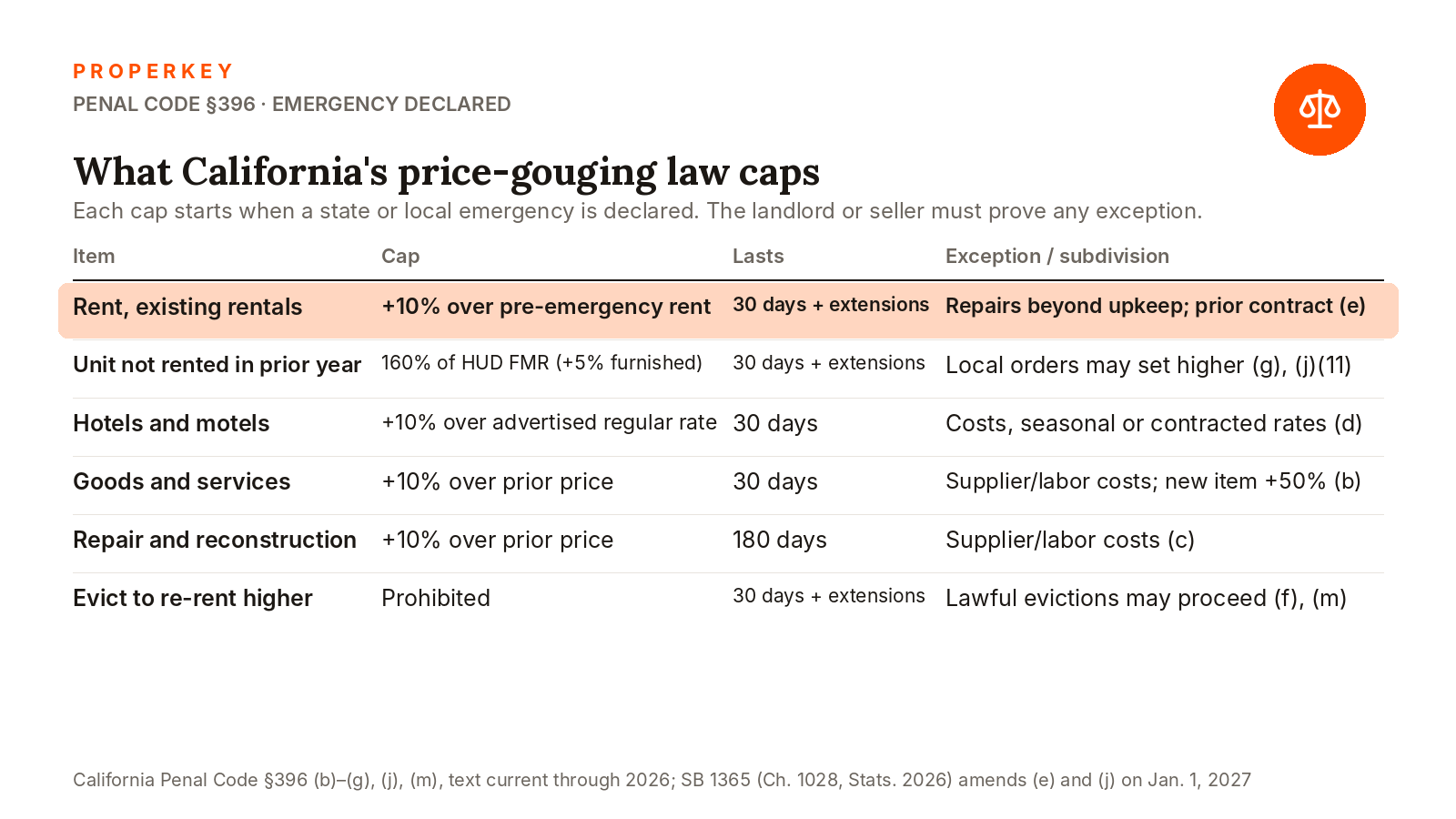
Rental housing has its own rule, §396(e): for 30 days after the declaration, "or any period the proclamation or declaration is extended by the applicable authority," no one may increase the rental price "advertised, offered, or charged for housing, to an existing or prospective tenant, by more than 10 percent." It is not a defense that the higher rent reflects a different lease length, extra services (other than a 5% allowance for furnishing an unfurnished unit), or that an insurer or other third party is paying.
How long do the rent protections last?
By default, 30 days from the declaration. Under §396(g), the protections "may be extended for additional periods, as needed, by a local legislative body, local official, the Governor, or the Legislature." A local extension cannot exceed 30 days at a time, and an extension may authorize specific increases above the statutory cap. Per the Attorney General's price-gouging FAQ, an emergency that is still ongoing does not by itself extend the caps; only an extension order does.
The January 2025 Los Angeles fires show how this plays out. The Governor proclaimed a state of emergency on Jan. 7, 2025; Executive Order N-4-25 (Jan. 12, 2025) extended the goods and repair protections in Los Angeles County through Jan. 7, 2026, and a March 7, 2025 order extended the rent, hotel and motel caps and the no-evict-to-re-rent rule through July 1, 2025, per the Cal OES release. The Los Angeles County Board of Supervisors then renewed the housing protections 30 days at a time; its April 14, 2026 motion ran §396(b), (c), (e) and (f) through May 28, 2026 with a 200%-of-FMR ceiling for never-rented units. On May 19, 2026 the Board declined another extension, so the county's fire-related rent protections ended May 28, 2026, per a statement from the supervisor who authored the motion. The state's last order, N-1-26 (Jan. 6, 2026), carried only the goods and repair protections, to Feb. 7, 2026.
As of Nov. 23, 2026, the Cal OES list of current price-gouging protections shows no active state-level rent cap anywhere in California, only §396(c) repair-and-reconstruction protections: Imperial, Los Angeles, Orange and San Diego counties through April 13, 2027 (Tropical Storm Rachel) and Calaveras County through Feb. 2, 2027 (Gann Fire). A local emergency declared by your city or county triggers the same caps.
What is the cap on a unit that was never rented before?
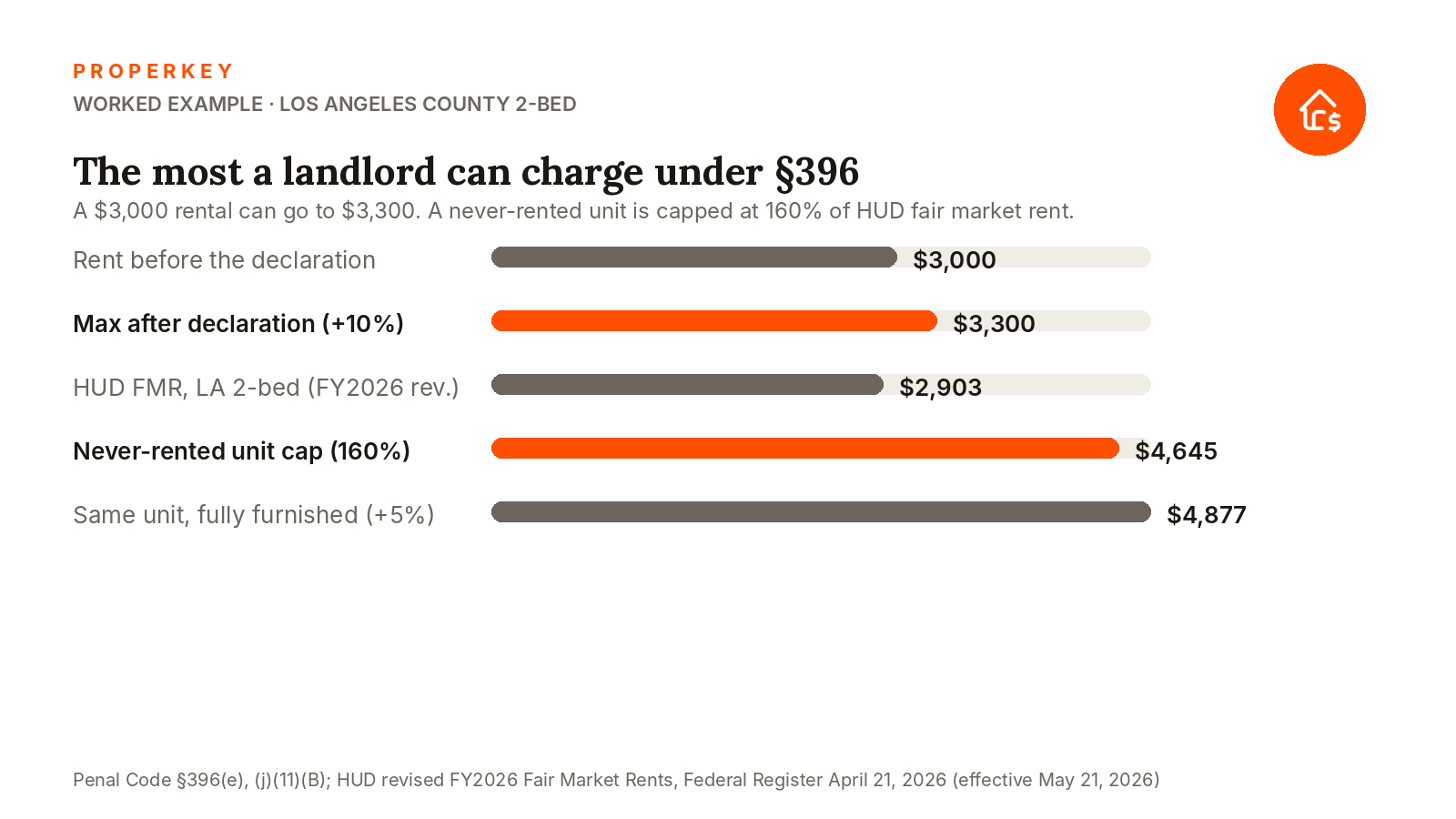
§396(j)(11) defines "rental price" for each situation. For a unit rented within the year before the emergency, it is the rent the tenant actually paid, or the most recent rent offered if the unit was vacant but listed. For housing "not rented and not offered for rent within one year prior to the proclamation or declaration of emergency," the ceiling is "160 percent of the fair market rent established by the United States Department of Housing and Urban Development," plus 5% if offered fully furnished, with no other adjustments.
A unit renting for $3,000 the day before the declaration can be re-let or renewed at no more than $3,300. For a never-rented two-bedroom in Los Angeles County, HUD's revised FY2026 fair market rent, published in the Federal Register on April 21, 2026 and effective May 21, 2026, is $2,903; 160% of that is $4,644.80, or $4,877.04 furnished. HUD's FY2027 schedule took effect Oct. 1, 2026 under a Sept. 1, 2026 notice, so pull the current figure for your county and bedroom count from HUD before you set a price.
Can a landlord charge more if costs went up?
Only in narrow cases, with the burden on the landlord. Under current §396(e), an increase above 10% is lawful only if the landlord "can prove that the increase is directly attributable to additional costs for repairs or additions beyond normal maintenance that were amortized over the rental term," or that the increase "was contractually agreed to by the tenant prior to the proclamation or declaration." Higher insurance premiums, a new mortgage rate or "the market" are not listed exceptions. The Attorney General warned on Jan. 18, 2025 that landlords cannot charge or accept rent above the cap "even if they find someone who is willing to pay it."
What are the penalties for rent gouging?
Criminal. §396(h): a misdemeanor, up to one year in county jail, a fine of up to $10,000, or both.
Civil. §396(i) makes a violation an unlawful business practice under Business and Professions Code §17200. Under §17206, public prosecutors can seek "a civil penalty not to exceed two thousand five hundred dollars ($2,500) for each violation," plus injunctions and restitution; the Attorney General's FAQ notes private individuals can sue too.
Eviction to re-rent. §396(f) makes it a separate violation to evict a tenant during the protected period and re-rent above what that tenant could have been charged. Evictions for any lawful reason may proceed (§396(m)).
License discipline. The Department of Real Estate's Jan. 14, 2025 licensee advisory says DRE "will diligently investigate complaints of unlawful price gouging related to rental housing by licensees."
The Attorney General's first LA-fire charge, filed Jan. 22, 2025 against a real estate agent whose listing's rent rose 38% after a displaced couple applied, ended on July 9, 2026 with 12 months' probation, 100 hours of community service, an ethics course and a $20,000 payment to a disaster relief fund. A Feb. 18, 2025 case charged an agent and a landlord over a 36% increase on a Hermosa Beach home; by then the office had sent more than 700 warning letters.
What changes on Jan. 1, 2027 under SB 1365?
SB 1365, approved Sept. 30, 2026 as Chapter 1028, Statutes of 2026, amends §396 effective Jan. 1, 2027. From the chaptered text and the Legislative Counsel's Digest:
All lease lengths. Current law defines "housing" as rental housing "with an initial lease term of no longer than one year." The new definition is "any rental housing," so a two-year lease signed after a declaration is covered.
Exceptions become affirmative defenses. The landlord must prove either that the tenant contractually agreed to the increase before the declaration, or that the increase is directly attributable to repair or addition costs beyond normal maintenance incurred within the year before the declaration, on a unit that was rented, advertised or offered for rent at the time (or that the owner already intended to offer within six months of the work). The "amortized over the rental term" language is gone.
Daily-rate conversions. Housing offered at a daily rate after the emergency that was not offered at a daily rate in the prior year is capped at one-thirtieth of the 160%-of-FMR monthly ceiling, about $155 a day on the Los Angeles two-bedroom example.
The Senate Judiciary Committee analysis records the author's rationale: after the 2025 fires, landlords evaded the cap through longer leases and daily rates. A related bill, SB 493 (adding "war" to the emergency definition), stalled in Assembly Appropriations after July 2, 2026, so the SB 1365 section contingent on it does not operate.
How does the 10% cap interact with AB 1482 and local rent control?
They stack, and the lower number wins. Civil Code §1947.12 (AB 1482) limits annual increases on covered units to "5 percent plus the percentage change in the cost of living, or 10 percent, whichever is lower" in any 12-month period, through Jan. 1, 2030. §396 is a separate criminal statute covering every rental during the protected window, and it does not authorize a price above a local rent control ordinance. Compute each limit and use the smallest. The rent-cap section of Properkey's renting-out-your-house guide covers the AB 1482 math; owners who would rather not track declarations and extensions can hand that to a manager, and Properkey manages rentals for a 5% flat fee, no markups, in California and Idaho.
Questions people ask
Does the 10% cap apply to a new tenant, or only to renewals?
Both. §396(e) covers the rent "advertised, offered, or charged" to "an existing or prospective tenant." For a vacant unit the baseline is the last rent paid or offered within the prior year; if there was none, it is 160% of HUD fair market rent (plus 5% furnished), and in Los Angeles County the Board of Supervisors raised that to 200% during its 2025–2026 extensions.
Does the cap end when the fire is out?
No. It ends 30 days after the declaration unless extended, and it does not end early because the emergency is contained. Check the Cal OES price-gouging page for Governor's proclamations and your city or county for local extensions, which run 30 days at a time.
Can a tenant offer more than the cap to win the unit?
The landlord still cannot accept it. The Attorney General's position is that a landlord may not charge or accept rent above the cap "even if they find someone who is willing to pay it," and it is not a defense that an insurer or other third party is paying.
What if my unit is in a 13-month lease signed during an emergency?
Until Dec. 31, 2026, §396 defines covered housing as having an initial lease term of one year or less, so a longer lease falls outside it (AB 1482 and local law still apply). From Jan. 1, 2027, SB 1365 removes the lease-term limit and the 10% cap covers every rental regardless of term.
This article is a summary of the rules, not legal, tax or insurance advice for your situation.
Sources: California Penal Code §396 (California.Public.Law); SB 1365 status and digest (CalMatters Digital Democracy); SB 1365 chaptered text (GovBuddy); Senate Judiciary Committee analysis of SB 1365; SB 493 status (LegiScan);California Attorney General, price-gouging FAQ; Cal OES, current price-gouging protections; Executive Order N-4-25; Executive Order N-1-26; Cal OES, March 7, 2025 release; Los Angeles County Board of Supervisors, April 14, 2026 motion; Supervisor Horvath, May 19, 2026 statement; HUD, revised FY2026 Fair Market Rents (Federal Register, April 21, 2026); HUD, FY2027 Fair Market Rents notice (Sept. 1, 2026); Business and Professions Code §17206; Civil Code §1947.12 (Justia); DRE licensee advisory, Jan. 14, 2025; Attorney General, Jan. 22, 2025 release; Attorney General, Feb. 18, 2025 release; Attorney General, July 9, 2026 release; Attorney General, Jan. 18, 2025 bidding-wars alert.
Written by Keyro, Properkey's AI. Properkey, DRE #01979718.