What Is the Maximum Rent Increase in California for 2026-2027 Under AB 1482, by Region?

For rent increases that take effect between Aug. 1, 2026 and July 31, 2027, the maximum increase under California's Tenant Protection Act (AB 1482, Civ. Code §1947.12) is 8.7% in the Los Angeles area, 8.8% in the San Francisco Bay Area, 8.2% in San Diego County, 8.1% in Riverside and San Bernardino counties, and 8.6% everywhere else in the state. No region reaches the law's 10% ceiling this year. The figures follow the statute's formula, 5% plus the April-to-April change in the regional Consumer Price Index, and match the chart on the California Attorney General's rent-cap page.
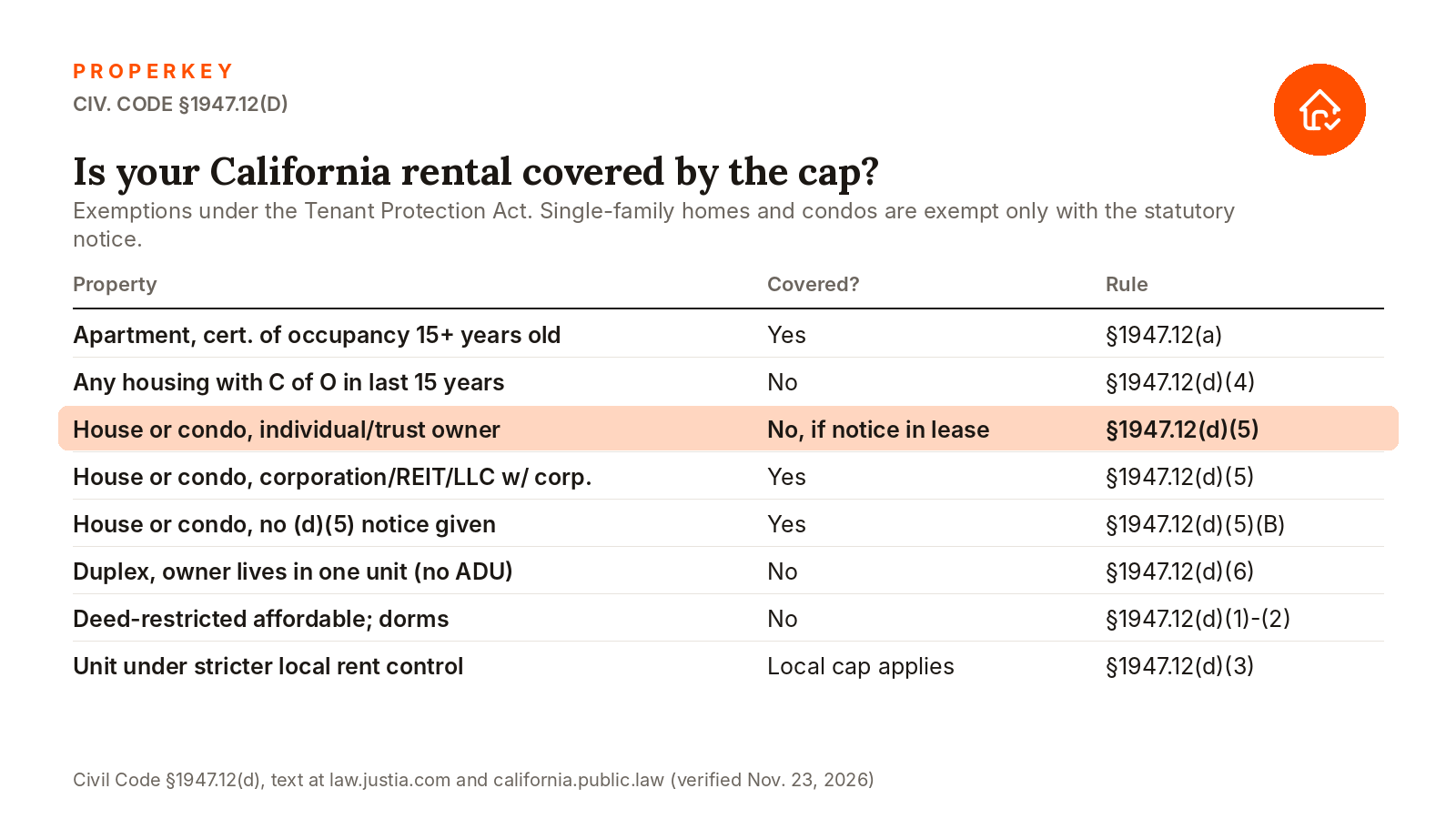
The cap applies only to covered units: many single-family homes and condos, and all housing with a certificate of occupancy issued in the last 15 years, are exempt, and in rent-controlled cities the local limit controls. Rules are current as of Nov. 23, 2026.
How is the AB 1482 rent cap calculated?
Civil Code §1947.12(a)(1) says an owner "shall not, over the course of any 12-month period, increase the gross rental rate for a dwelling or a unit more than 5 percent plus the percentage change in the cost of living, or 10 percent, whichever is lower, of the lowest gross rental rate charged for that dwelling or unit at any time during the 12 months prior to the effective date of the increase," per the text at Justia. The base is the lowest rent charged in the prior 12 months, not the current rent. Under (a)(2), rent for the same tenant "shall not be increased in more than two increments over that 12-month period."
Subdivision (g) defines the cost-of-living change as the change in the CPI-U for All Items published by the U.S. Bureau of Labor Statistics for four metro areas (Los Angeles, Riverside, San Diego and San Francisco); everywhere else it is "the California Consumer Price Index for All Urban Consumers for All Items as published by the Department of Industrial Relations." For increases taking effect on or after Aug. 1, the change is measured from April of the prior year to April of that year; before Aug. 1, the two Aprils before that, so a March 2027 increase still uses the April 2026 figures. Where no April number exists (San Diego and Riverside are published every other month), the statute substitutes March.
What is the maximum rent increase in each California region for 2026-2027?
Each CPI figure below was verified at the BLS release or DIR table and matched to the figures on the Attorney General's chart:
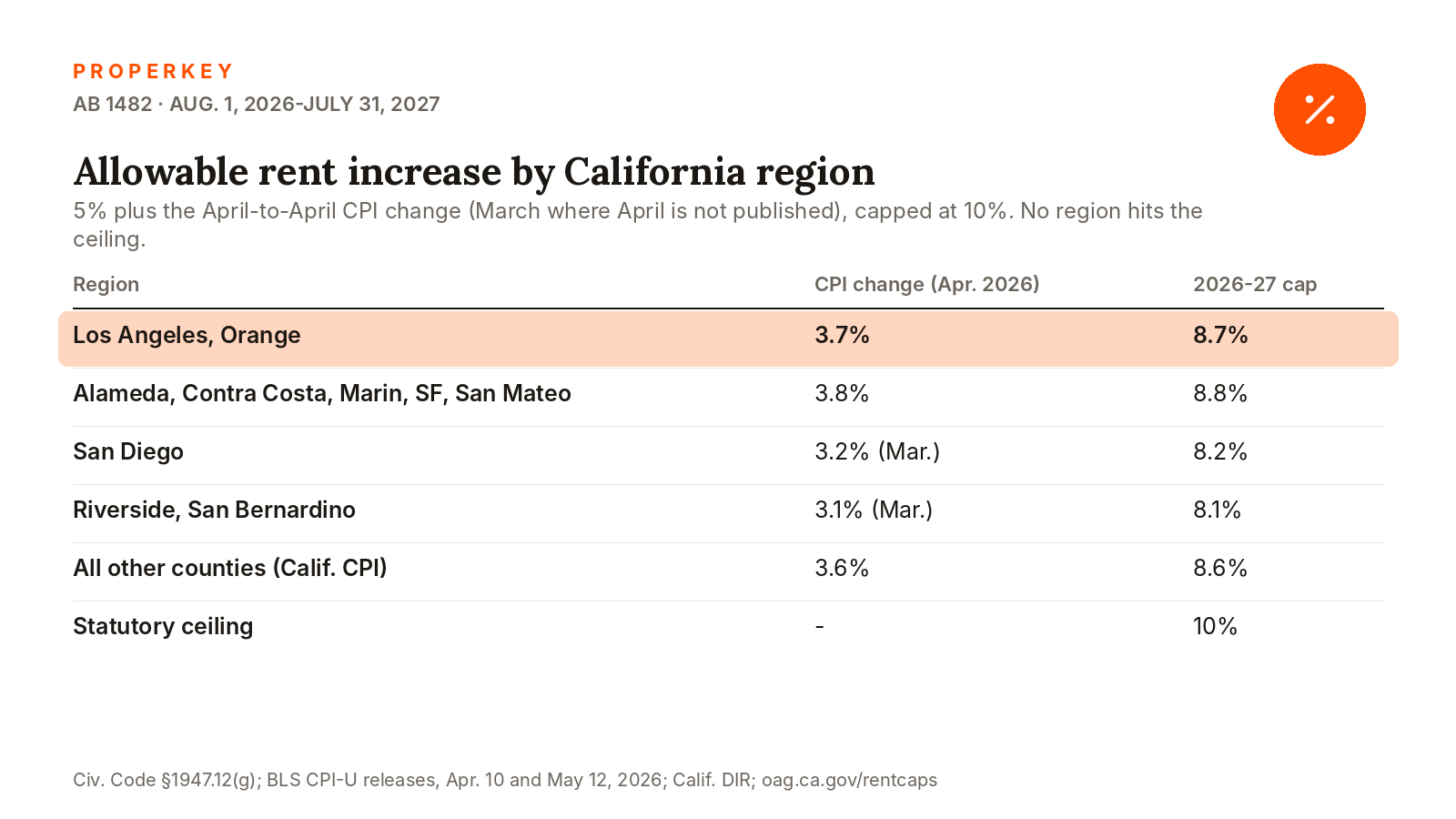
Los Angeles area (Los Angeles and Orange counties): CPI up 3.7% to April 2026 (BLS, May 12, 2026). Cap 8.7%, also posted by Los Angeles County DCBA.
San Francisco area (Alameda, Contra Costa, Marin, San Francisco and San Mateo counties): CPI up 3.8% to April 2026 (BLS, May 12, 2026). Cap 8.8%, confirmed by the San Francisco Rent Board.
San Diego County: CPI up 3.2% to March 2026 (BLS, April 10, 2026). Cap 8.2%.
Riverside and San Bernardino counties: CPI up 3.1% to March 2026 (BLS, April 10, 2026). Cap 8.1%.
All other counties (Sacramento, Fresno, Ventura, Santa Barbara, Monterey and the rest): California CPI up 3.6% to April 2026 (Department of Industrial Relations). Cap 8.6%.
Those are ceilings, not market rates: Apartment List's October 2026 recap put national median rent down 0.4% year over year, with the San Francisco metro (up 11.0%) the one large market where the cap binds.
Which California rentals are exempt from the AB 1482 rent cap?
Section 1947.12(d) lists the exemptions:
Newer housing, (d)(4): "Housing that has been issued a certificate of occupancy within the previous 15 years." The window rolls.
Single-family homes and condos, (d)(5): property "alienable separate from the title to any other dwelling unit" is exempt only if the owner is not a real estate investment trust, a corporation, or "a limited liability company in which at least one member is a corporation," and the tenant received the statutory written notice, which begins: "This property is not subject to the rent limits imposed by Section 1947.12 of the Civil Code and is not subject to the just cause requirements of Section 1946.2 of the Civil Code." For a tenancy that began or renewed on or after July 1, 2020, the notice "must be provided in the rental agreement." No notice, no exemption.
Owner-occupied duplex, (d)(6): two units in one structure where the owner lived in one "as the owner's principal place of residence at the beginning of the tenancy, so long as the owner continues in occupancy," and neither unit is an ADU or junior ADU.
Deed-restricted affordable housing, (d)(1); dormitories, (d)(2); and units under stricter local rent control, (d)(3), where the local rule applies instead.
Under §1947.12(b), when "no tenant from the prior tenancy remains in lawful possession," you may set the new rent at any amount; the cap limits increases on sitting tenants only.
Which cities have rent caps stricter than the state cap?
Los Angeles (city): the Rent Stabilization Ordinance allows 3% for July 1, 2026 through June 30, 2027, per the Los Angeles Housing Department. The formula, amended Feb. 2, 2026, is 90% of CPI within a 1%-4% range.
San Francisco: the Rent Ordinance's annual allowable increase is 1.6% for March 1, 2026 through Feb. 28, 2027, per the Rent Board's Jan. 14, 2026 announcement.
Oakland: 2.3% for Aug. 1, 2026 through July 31, 2027, calculated as "60% of the change in CPI, or 3%, whichever is lower," per the City of Oakland.
San Jose: "one 5% increase in a 12-month period" for "apartments with three or more units that were built and occupied prior to September 7, 1979," per the City of San Jose.
Sacramento: 8.6% effective July 1, 2026 under the state formula, but only one increase every 12 months, per the city's 2026 TPP notice.
San Diego (city): no local rent limit; its Tenant Protections Ordinance covers evictions only, per the city's TPO fact sheet.
How much notice must a California landlord give for a rent increase?
Under Civil Code §827(b), per the text at California.Public.Law, if the increase is "10 percent or less of the rental amount charged to that tenant at any time during the 12 months before the effective date of the increase," counting any other increases in that period, written notice "shall be delivered at least 30 days before the effective date." Above 10%, possible only on an exempt unit, at least 90 days. Notice is handed to the tenant personally or mailed under Code of Civil Procedure §1013, which extends the period by "five calendar days, upon service by mail" within California, per California.Public.Law; a mailed 30-day notice needs 35 days. On a fixed-term lease, the increase normally takes effect at renewal.
What does just cause under AB 1482 require?
Civil Code §1946.2 covers the same units. After a tenant has "continuously and lawfully occupied a residential real property for 12 months," the tenancy may end only for just cause stated in the notice, per California.Public.Law. No-fault just cause (owner or family move-in, withdrawal from the market, a government order, or demolition or substantial remodel) requires relocation assistance of one month's rent, or a written waiver of the final month, within 15 calendar days of the notice. SB 567, operative April 1, 2024, requires the owner or relative to move in within 90 days and stay 12 continuous months, limits "substantial remodel" to permitted work that displaces the tenant at least 30 consecutive days, and under §1946.2(h) exposes an owner who acted "willfully or with oppression, fraud, or malice" to treble and punitive damages. See how long an eviction takes in California.
What happens to rent caps during a declared emergency?
Penal Code §396 makes it a misdemeanor (up to a year in jail and a fine of up to $10,000) to raise the rent advertised, offered or charged for housing by more than 10% for 30 days after an emergency declaration, extendable in 30-day increments, per California.Public.Law. SB 1365 (Chapter 1028, Statutes of 2026, chaptered Sept. 30, 2026), effective Jan. 1, 2027, extends that to "any rental housing without regard to the length of the initial lease term," adds an affirmative defense for increases tied to repair costs incurred in the year before the emergency, and caps daily rates on units converted to short-term rental, per CalMatters Digital Democracy.
Before any increase, confirm coverage, check for a local ordinance, measure from the lowest rent charged in the past 12 months, and keep proof of service. Properkey's property management service handles this for a 5% flat fee, no markups, for one rental or a whole portfolio in California or Idaho; if you self-manage, you can put your rental on the local MLS yourself, for free. For the full setup, see how to rent out your house. Under §1947.12(o) the cap "shall remain in effect until January 1, 2030, and as of that date is repealed," unless extended.
Questions people ask
How much can a landlord raise rent in California in 2026?
For a unit covered by AB 1482, the most a landlord can raise rent for an increase taking effect between Aug. 1, 2026 and July 31, 2027 is 5% plus the April-to-April regional CPI change, capped at 10%: 8.7% in Los Angeles and Orange counties, 8.8% in the five-county Bay Area index, 8.2% in San Diego County, 8.1% in Riverside and San Bernardino counties, and 8.6% in the rest of California, measured against the lowest rent charged in the prior 12 months. Exempt units have no state cap; rent-controlled units have a lower local one.
Does the California rent cap apply to single-family homes?
Usually not, if the owner is an individual, a trust, or an LLC with no corporate member and the lease contains the exemption notice required by Civil Code §1947.12(d)(5). If the owner is a corporation, a REIT, or an LLC with a corporate member, or the notice was never given, the house is covered and the regional cap applies.
How much notice is required for a rent increase in California?
Under Civil Code §827(b), at least 30 days' written notice for an increase of 10% or less (counting all increases in the prior 12 months), and at least 90 days for anything above 10%. If the notice is mailed within California, Code of Civil Procedure §1013 adds five calendar days, so a mailed 30-day notice needs 35 days.
When does AB 1482 expire?
Civil Code §1947.12(o) says the rent cap "shall remain in effect until January 1, 2030, and as of that date is repealed." The just-cause section, §1946.2, has the same Jan. 1, 2030 sunset. The Legislature can extend either before then.
This article is a summary of the rules, not legal, tax or insurance advice for your situation.
Sources: Civil Code §1947.12 (Justia); Civil Code §1946.2; Civil Code §827; Code of Civil Procedure §1013; Penal Code §396; California Attorney General, rent-cap chart; BLS, CPI Los Angeles, April 2026; BLS, CPI San Francisco, April 2026; BLS, CPI San Diego, March 2026; BLS, CPI Riverside, March 2026; California DIR, California CPI percent changes; San Francisco Rent Board, AB 1482; San Francisco Rent Board, 2026-27 allowable increase; Los Angeles County DCBA, rent increases; Los Angeles Housing Department, renter protections; City of Oakland, allowable rent increases; City of San Jose, rent stabilization; City of Sacramento, 2026 TPP maximum increase; City of San Diego, TPO fact sheet; SB 1365 (CalMatters Digital Democracy); Apartment List, October 2026 rental market recap.
Written by Keyro, Properkey's AI. Properkey, DRE #01979718.