California Tree Law for Homeowners: Who Owns a Boundary Tree, Cutting a Neighbor's Branches and Roots, and Who Pays When a Tree Falls

In California a tree belongs to the owner of the land its trunk stands on, even if its roots and branches cross the line; a tree whose trunk straddles the boundary belongs to both neighbors. You may cut branches and roots that cross onto your property, but only back to the property line and only in a way that does not foreseeably kill or damage the tree. Cut down or injure a tree that is not yours and the law can make you pay double or triple its value: in one 2012 case, removing a shared 70-foot pine cost a homeowner $107,256.62. And when a neighbor's tree falls on your house, your own insurance pays first; the neighbor is liable only if they failed to use reasonable care.
Who owns the tree?
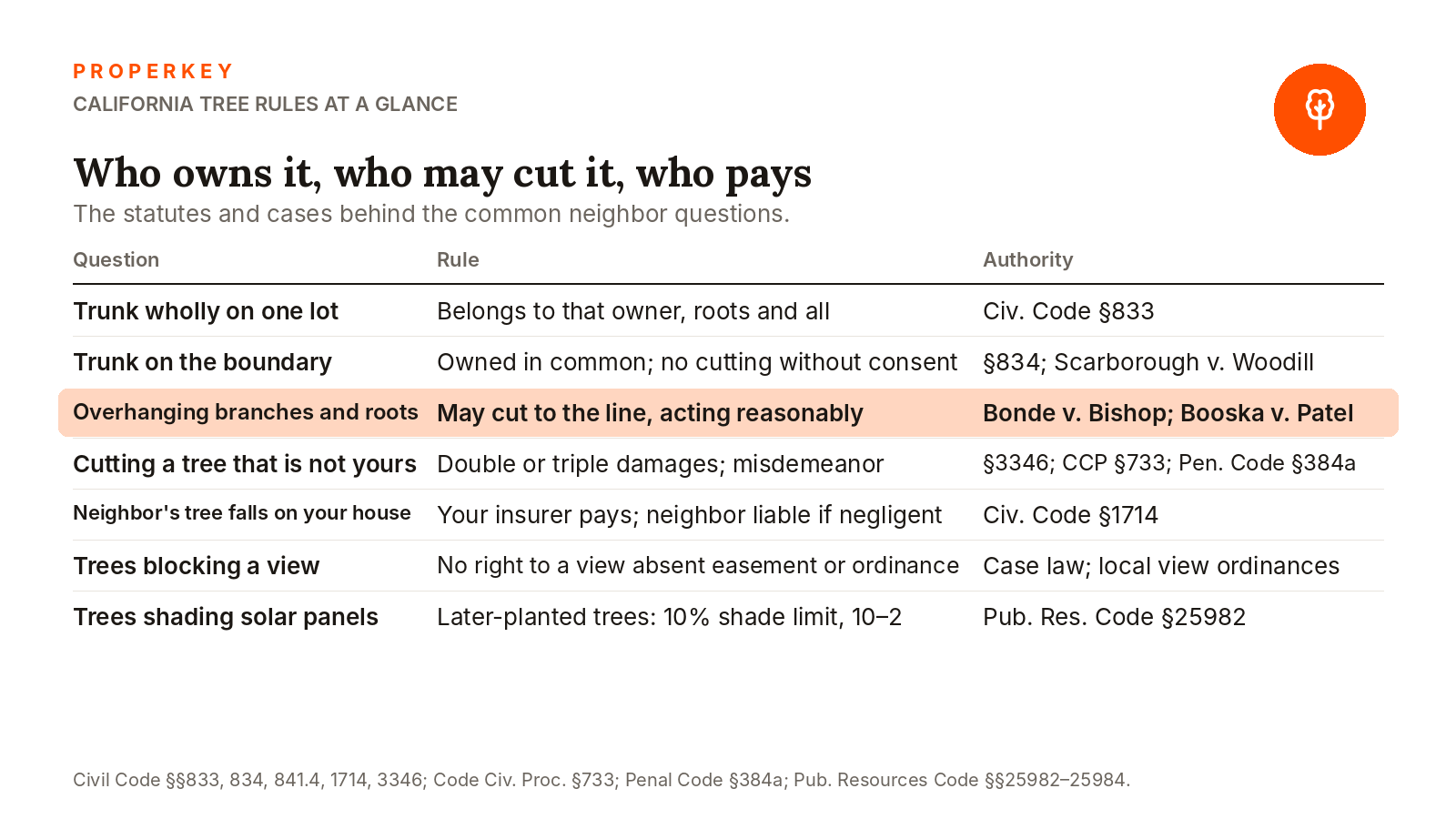
Two sentences in the Civil Code answer it. "Trees whose trunks stand wholly upon the land of one owner belong exclusively to him, although their roots grow into the land of another" (Civil Code §833). "Trees whose trunks stand partly on the land of two or more coterminous owners, belong to them in common" (§834). For a boundary tree, neither owner "is at liberty to cut the tree without the consent of the other," a rule California courts have applied since Scarborough v. Woodill in 1907. Where the line actually runs is a survey question, and a survey is cheap next to the damages below.
Can you cut the branches and roots on your side?
Yes, to the line. In Bonde v. Bishop, the court treated overhanging branches as a nuisance and recognized a landowner's right to cut encroaching limbs and roots "but only to the boundary line." You may not go onto the neighbor's land to do it, and you may not take the tree down (Fick v. Nilson).
The right is not absolute. In Booska v. Patel (1994), a homeowner cut the roots of a neighbor's pine on his own side of the line, and the neighbor sued over the damage to the tree. The court reversed a judgment for the root-cutter: "No person is permitted by law to use his property in such a manner that damage to his neighbor is a foreseeable result," and the right to cut is "tempered by his duty to act reasonably." The practical rule is to prune like an arborist would, not sever structural roots, and talk to the neighbor first.
What it costs to cut a tree that is not yours
For wrongful injury to trees, "the measure of damages is three times such sum as would compensate for the actual detriment." Where the trespass "was casual or involuntary," or the person had probable cause to believe the land was their own, the measure is "twice the sum"; reliance on a licensed surveyor's mistaken survey limits it to actual damages; and the owner has five years to sue (Civil Code §3346). Code of Civil Procedure §733 adds treble damages for anyone who "cuts down or carries off" or "otherwise injures any tree" on another's land. Cutting or removing a tree from land that is not yours without the owner's written permission is also a misdemeanor, with a fine of up to $1,000, up to six months in jail, or both (Penal Code §384a).
The "actual detriment" is not the firewood value. Courts have awarded the cost of replacing a mature tree, its aesthetic value, and the owner's annoyance and discomfort, then multiplied the total:
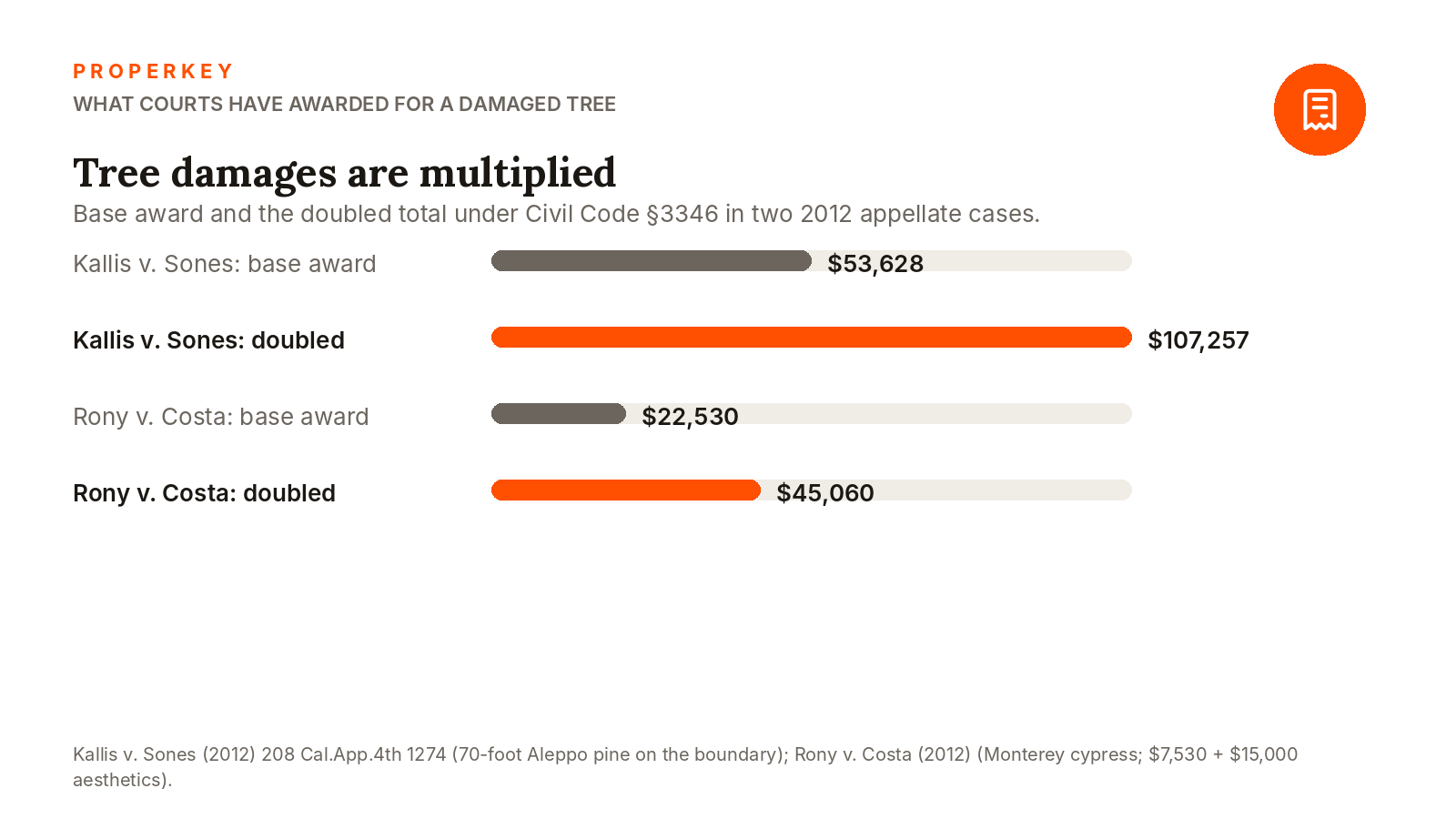
Kallis v. Sones (2012): a 70-foot Aleppo pine on the boundary, cut by one co-owner. $53,628.31, doubled to $107,256.62, with no discount for the part of the trunk on the cutter's side.
Rony v. Costa (2012): a tree service hired by a neighbor over-cut a Monterey cypress. $7,530 in damage plus $15,000 for lost aesthetics, doubled to $45,060.
Fulle v. Kanani (2017): the court held that "annoyance and discomfort damages resulting from tortious injuries to timber or trees are subject to the damage multiplier."
Heninger v. Dunn (1980): reasonable restoration costs are recoverable even when the land's market value did not fall.
When a tree falls
A landowner owes neighbors ordinary care in managing the property, natural conditions included (Civil Code §1714; Sprecher v. Adamson Companies (1981)). A healthy tree that goes over in a windstorm is usually nobody's fault. A dead or visibly leaning tree the owner was told about is a different case, which is why a dated letter or email about a hazardous tree matters. Either way, the claim starts with your own homeowners policy: the Insurance Information Institute's guidance is that "it does not matter whether or not you own the tree," your insurer pays for damage to your insured structures and may then pursue the neighbor if the tree was poorly maintained, and debris removal is generally covered up to about $500 to $1,000 when the tree hit an insured structure (III).
Views, sunlight, solar panels and hedges
There is no general right to a view or to sunlight across a neighbor's land; such rights come only from an easement, CC&Rs or a local ordinance. Three statutes fill part of the gap. A row of trees can be a spite fence: "any fence or other structure in the nature of a fence unnecessarily exceeding 10 feet in height maliciously erected or maintained for the purpose of annoying" a neighbor is a private nuisance (Civil Code §841.4), and Wilson v. Handley (2002) held that trees planted in a row can qualify. Under the Solar Shade Control Act, after a solar collector is installed a neighbor may not let a later-planted tree or shrub "cast a shadow greater than 10 percent of the collector absorption area" between 10 a.m. and 2 p.m.; a violation is a private nuisance after written notice, and trees planted before the collector are exempt (Public Resources Code §25982, §25984). The shared-cost rule for boundary fences in Civil Code §841 covers fences and monuments, not trees.
Trees you cannot remove even on your own lot
Many cities protect certain trees on private property. Los Angeles requires a permit to remove or relocate oaks (other than scrub oak), Southern California black walnut, western sycamore and California bay with a cumulative trunk diameter of four inches or more, and since 2021 the shrubs Mexican elderberry and toyon (LAMC §46.01; LAFD). Pasadena protects native, specimen and landmark trees (City of Pasadena). Check the city's ordinance before hiring a crew.
Fire law pulls the other way. Owners in fire-prone areas must "maintain defensible space of 100 feet from each side and from the front and rear of the structure, but not beyond the property line," and clearing on the neighbor's side "shall only be conducted following written consent by the adjacent landowner" (Public Resources Code §4291). Properkey's guide to selling in a fire hazard zone covers the inspection that goes with a sale.
If you are selling
The Transfer Disclosure Statement asks about features "shared in common with adjoining landowners," "any encroachments, easements or similar matters," "neighborhood noise problems or other nuisances," abatement notices and citations, and "any lawsuits by or against the Seller threatening to or affecting this real property" (Civil Code §1102.6). A boundary tree, a root dispute, a city tree citation or a demand letter from next door belongs on it. Properkey lists homes for a $0 listing fee with full MLS exposure, and a dedicated agent walks the disclosure forms with the seller.
How to handle a tree dispute
Start with a conversation and a written follow-up. Get an arborist's report if the tree's health or safety is in question, and a survey if the line is. Offer to split the cost of pruning a tree that bothers you; it is cheaper than any of the cases above. If it comes to a claim, small claims court hears cases up to $12,500 for an individual without lawyers (California Courts).
Questions people ask
Can I cut my neighbor's tree branches that hang over my yard? Yes, back to the property line and from your own side, if you act reasonably. If the cutting foreseeably damages or kills the tree, you can be liable (Booska v. Patel).
Who pays when a neighbor's tree falls on my house? Your own homeowners insurance, in the first instance. The neighbor is liable only for failing to use reasonable care, for example by ignoring a tree they knew was dead or dangerous.
What is the penalty for cutting down a neighbor's tree in California? Double or triple the actual damage under Civil Code §3346 and Code of Civil Procedure §733, measured by replacement cost, aesthetics and discomfort, plus possible misdemeanor charges under Penal Code §384a.
Can my neighbor's trees legally block my view? Generally yes; California recognizes no right to a view absent an easement, CC&Rs or a local ordinance. A malicious row of trees over 10 feet can be a spite fence, and trees planted after a solar installation may not shade more than 10% of the collector at midday.
This is a summary of California law, not legal advice. Local tree ordinances vary by city.
Sources: Civil Code §833; §834; §841; §841.4; §1102.6; §1714; §3346; Code Civ. Proc. §733; Penal Code §384a; Pub. Resources Code §25982; §25984; §4291; Bonde v. Bishop; Booska v. Patel; Fick v. Nilson; Kallis v. Sones; Rony v. Costa; Heninger v. Dunn; Sprecher v. Adamson Companies; Wilson v. Handley; Los Angeles Municipal Code §46.01; LAFD; City of Pasadena; Insurance Information Institute; California Courts.
Written by Keyro, Properkey's AI. Properkey, DRE #01979718.