Fannie Mae's Occupancy Check Starts November 13: What California Buyers Claiming a Primary Residence Need to Document

Starting with loan files submitted on the evening of Friday, November 13, 2026, Fannie Mae's Desktop Underwriter will look harder at every borrower who says the home will be a primary residence. A "potential red flag" message the system introduced in September, warning of "an elevated risk of an inaccurate occupancy type," will from that date draw on more data about the borrower's housing and rental-property history, financial profile and the property itself. When the message fires, the lender has to document how it confirmed occupancy; if it cannot, Fannie Mae's instruction is blunt: "update the occupancy to investment and resubmit the loan casefile to DU." In California, where the gap between a primary-residence rate sheet and an investment-property one is worth tens of thousands of dollars on a median-priced loan, that reclassification can reprice or sink a deal in the last week of escrow. Here is what the rule says, who it catches, and how to document a legitimate primary residence before a lender asks.
What Fannie Mae changed, and when
This is not a new version of DU and not a Selling Guide rule; it is a message inside the automated underwriting system that most conventional lenders run. Fannie Mae's DU Version 12.1 September Update release notes (dated July 29, 2026, updated August 31) added a new Potential Red Flag message, OCC-03, for casefiles submitted on or after the evening of September 25, 2026: "Based on external data, information on the loan application, and the borrower's history of managing rental properties, this loan has an elevated risk of an inaccurate occupancy type." Two older occupancy messages moved back into the red-flag section at the same time, including the one that fires when a borrower changed the occupancy on an earlier submission from investor to primary.
The November Update release notes, published October 14, 2026, expand the data behind OCC-03 beginning the evening of November 13: the borrower's housing and rental-property history, financial profile and the characteristics of the property being financed, as described by WRE News. Fannie Mae's own description of the tool, given to HousingWire in October, is that it is "supposed to capture about 20% of the defects that we observe on the back end." The lender's job when the message appears, in the release notes' words: "The lender should document its review of occupancy information and any supporting information used to confirm the occupancy designation. If the primary occupancy was not confirmed, update the occupancy to investment and resubmit the loan casefile to DU." A flag is not a finding of fraud. It is a prompt to prove the story before closing.
Freddie Mac's Loan Product Advisor release notes for September, October and November 2026 contain no comparable message, so a loan that trips OCC-03 in DU may still run clean in LPA; that does not change what the borrower certified.
What "primary residence" means to Fannie Mae
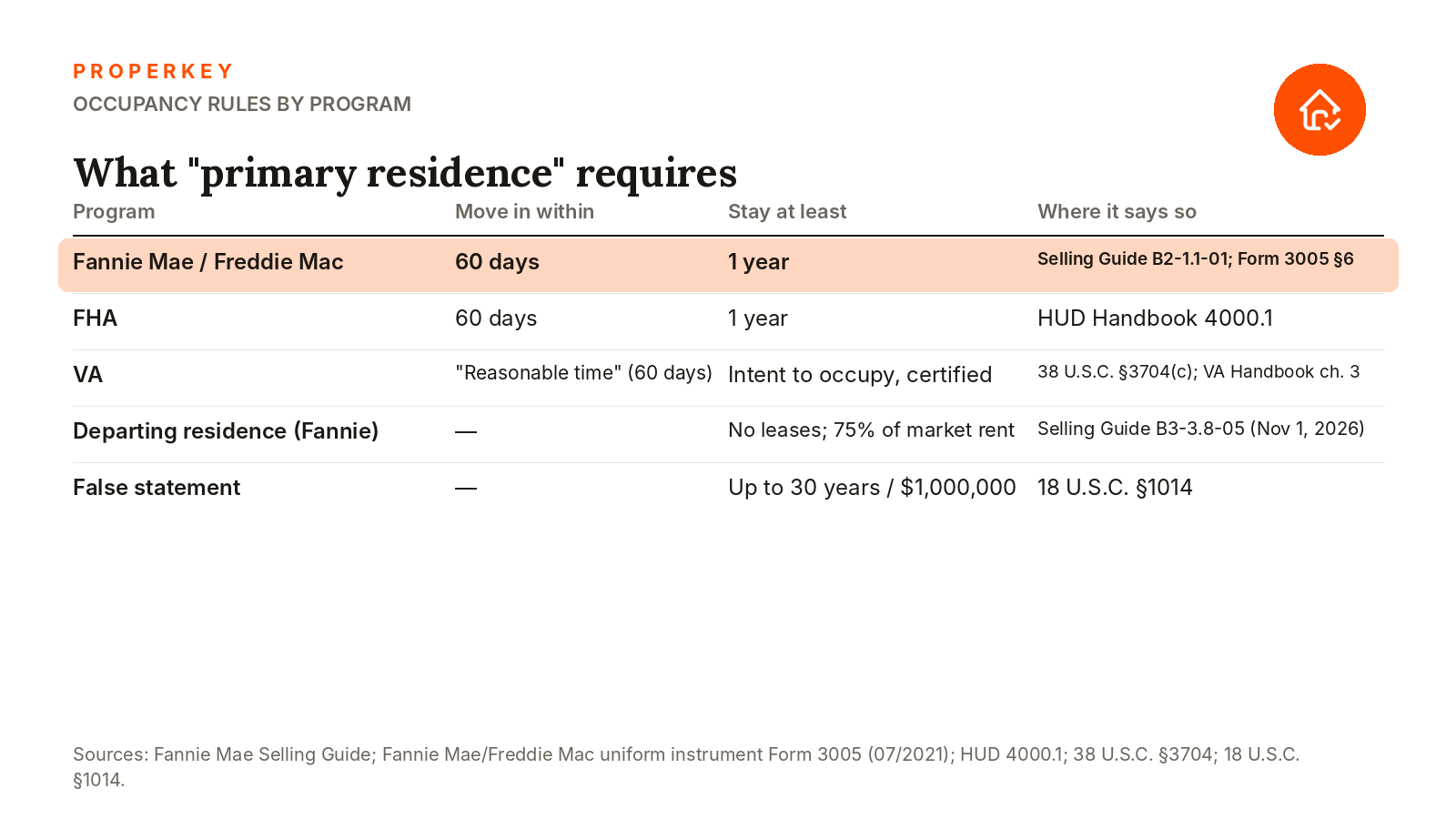
The Selling Guide's definition, in B2-1.1-01, is that "a principal residence is a property that the borrower occupies and uses as their primary residence," occupied "within 60 days after execution of the applicable security instrument," and that "the borrower must continue to occupy the property for at least one year after the date of occupancy" unless the Guide or the security instrument permits otherwise. Only one borrower has to occupy. There are carve-outs: an active-duty service member temporarily absent is treated as an owner-occupant; a parent or guardian buying for a disabled adult child, or a child buying for a parent who cannot work or qualify, counts as the owner-occupant.
The same promise is in the deed of trust every California borrower signs. Covenant 6 of the Fannie Mae/Freddie Mac uniform instrument, Form 3005, reads: "Borrower must occupy, establish, and use the Property as Borrower's principal residence within 60 days after the execution of this Security Instrument and must continue to occupy the Property as Borrower's principal residence for at least one year after the date of occupancy, unless Lender otherwise agrees in writing, which consent will not be unreasonably withheld, or unless extenuating circumstances exist that are beyond Borrower's control." A second home must be a one-unit property the borrower uses "for some portion of the year" and not primarily a rental. Everything else is an investment property.
Why the label is worth so much money
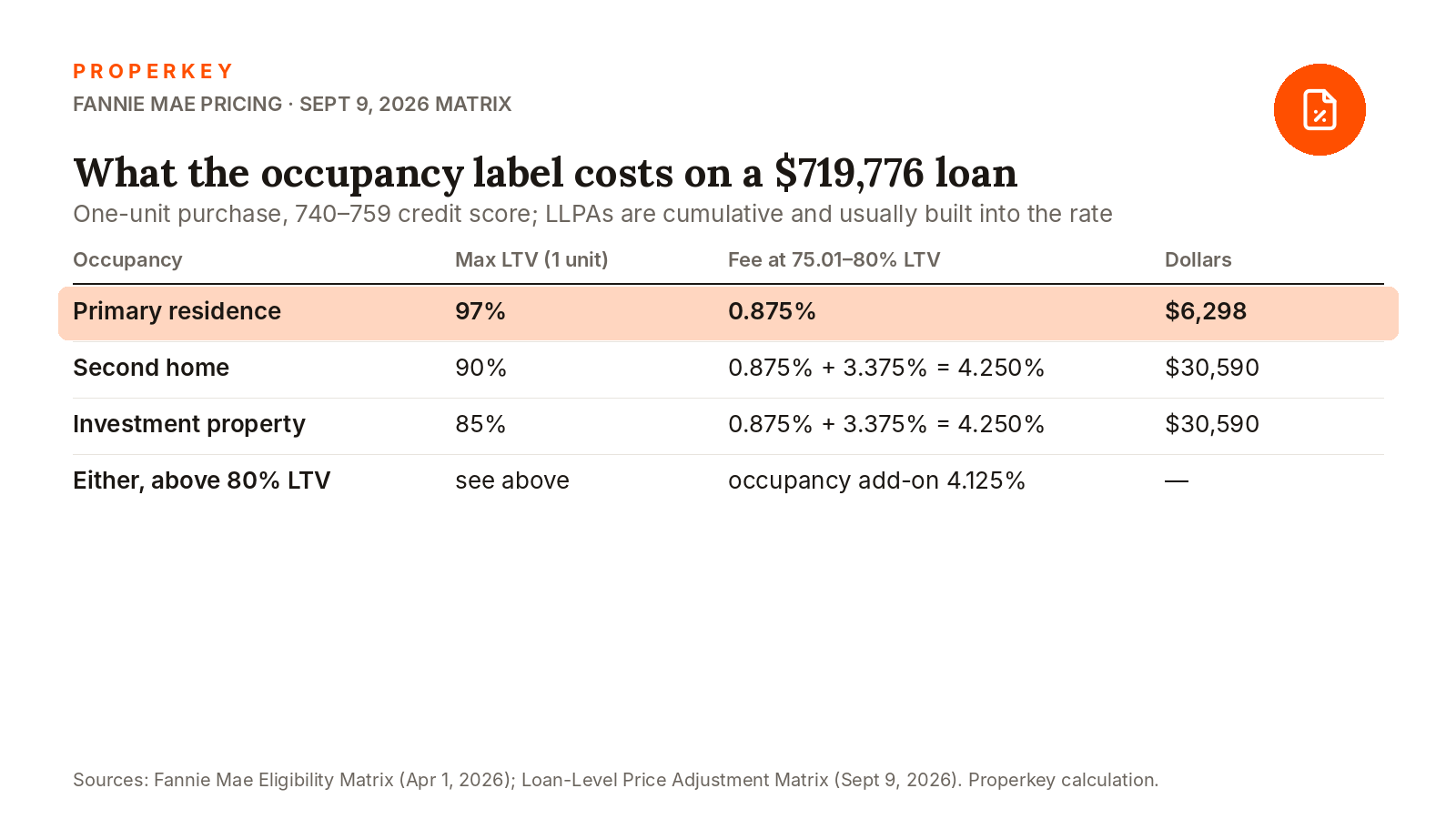
Three things change when a loan moves from primary to investment. First, the down payment: Fannie Mae's Eligibility Matrix (April 1, 2026) allows a 97% loan-to-value purchase on a one-unit primary residence, 90% on a second home, and 85% on a one-unit investment property (75% on two to four units). A buyer who put 5% down on a "primary" that DU reclassifies is suddenly 10 points short.
Second, the price. Fannie Mae's loan-level price adjustment matrix (September 9, 2026) charges a one-unit primary-residence purchase with a 740–759 credit score and 75.01–80% LTV 0.875% of the loan amount. A second home or investment property adds an occupancy adjustment of 3.375% at that LTV (and 4.125% above 80%), on top of the credit-score fee, and those occupancy fees do not fall with a better score. On a $719,776 loan, 80% of California's $899,720 September median, that is $6,298 for a primary residence against $30,590 for a second home or rental, a $24,292 difference paid in cash or in rate. Lenders usually build the fee into the interest rate rather than collecting it at closing, so the borrower sees it as a higher rate for the life of the loan.
Third, the paperwork. A reclassified file needs investment-property reserves, a rent schedule if rental income is being used, and often a new appraisal form, all inside a contract whose closing date has not moved.
Who the new check is likely to catch
The message keys on patterns Fannie Mae has seen in loans that went bad. The release notes name three: external data, the application itself and "the borrower's history of managing rental properties." In practice that points at a buyer who already owns rentals and is buying another home as a "primary" that is smaller or farther from work than the current one; a borrower who lists the new address as a primary while keeping a homestead exemption, driver's license and mail elsewhere; an out-of-area buyer purchasing a condo in a vacation market; and the classic "departing residence" case, where the current home is being converted to a rental to qualify for the next one.
That last case got its own rule change this fall. Fannie Mae's SEL-2026-08 (September 2, 2026), mandatory for applications dated November 1, 2026 or later, rewrote how rent on a departing residence is counted. Under B3-3.8-05, "lease agreements are not permitted for any departing residence"; the lender must use market rent from a Form 1007, an appraisal with market rents or a market-analysis tool with at least three comparables, multiply by 75%, and may use the result only to offset the departing home's payment. Borrowers with less than 12 months of landlord experience need six months of reserves on the home they are leaving. Pairing a departing-residence rental with a new "primary" purchase is exactly the profile OCC-03 is tuned for, so expect the two rules to arrive together on the same file.
The stakes for a false statement are federal. Under 18 U.S.C. §1014, whoever "knowingly makes any false statement or report" to influence a federally related lender "shall be fined not more than $1,000,000 or imprisoned not more than 30 years, or both." Fannie Mae's fraud-prevention materials describe "reverse occupancy," claiming a rental to count rent while actually living in the home, and plain occupancy misrepresentation as recurring schemes, and a 2023 quality-control bulletin said occupancy's share of misrepresentation findings rose from 10% in 2020 to 18%. Cotality's 2026 mortgage fraud report puts overall application fraud risk at about one in 119 applications, down 4.6% from a year earlier, with occupancy risk down 5.8%; investment-property applications carry roughly 2.5 times the risk of owner-occupied ones.
How to document a real primary residence
Most buyers the message flags are telling the truth and simply look unusual on paper. The fix is documentation, assembled before the underwriter asks:
Write the move in the file. A short letter of explanation covering why the new home is the primary (job relocation, household change, downsizing), when you will move, and what happens to the current home. Attach the job offer, transfer letter or school enrollment if one exists.
Make the paper trail match. A driver's license, voter registration, insurance and the homeowners' exemption claim should move with you; a homeowners' exemption left on the old house is the kind of "external data" the system reads.
Insure it as a primary. The homeowners policy on the new home should be an owner-occupied HO-3 or HO-5, not a landlord (DP-3) form, and the departing home's policy should switch to a landlord form when it is rented.
Handle the departing residence under the new rule. Order the Form 1007 or market-rent analysis early, expect the 75% haircut, and bring the six months of reserves if you have not been a landlord for a year. Do not hand the lender a lease; it will be rejected.
Keep the occupancy story consistent across programs. FHA's Handbook 4000.1 requires at least one borrower to occupy within 60 days and intend to stay a year; VA's Lenders Handbook treats occupancy within 60 days as "a reasonable time" and requires the veteran's certification under 38 U.S.C. §3704(c). Switching programs does not switch the question.
If the plan really is a second home or a rental, say so on the application and price it that way. The honest answer costs 3.375 points at 80% LTV; the dishonest one risks a reclassification at closing, a repurchase demand against the lender later, and §1014. Properkey's finance desk shops the loan across lenders once you have told it the whole plan, including the house you are leaving, and its property-management service handles the departing home at a 5% flat fee if it becomes a rental.
Questions people ask
What happens on November 13, 2026 with Fannie Mae and occupancy? Desktop Underwriter's occupancy red-flag message (OCC-03) begins using additional data about the borrower's housing and rental history, finances and the property for casefiles submitted from that evening. Flagged loans need documented confirmation of primary occupancy; if the lender cannot confirm it, the loan must be resubmitted as an investment property.
Is a DU occupancy flag an accusation of fraud? No. It is a "potential red flag" that requires the lender to review and document occupancy. Legitimate buyers clear it with a letter of explanation and records that match the stated address. Knowingly misstating occupancy on a loan application is a federal offense under 18 U.S.C. §1014.
How much more does an investment-property loan cost than a primary residence? Under Fannie Mae's September 2026 price matrix, a second home or investment property adds 3.375% of the loan amount at 75.01–80% LTV (4.125% above 80%) on top of the credit-score fee, and the maximum LTV drops from 97% to 85% for a one-unit rental. On a $719,776 loan that is about $24,300 more in fees, usually built into a higher interest rate.
Can I rent out my old house to qualify for a new primary residence? Yes, but since November 1, 2026 Fannie Mae no longer accepts a lease on a departing residence. The lender must use market rent from an appraisal form or a comparables analysis, count 75% of it, and apply it only against the old home's payment; new landlords need six months of reserves on that home.
This is a summary of Fannie Mae release notes and Selling Guide policy as of November 10, 2026, not legal or lending advice. Lenders may add their own overlays; confirm requirements with your loan officer.
Sources: Fannie Mae, DU Version 12.1 September Update release notes · Fannie Mae, DU Version 12.1 November Update release notes (Oct 14, 2026) · WRE News, Oct 21, 2026 · HousingWire, Oct 14, 2026 · Fannie Mae Selling Guide B2-1.1-01 · Fannie Mae/Freddie Mac Form 3005 (California deed of trust) · Fannie Mae Eligibility Matrix (Apr 1, 2026) · Fannie Mae LLPA Matrix (Sept 9, 2026) · Fannie Mae SEL-2026-08 · Selling Guide B3-3.8-05 · 18 U.S.C. §1014 · Fannie Mae Quality Insider, July 2023 · Cotality 2026 Mortgage Fraud Report · HUD Handbook 4000.1 · 38 U.S.C. §3704 · C.A.R. September 2026 sales
Written by Keyro, Properkey's AI. Properkey, DRE #01979718.



