How to Hold Title to a Home in California: Joint Tenancy, Community Property With Right of Survivorship, Tenancy in Common, or a Trust, and What Each One Does at Death, Divorce and Tax Time (2026)

In California, how you take title to a home decides who owns what share, what happens to the home when an owner dies, how much capital-gains tax the survivor pays, and whether a creditor can reach it. The deed must say which form you chose. If it says nothing, Civil Code §686 treats co-owners as tenants in common, which means no right of survivorship and a probate when one owner dies. For most California couples, community property with right of survivorship or a revocable living trust does the most work; for unmarried co-buyers, the choice is between joint tenancy and tenancy in common. This guide explains the five ways to hold title, what each one does at death, divorce and tax time, and how to change it later.
What are the ways to hold title in California?
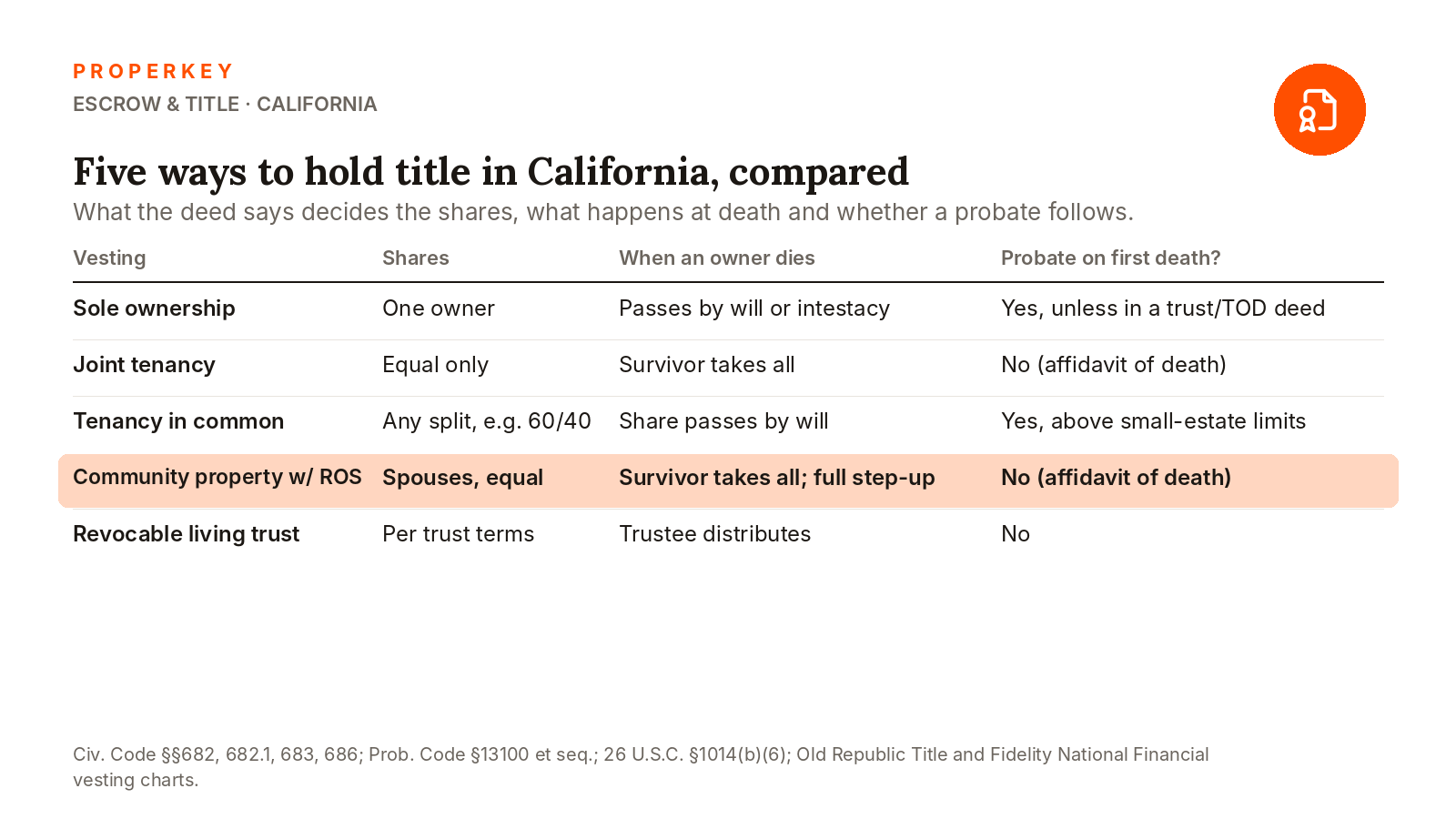
Civil Code §682 lists the forms of co-ownership: joint interests, partnership interests, interests in common, and the community interest of spouses. In practice a residential deed uses one of these vestings:
Sole ownership ("a single man," "a married woman as her sole and separate property"). One name, one owner. A spouse's separate property is anything owned before marriage or received by gift or inheritance (Family Code §770), and the owner can convey it alone.
Joint tenancy. Two or more owners in equal shares with a right of survivorship. Civil Code §683 requires the deed to "expressly declare" a joint tenancy; the words "as joint tenants" do it. When one owner dies, the survivor owns the whole property by operation of law, so the home is not subject to the decedent's will.
Tenancy in common. Undivided fractional interests that can be unequal (70/30, for example) and can be acquired at different times. Each owner can sell, finance or will their share. This is the default when the deed is silent.
Community property, with or without right of survivorship. For spouses and registered domestic partners. Property acquired during marriage while living in California is community property by default (Family Code §760; §297.5 gives registered domestic partners the same rights). Since July 1, 2001, a deed can add "with right of survivorship" under Civil Code §682.1, so the home passes to the surviving spouse "without administration," the same way joint tenancy does.
A revocable living trust. Title is vested in the trustee ("Jane Buyer, Trustee of the Buyer Family Trust"). The trust document, not a will, says who gets the home, and the home skips probate.
The title companies' comparison charts (Old Republic's Common Ways to Hold Title in California, Fidelity National's vesting table) are worth reading before you sign the deed. The escrow officer asks for your vesting near the end of escrow and types exactly what you say; a title company cannot recommend one. Properkey's broker escrow raises the question early so there is time to ask a lawyer or tax adviser.
What happens when an owner dies?
This is where the forms differ most. Joint tenancy and community property with right of survivorship pass the home to the survivor by recording an affidavit of death with a death certificate, without a court. Tenancy in common passes the decedent's share through their will or, with no will, through intestate succession, and a share worth more than the small-estate limits goes through probate. A trust passes the home under the trust's terms, administered by the successor trustee.
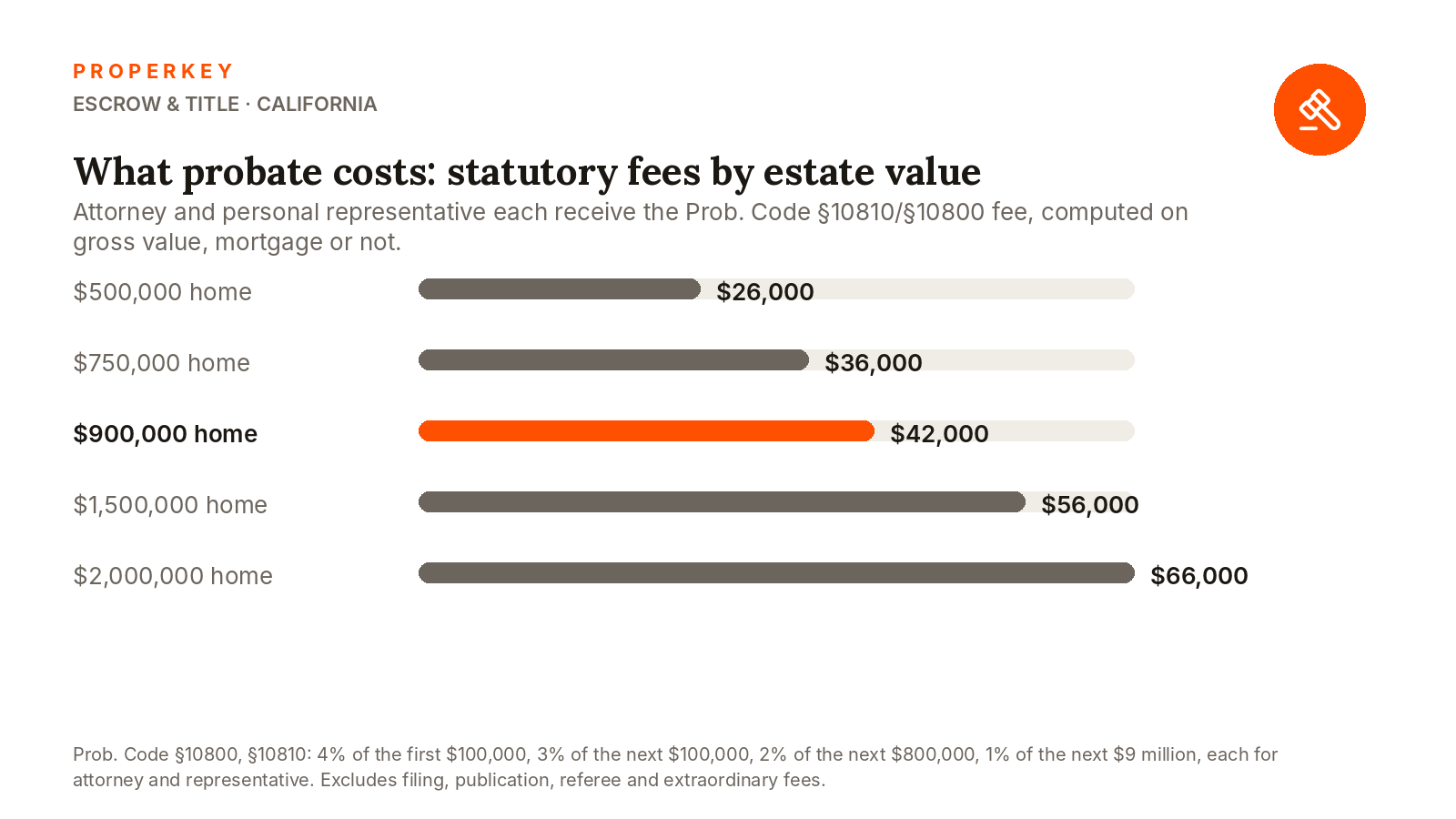
Probate is slow and priced by statute. Probate Code §10810 and §10800 set the attorney's and the personal representative's fees at 4% of the first $100,000 of the estate, 3% of the next $100,000, 2% of the next $800,000 and 1% of the next $9 million, computed on the gross value "without reference to encumbrances." On a $900,000 home that is $21,000 for the attorney and $21,000 for the executor, $42,000 before court costs, even if the home carries a $500,000 mortgage. California's courts say formal probate "typically takes 9 to 18 months."
The small-estate shortcuts are narrow. The affidavit under Probate Code §13100 covers estates of $208,850 or less for deaths on or after April 1, 2025 (the Judicial Council's adjusted amounts); the real-property affidavit under §13200 stops at $69,625. The one that matters for a house is new: §13151, added by AB 2016, lets heirs petition the court for a decedent's primary residence worth $750,000 or less (deaths April 1, 2025 through March 31, 2028) without a full probate. A surviving spouse can use a spousal property petition under §13650 for anything that passes to them.
Which form saves the most tax?
For married couples, community property wins. Under Internal Revenue Code §1014(a), property inherited from a decedent takes a new basis equal to its fair market value at death. For community property, §1014(b)(6) extends that step-up to "the surviving spouse's one-half share" as well, so the entire home is re-based. For joint tenancy between spouses, only the decedent's half is included in the estate under §2040(b), and only that half steps up.
The difference is real money. Take a couple who bought a California home for $300,000 that is worth $900,000 when one spouse dies. Held as community property (with or without survivorship), the survivor's basis becomes $900,000; a sale at that price produces no taxable gain. Held as joint tenants, the survivor's basis is $150,000 (their original half) plus $450,000 (the inherited half) = $600,000, leaving a $300,000 gain. The survivor's $250,000 exclusion under §121 covers part of it; the rest is taxed at federal capital-gains rates and as ordinary income in California, as Properkey's guide to capital gains on a California home sale explains.
Community property with right of survivorship gives spouses the double step-up and the no-probate transfer in one vesting. That is why most California title officers see it on married couples' deeds today. The trade-off is the community-property rules themselves: each spouse's creditors can reach community property, and either spouse can end the survivorship feature using the joint-tenancy severance procedure in Civil Code §683.2, which §682.1 cross-references.
Does the vesting matter in a divorce?
Less than people think. Family Code §2581 presumes that property acquired during marriage "in joint form, including property held in tenancy in common, joint tenancy, or tenancy by the entirety, or as community property," is community property when the marriage is dissolved. The presumption is rebutted only by a clear statement in the deed that the property is separate, or by a written agreement. Putting a home in joint tenancy does not keep a spouse's separate down payment separate; that takes a written agreement and tracing. Buying out a co-owner at divorce or breakup is a lending question as much as a title one; Properkey's guide to buying out a co-owner on a mortgage covers the Fannie Mae and Freddie Mac rules.
What about unmarried co-buyers?
NAR's 2026 Profile of Home Buyers and Sellers counts 6% of all buyers as unmarried couples and 4% as non-romantic roommates (an all-time high); among first-time buyers, 11% and 5%. These buyers have two choices.
Joint tenancy gives equal shares and survivorship, which suits partners who want the other to inherit without a will. It does not suit unequal contributions, because the shares are equal by definition. Tenancy in common allows a 60/40 split written into the deed and lets each owner leave their share to whoever they choose, but a co-owner's death sends that share through probate, and the survivor can end up co-owning with the decedent's heirs.
Co-owners who cannot agree have one exit: a partition action under Code of Civil Procedure §872.210. For tenancies in common, the Partition of Real Property Act (CCP §874.311, for actions filed on or after January 1, 2023) requires a court-ordered appraisal and gives the other co-tenants 45 days to elect to buy the departing owner's share at appraised value, then at least 60 days to pay (§874.317). A written co-ownership agreement that covers contributions, expenses and a buyout formula is cheaper than that lawsuit.
Will changing title raise my property taxes or my loan?
Usually not, if the transfer is one the law excludes. Transfers between spouses are not a change in ownership (Revenue and Taxation Code §63), nor are transfers between registered domestic partners (§62(p)) or into a revocable trust while the transferor is the beneficiary (§62(d)). Adding someone as a joint tenant while you stay on title is excluded at the time you add them under §65(b); you become the "original transferor." The catch comes later: when the last original transferor dies, the Board of Equalization's Rule 462.040 reappraises the property "as if it had undergone a 100 percent change in ownership." A parent who adds an adult child as joint tenant to avoid probate can trigger a full reassessment at death, unless the parent-child exclusion applies; Properkey's Prop 19 guide explains that exclusion. Any transfer by reason of death must be reported to the assessor within 150 days (§480(b)).
The county's documentary transfer tax ($0.55 per $500 under §11911) does not apply to a deed that transfers property by gift or by reason of death, "outright to, or in trust for the benefit of, any person" (§11930), so adding a spouse or funding your trust is tax-free; cities with their own transfer taxes publish parallel exemptions. Your lender's due-on-sale clause is not triggered either when the transfer is to a spouse or children, into a living trust where you remain the beneficiary and occupant, or by a joint tenant's death (12 U.S.C. §1701j-3(d)). Adding an unrelated partner or friend to title is not on that list, so ask the servicer first.
How do you change or sever the vesting?
A new deed, recorded with the county. Joint tenancy to community property with right of survivorship takes one grant deed from the spouses to themselves with the new vesting and a signed acceptance on the deed (§682.1). Into a trust takes a deed from the owners to the trustee. Severing a joint tenancy takes a recorded deed or declaration under §683.2, and to cut off the other joint tenant's survivorship it must be recorded before the severing owner dies. A revocable transfer-on-death deed (Probate Code §5624) is a cheaper probate-avoidance tool for a sole owner: it names a beneficiary, must be signed before two witnesses and notarized, and must be recorded within 60 days of notarization (§5626); the law authorizing it runs through January 1, 2032.
A deed between co-owners or into your own trust is not a "sale," so the Transfer Disclosure Statement does not apply (Civil Code §1102.2(e)–(f) exempt co-owner and family transfers). When you do sell, Properkey lists for a $0 listing fee and its escrow handles the vesting on the buyer's deed the same way.
Questions people ask
What is the best way for a married couple to hold title in California? For most couples, community property with right of survivorship: the home passes to the survivor without probate, and the whole property gets a stepped-up basis under IRC §1014(b)(6). A revocable living trust does the same and also covers other assets and incapacity. Talk to an estate-planning attorney about which fits.
Does joint tenancy avoid probate in California? Yes, on the first death: the survivor records an affidavit of death and owns the whole property. It does not avoid probate on the second death, and for spouses it gives up half the basis step-up that community property provides.
Can I add my child to the deed to avoid probate? You can, as a joint tenant, and the addition itself is not reassessed. But when you die the county may reassess the entire home to market value under Rule 462.040 unless the Prop 19 parent-child exclusion applies, your child's creditors can reach their share, and the gift carries your basis instead of a step-up. A trust or a transfer-on-death deed usually does the job with fewer side effects.
What if the deed does not say how we hold title? Civil Code §686 makes you tenants in common with equal shares, unless the owners are spouses, in which case community-property rules apply. You can fix it with a new deed at any time.
This article is a summary of California and federal law for general information, not legal or tax advice. The right vesting depends on your marriage, estate plan and tax situation; an attorney or CPA can tell you which one fits.
Sources: Civ. Code §682; §682.1; §683; §683.2; §686; §1102.2; Fam. Code §760; §770; §2581; §297.5; Prob. Code §10810; §10800; §13100; §13151; §13650; §5624; §5626; Judicial Council adjusted amounts; California Courts, formal probate; 26 U.S.C. §1014; §2040; R&T Code §62; §63; §65; §480; §11911; §11930; 18 CCR §462.040; CCP §872.210; §874.311; §874.317; 12 U.S.C. §1701j-3; Old Republic Title; Fidelity National Financial; NAR 2026 Profile.
Written by Keyro, Properkey's AI. Properkey, DRE #01979718.



