Prop 19 in 2026: How California Homeowners 55 and Over Move Their Property-Tax Base, Up to Three Times, and What Changed for Inherited Homes

A California homeowner who is 55 or older can sell a home and carry its Proposition 13 tax base to a replacement home anywhere in the state, of any price, up to three times in a lifetime. That is Proposition 19, in force since April 1, 2021, and five years on it is the single most valuable rule for the owners who hold most of the state's equity: sellers who have been in place a record 12 years (NAR, November 2026) and whose assessed values sit far below market. The same measure took most of the old parent-to-child exclusion away: an inherited home keeps its low tax base only if the child moves in within a year, and only up to the old base plus $1,044,586. This is how both halves work, with the Board of Equalization's text and a worked example.
Who can move their tax base, and where?
Revenue and Taxation Code §69.6 lets three groups transfer the "taxable value" of a principal residence to a replacement: anyone who "has attained the age of 55 years or older at the time of the sale of the original property," anyone severely and permanently disabled, and victims of a wildfire or a natural disaster declared by the Governor. The Board of Equalization's comparison chart sets out what changed on April 1, 2021: the replacement home may be "anywhere in California" (before Prop 19 it had to be in the same county or one of ten participating counties), it may be "any value" (before, it had to be of equal or lesser value), and the transfer may be used "three times" (before, once). Disaster victims face no limit; the BOE's Letter to Assessors 2022/009 says the three-time limit "does not apply to a claimant who is a victim of wildfire or natural disaster," and transfers under the older propositions do not count toward the three.
The timing rules are the ones that trip people. The replacement must be bought or newly built within two years of the sale of the original home, in either order; §69.6 allows either transaction, but not both, to predate April 1, 2021. Both homes must be the claimant's principal residence, eligible for the homeowners' or disabled veterans' exemption. The claim, on form BOE-19-B for owners 55 and over (BOE-19-D plus a certificate of disability, or BOE-19-V for disaster victims), goes to the assessor of the county where the replacement home sits, "after both transactions have been completed and you are living in the replacement home," and, the BOE adds, "this is not done through escrow." File within three years of buying the replacement. A late claim is not lost, but relief starts only "with the lien date of the assessment year in which the claim is filed," with no refund for the years in between. One more detail from the BOE's FAQ: if you buy the replacement before selling, you pay tax on its full market value "for the period between the date of purchase and date of sale," and "there will be no refund for this period."
What happens when the new home costs more?
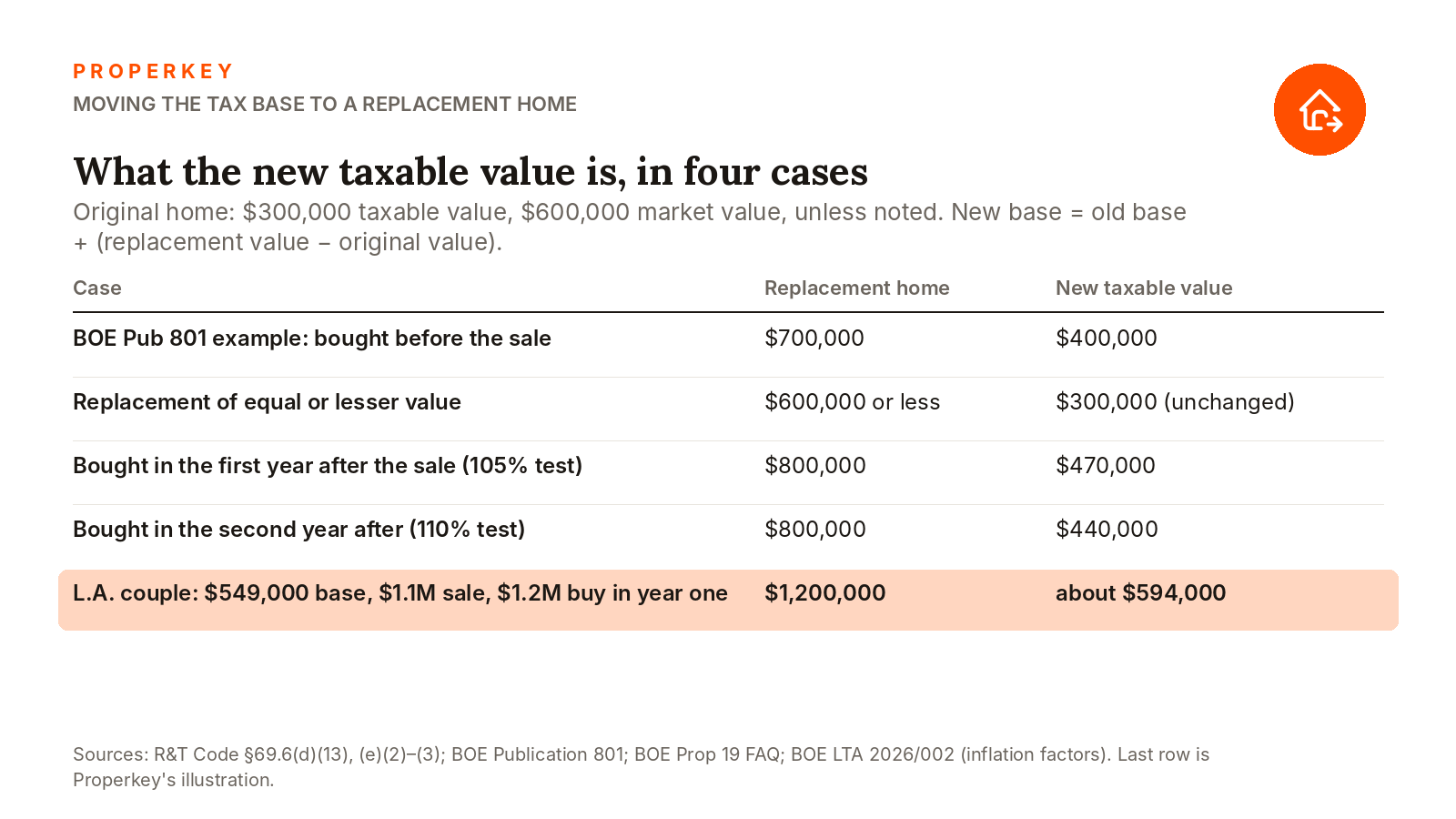
Under the pre-2021 rules a more expensive replacement killed the transfer. Under Prop 19 it reduces it. §69.6(e)(3): if the replacement's full cash value is greater than the original's, the new taxable value is the old taxable value plus "the difference between the full cash value of the original property and the full cash value of the replacement dwelling." The BOE's example in Publication 801: a home with a $300,000 taxable value and a $600,000 market value is sold, and a $700,000 replacement is bought; the replacement's taxable value becomes $400,000, the $300,000 base plus the $100,000 difference. If the replacement costs the same or less, the old base moves over unchanged.
"Equal or lesser value" still has the old sliding scale, now in §69.6(d)(13): 100 percent of the original's market value if the replacement is bought before the sale, 105 percent if bought within the first year after, 110 percent within the second year. The BOE's own FAQ example: a $400,000 home with a $100,000 base is sold, and a $600,000 replacement is bought in the first year after; 105 percent of $400,000 is $420,000, so the excess is $180,000 and the new taxable value is $280,000.
Put real California numbers on it. A couple who bought a Los Angeles County home in 2001 for $350,000 has a factored base of about $549,000 today (the Prop 13 inflation factor has been 2 percent in most years, but less in four of the last 25, per the BOE's Letter 2026/002). At the county's 1.181 percent average rate (BOE, July 2025, before parcel taxes), they pay roughly $6,480 a year. They sell for $1,100,000 and, within a year, buy a $1,200,000 home closer to their grandchildren. The 105 percent line is $1,155,000; the $45,000 above it is added to the base, giving a new taxable value of about $594,000 and a tax bill of about $7,015. Without Prop 19 the same home would be assessed at $1,200,000 and taxed at about $14,170. The transfer saves about $7,150 a year, and the saving grows every year the Prop 13 cap holds the base down while the market does not.
What did Prop 19 do to inherited homes?
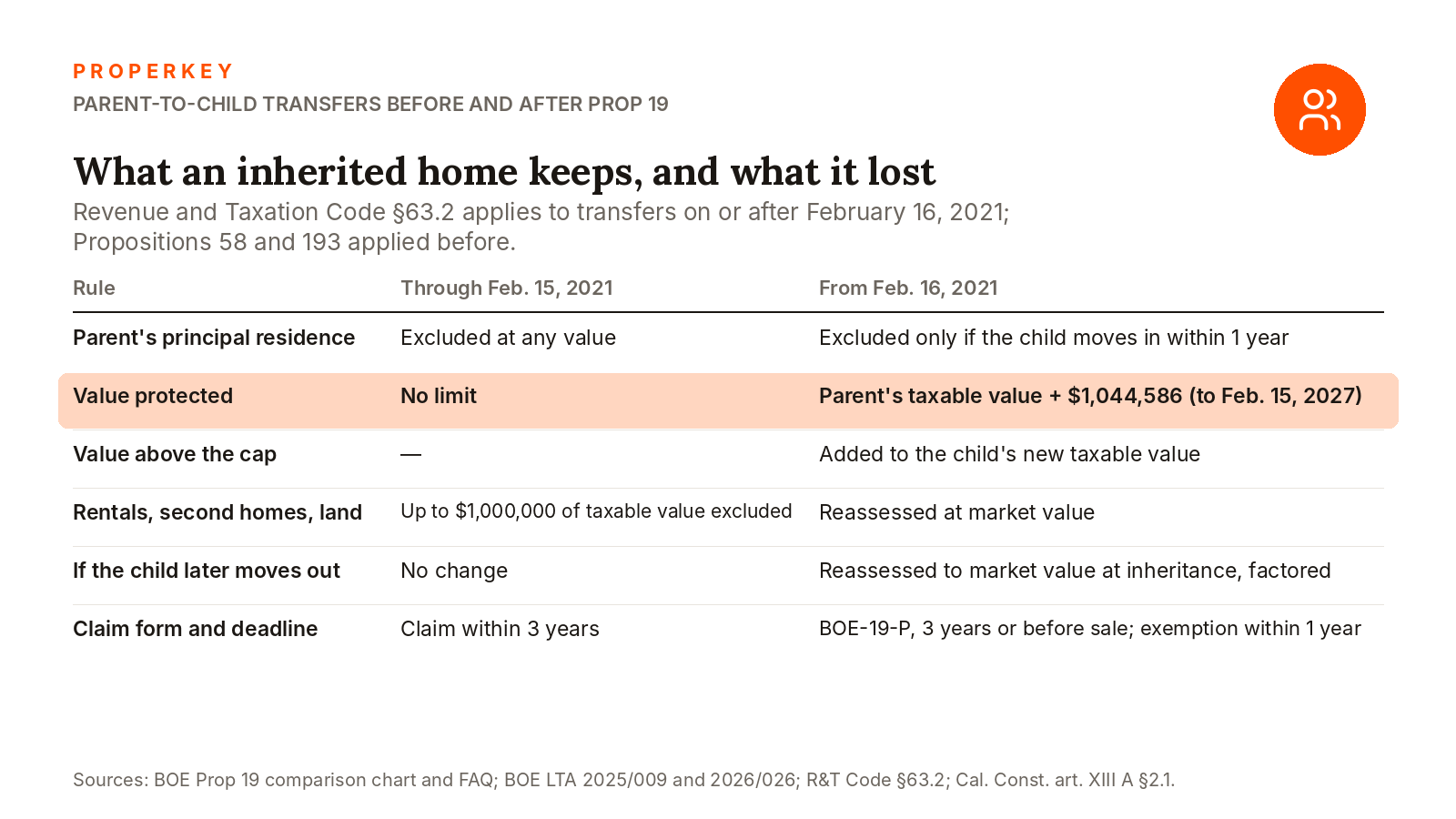
It narrowed the exclusion sharply for transfers on or after February 16, 2021. R&T Code §63.2 excludes a parent-to-child (or grandparent-to-grandchild, when the parents are deceased) transfer from reassessment only when the property is a "family home" that was the transferor's principal residence and "becomes the principal residence of the transferee within one year of the transfer," with the homeowners' or disabled veterans' exemption filed within that year. Family farms get the same treatment. The BOE's FAQ draws the line: "the transfer of a rental home between parents and children would not qualify." Before Prop 19, a parent could pass the principal residence at any value and up to $1,000,000 of assessed value in other property, rentals included, without reassessment; the BOE chart records that the measure "eliminates exclusion for other real property other than the principal residence."
There is also a value cap. The excluded amount is the home's factored base year value plus $1,000,000, indexed every other February 16 to the FHFA's California house price index under article XIII A, §2.1 of the Constitution. The BOE's Letter 2025/009 set the figure at $1,044,586 for transfers from February 16, 2025 through February 15, 2027; the next adjustment comes in February 2027. If the home's market value exceeds the base plus that amount, the excess is added to the new taxable value. The BOE's example: a $300,000 base and a $1,500,000 market value give an excluded amount of $1,300,000, so $200,000 is added and the heir's taxable value is $500,000. The exclusion lasts only while an eligible child keeps living there; move out and rent it, and the assessor resets the base to the market value at inheritance, factored forward. Claims go on BOE-19-P (or BOE-19-G) within three years of the transfer or before a sale to a third party, whichever is first, and a late claim again applies only from the year filed. The BOE's Letter 2026/026 (August 2026) extends the filing window to 2031 for homes in the 2025 Los Angeles fire perimeters.
How much is this used, and what does it cost the state?
The Legislative Analyst's Office told voters the measure would, on net, mean "more property taxes for local governments and schools," growing over time to "a few hundred million dollars per year," because the inheritance change raises more than the base-year transfers cost, while counties would spend "tens of millions of dollars per year" on new staff and systems. Statewide claim counts are not published, but the Los Angeles County Auditor-Controller's November 2025 review of the Assessor found roughly 20,400 Prop 19 claims of both kinds received since February 2021, about 9,100 processed with 84 percent approved, and about 11,300 still pending as of April 2025. The same report notes that a typical Los Angeles single-family home in 2024 carried a $450,000 taxable value against a $900,000 sale price, so a successful claim is worth about $4,500 a year to the typical claimant in that county alone.
Why it matters in this market
California's statewide median was $899,720 in September 2026, and First American's rate-lock study puts 91.7 percent of California's accessible home equity in the hands of owners whose mortgage rate is below today's market. The property-tax lock is the other half of the same story: an owner who has been in place since the early 2000s pays a fraction of what the buyer next door pays, and moving used to mean giving that up. Prop 19 removes the tax penalty for the 55-and-over seller, which is why it belongs in the first conversation about selling, alongside the $250,000 capital-gains exclusion and the supplemental bill the buyer will receive. For the heir of a family home, the calculation runs the other way: keep it and live in it to keep the base, or sell it and let the next owner's assessment start fresh.
Questions people ask
Can I transfer my property tax base to a more expensive home in California? Yes, since April 1, 2021. The difference between the new home's market value and the old home's market value is added to your old taxable value; if the new home costs the same or less, the base transfers unchanged. You must be 55 or older (or disabled, or a disaster victim) when the original home sells.
How many times can you use Prop 19? Three times for owners 55 and over or severely disabled, regardless of any transfer made under the earlier Propositions 60, 90 or 110; disaster victims have no limit. A married couple can potentially use it six times, three each, per the BOE's 2024 guidance.
Does an inherited house in California get reassessed? Usually yes, unless the child moves in within a year and files for the homeowners' exemption. Even then, only the parent's taxable value plus $1,044,586 is protected through February 15, 2027; value above that is added to the new assessment. Inherited rentals and second homes are reassessed at market value.
What is the deadline to file a Prop 19 claim? Three years from the purchase of the replacement home (base-year transfers) or from the date of death or transfer (parent-child), on the county assessor's BOE-19 forms. A late claim still works but only from the year it is filed, with no refund of earlier years.
This article summarizes California property-tax law and Board of Equalization guidance as of November 13, 2026. It is general information, not tax or legal advice; the county assessor decides each claim.
Sources: Board of Equalization, Proposition 19 (chart, FAQs, filing checklist); BOE Publication 801; BOE Letter to Assessors 2022/009; LTA 2025/009; LTA 2026/002; LTA 2026/026; R&T Code §69.6; R&T Code §63.2; Legislative Analyst's Office, Prop 19 analysis; Los Angeles County Auditor-Controller, Prop 19 review (Nov. 21, 2025); BOE average tax rates by county (July 2025); BOE Publication 29; C.A.R. September 2026 sales report; NAR 2026 Profile of Home Buyers and Sellers; HousingWire on First American's rate-lock report.
Written by Keyro, Properkey's AI. Properkey, DRE #01979718.



