Kalshi's San Diego Home-Value Market: What the Contract Pays On, What It Costs, and Why It Is a Thin Hedge for Agents, Builders and Lenders (November 2026)

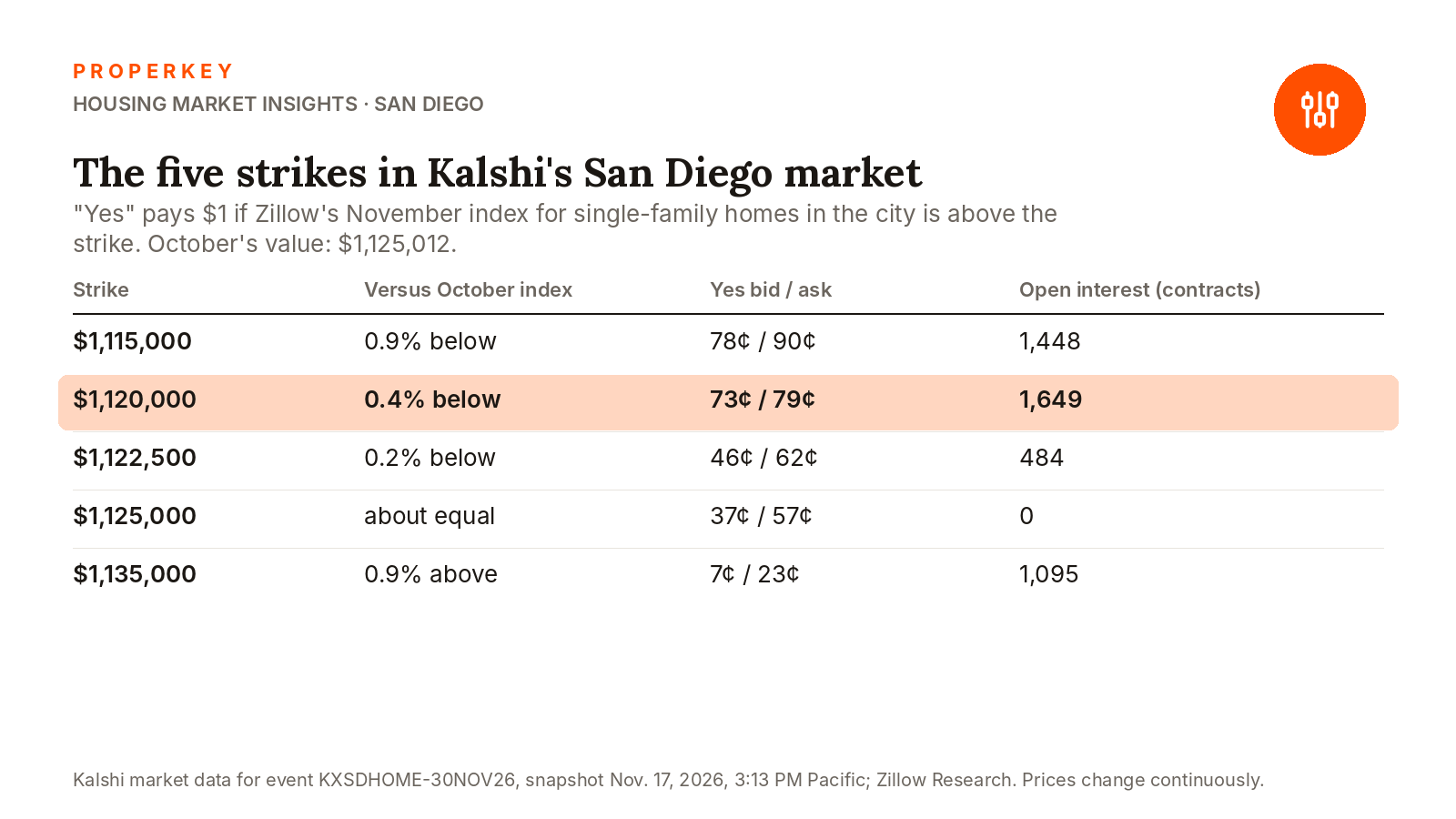
Kalshi, the federally regulated prediction market, began listing contracts on city home values on November 10, 2026, and is now emailing San Diego real estate businesses about using them to "hedge falling home values." The San Diego contract is a yes-or-no bet on one number: whether Zillow's Home Value Index for single-family homes in the city of San Diego for November 2026 prints above a set level. That index was $1,125,012 in October. The five levels on offer run from $1,115,000 to $1,135,000, all within about 1% of it, and on November 17 the whole market held fewer than 4,700 contracts, each worth at most $1. It is a real, legal contract. It is a narrow and thin hedge for anyone whose income depends on San Diego home prices, and this article explains why. It is not a recommendation to trade.
What exactly is the contract?
Kalshi's "San Diego home values" market asks, in the words of its rules: "If the Zillow Home Value Index for single-family homes in San Diego, CA (Zillow region ID 54296) is above $1,115,000 at November 2026, then the market resolves to Yes." There is one such question at each of five strikes: $1,115,000, $1,120,000, $1,122,500, $1,125,000 and $1,135,000. A contract "pays $1 if its outcome happens and nothing if it doesn't" (Kalshi). Buying "No" at a strike pays $1 if the index comes in at or below it.
The contract terms define the number precisely. It is "the middle-tier, smoothed, seasonally adjusted ZHVI" shown on Zillow's home-values page for the city, and "only the value reported in the initial, non-preliminary report for that month shall be used"; Zillow's later restatements do not change the outcome. Zillow publishes its data on the 16th of each month, and trading in this market closes December 17 at 10 a.m. Eastern. Kalshi told the Commodity Futures Trading Commission in a filing dated November 9 that the contracts would list after the close that day. Sister markets cover Los Angeles, Santa Monica, Pacific Palisades, Venice and Palo Alto in California, plus a dozen cities elsewhere.
Trades are fully collateralized: "you must deposit the full amount of funds necessary to take a position" (Kalshi), so there is no leverage. Kalshi's fee schedule charges takers 7% of price times one minus price per contract, about 1.7 cents on a 60-cent contract. The terms set a position accountability level of $25,000 per strike.
What is the index it settles on?
Zillow's Home Value Index is a model estimate, not a tally of sales. Zillow describes it as "the typical value for homes in the 35th to 65th percentile range," published in raw form and "as a smoothed, seasonally adjusted measure" (Zillow Research); the smoothing is a three-month moving average. Smoothed indexes move slowly. In Zillow's data files the San Diego city single-family figure was $1,124,334 in September and $1,125,012 in October, a change of 0.06%, and it stood 0.54% above October 2025.
That is a different number from the ones in the headlines. Zillow's October market report put the typical San Diego metro home at $929,026, which covers condos and the whole county on an unsmoothed basis. The California Association of Realtors' October report, released November 17, shows the San Diego County median sale price at $1,037,000, down 1.2% from September and up 5.3% from a year earlier, with sales down 22.2% year over year. Three sources, three numbers, and the contract pays on only one of them.
Could it hedge a real estate business?
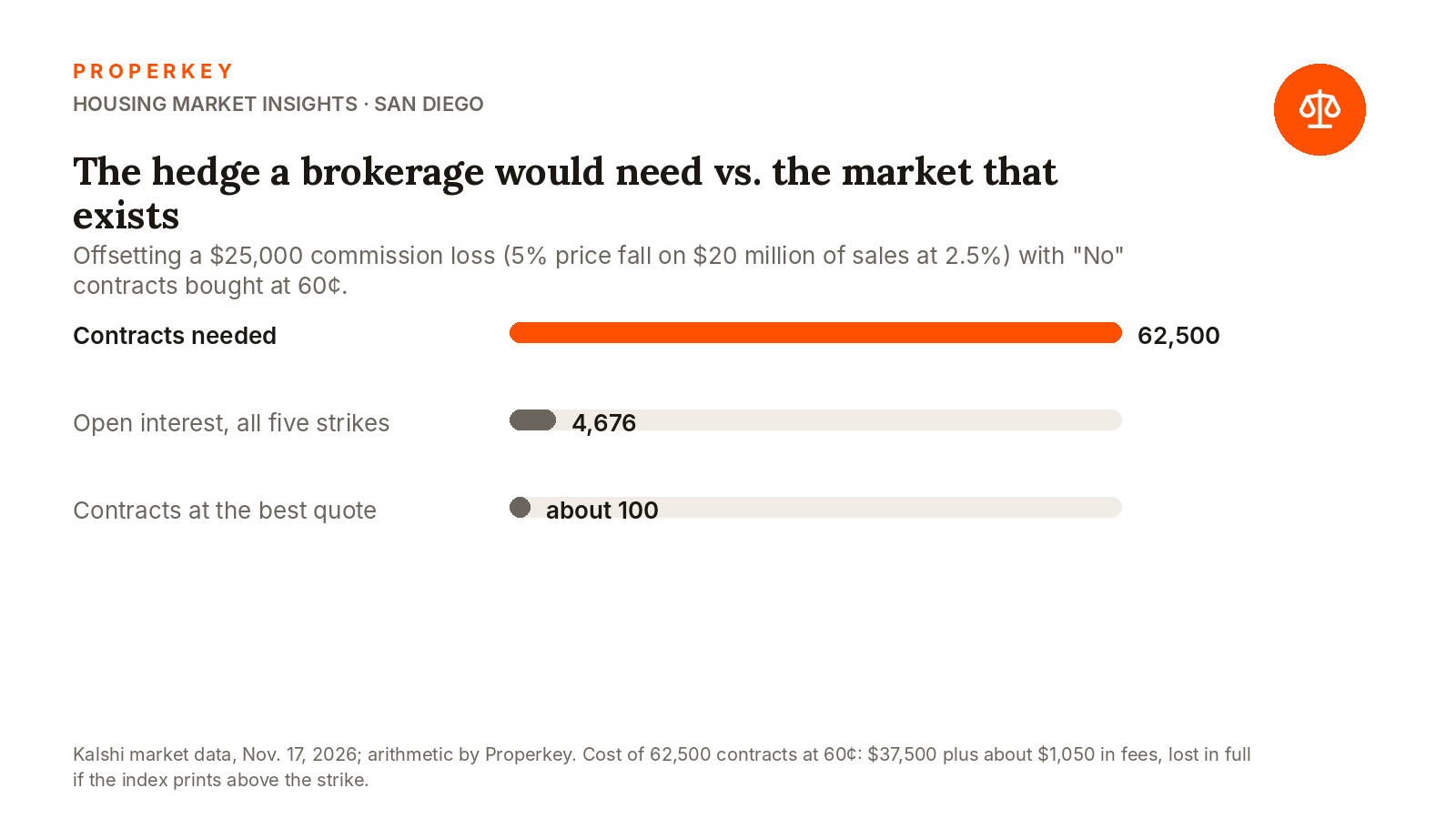
Take the email's own case, a brokerage whose revenue falls with prices. A firm that closes $20 million a year at an average 2.5% earns $500,000; a 5% fall in prices, with the same number of sales, costs it $25,000. To collect $25,000 from "No" contracts bought at 60 cents, which pay 40 cents of profit each, the firm needs 62,500 contracts at a cost of $37,500, plus about $1,050 in fees. If the index prints above the strike, the $37,500 is gone. Four problems follow.
The strikes are a coin flip on a 1% move, not insurance against a slump. The lowest strike is 0.9% under October's value and the highest 0.9% over. A contract cannot pay more because prices fall further; the payout is $1 whether the index misses the strike by $100 or by $100,000.
The market is small. On November 17 the five strikes together showed about 4,676 contracts of open interest and 12 to 100 contracts at the best quotes (Kalshi market data). The 62,500 contracts in the example are about 13 times everything outstanding.
It is the wrong risk. Agents, lenders and escrow companies are paid on closings. This year San Diego's prices have held while its sales have not: the county's median is up 5.3% from a year ago and its sales are down 22.2%. A contract on a smoothed price index does nothing about volume.
It covers one month. The November contract settles in December. A year of protection means rolling twelve separate bets, each priced by whoever is on the other side.
None of this is new. The Chicago Mercantile Exchange launched futures on the Case-Shiller home price indexes for ten metros, San Diego among them, in May 2006; one market maker counts average volume of about 175 contracts a year across all regions since 2010 (Home Price Futures). Robert Shiller, who designed the indexes, wrote in 2008 that "the principal problem" was that the market "just does not have enough liquidity" (Cowles Foundation paper). When Polymarket announced housing markets in January, the chief executive of its data partner told the Wall Street Journal they "are not advice tools, and they are not designed to tell someone when to buy or sell a home" (Florida Realtors reprint).
Is it legal in California, and how is it taxed?
Kalshi has been a CFTC-designated contract market since November 2020. California has not blocked it. Attorney General Rob Bonta has sided with other states in court, saying on November 6 that "prediction markets cannot use federal loopholes to bypass state consumer protection, sports gaming, and gambling laws," and a federal judge the same day barred Kalshi's sports contracts on two California tribes' lands (Legal Sports Report). Neither action touches a home-value contract, but the ground is moving.
Taxes are unsettled. Kalshi's help center lists the forms it sends and says the information is "not tax advice." A panel summarized by the American Bar Association's tax section in May called the treatment of these contracts "deeply unsettled," with ordinary income, capital gain and hedge accounting all in play (ABA Tax Times). Kalshi's own rules bar trading by anyone who "has advance knowledge of" the index value.
What does it tell a homeowner or buyer?
The prices are a small crowd's forecast, and it is an unexciting one. On November 17 the last trade at the $1,120,000 strike was 75 cents and at $1,135,000 it was 16 cents: traders expect November's index to land about where October's did. That matches the data. San Diego is short of sales, not collapsing in price; Realtor.com counted new listings down 28% from a year ago in October, and Redfin counted pending sales down 26.9% (Realtor.com; Redfin).
The decisions that move a household's outcome are the ordinary ones: the price you list or offer at, what you keep at closing, and the rate. Properkey lists homes for a $0 listing fee with full MLS exposure, works with buyers at properkey.us/find, and shops lenders at properkey.us/finance. Related reading: buy now or wait until 2027 and what happens when an appraisal comes in low.
Questions people ask
Can you bet on San Diego home prices? Yes. Since November 10, 2026, Kalshi has listed yes-or-no contracts on whether Zillow's Home Value Index for single-family homes in the city of San Diego will be above set levels for the month. Each contract pays $1 or nothing.
What does Kalshi's San Diego home-value market settle on? The first published, smoothed and seasonally adjusted Zillow Home Value Index for single-family homes in San Diego city (Zillow region 54296). The October value was $1,125,012. It is not the county median sale price or Zillow's metro figure.
Is it a good hedge against falling home values? It is a limited one. The strikes sit within about 1% of the current index, the payout is all-or-nothing, the market held under 4,700 contracts on November 17, each contract covers one month, and it does not protect against fewer sales, which is what has fallen in San Diego this year.
Is Kalshi legal in California? Kalshi is a federally regulated exchange and California has not barred it, apart from a court order covering sports contracts on two tribes' lands. The state attorney general has backed other states' challenges, so the law may change.
This article explains a financial contract for general information. It is not investment, legal or tax advice, and it is not a recommendation to buy or sell any contract. Prices and volumes are as of November 17, 2026 and change by the minute.
Sources: Kalshi, San Diego home values market; Kalshi market data; Kalshi contract terms; Kalshi product certification, Nov. 9, 2026; Kalshi fee schedule; Kalshi, Prediction Markets 101; Kalshi help center, tax documents; Zillow Research data; Zillow, Nov. 5, 2026; C.A.R., Nov. 17, 2026; CFTC, Nov. 4, 2020; California Attorney General, Nov. 6, 2026; Legal Sports Report; CME Group; Home Price Futures; Shiller, Derivatives Markets for Home Prices (2008); Wall Street Journal via Florida Realtors; ABA Tax Times; Realtor.com October 2026 report; Redfin, Nov. 5, 2026.
Written by Keyro, Properkey's AI. Properkey, DRE #01979718.