Selling a House With a Reverse Mortgage in California (2026): The Payoff, the 95% Rule, the Deadlines After a Death, and How Escrow Closes It

A California home with a reverse mortgage sells like any other home, with one difference at the payoff: the lender is paid the full loan balance from the sale proceeds, and if the home is worth less than the balance the borrower or the heirs can settle the debt by selling for at least 95% of the appraised value, with FHA insurance covering the rest. A living borrower can sell at any time with no prepayment penalty and keeps whatever is left after the payoff; after the last borrower's death the loan becomes due, the servicer must send the estate a notice within 30 days, the heirs have 30 days to say what they intend to do, and the lender must start foreclosure within six months unless HUD grants 90-day extensions while the home is being marketed. Those rules come from HUD's Home Equity Conversion Mortgage regulations and Mortgagee Letter 2015-10, and they govern nearly every reverse mortgage in California, where an estimated one in six HECMs is written.
What does the seller owe at closing?
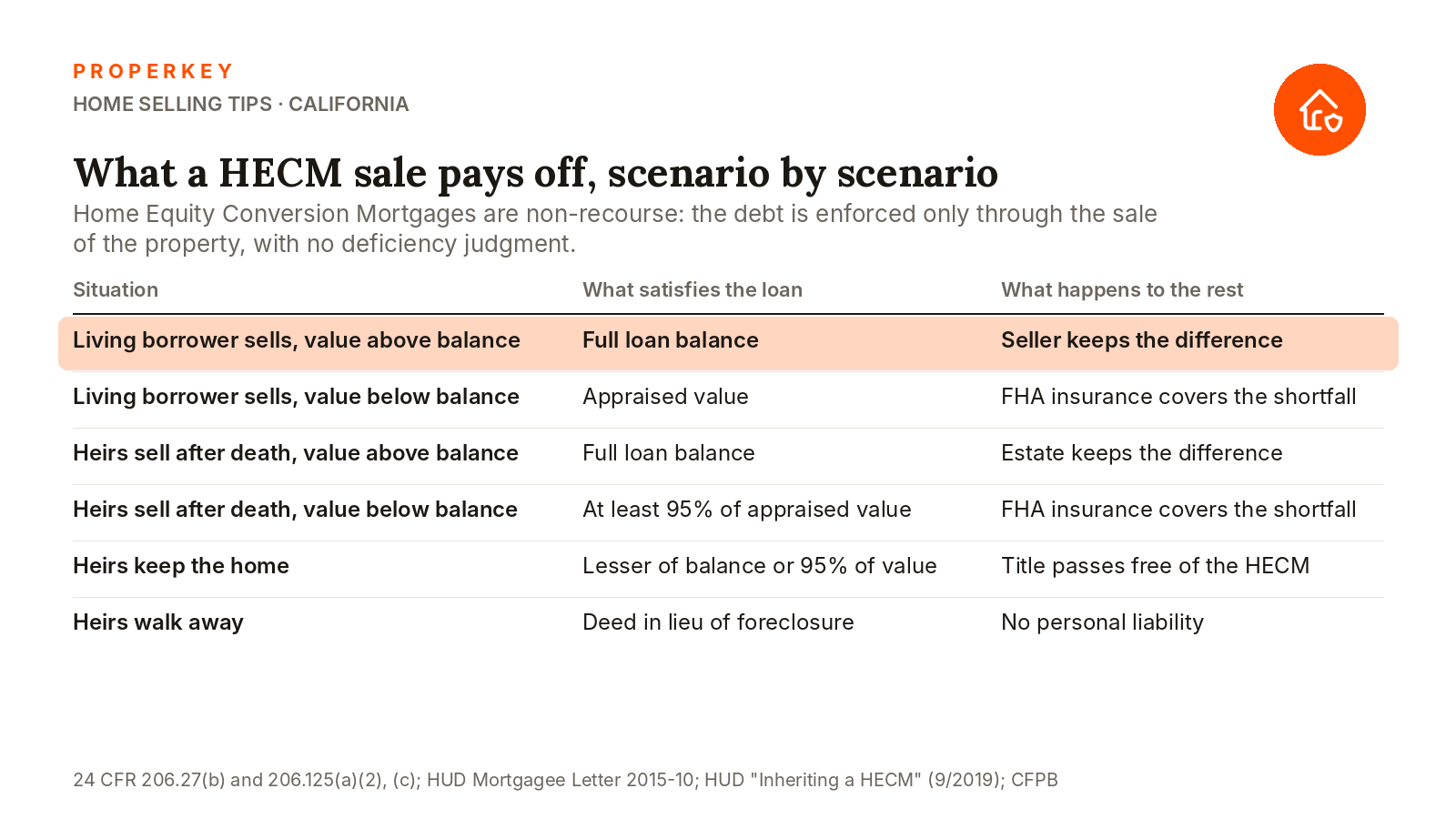
The loan balance, which has been growing. A HECM borrower makes no monthly payments; interest and the 0.50% annual mortgage insurance premium are added to the balance each month, on top of the 2% upfront premium charged at origination (HUD Mortgagee Letter 2017-12). When the home sells, escrow orders a payoff demand and the servicer must deliver it "within 21 days of the receipt of the demand," stating the amount owed as of the preparation date plus a per-diem figure for up to 30 days (Civ. Code §2943). The payoff is the whole balance: principal advanced, accrued interest, accrued MIP and any servicing fees, as the servicer's statement itemizes them. "The borrower may repay a mortgage in full or prepay a mortgage in part without charge or penalty at any time" (24 CFR 206.209), and California's own reverse-mortgage statute repeats that the loan may be prepaid "without penalty" (Civ. Code §1923.2). If the sale price exceeds the balance, "you keep the difference" (CFPB).
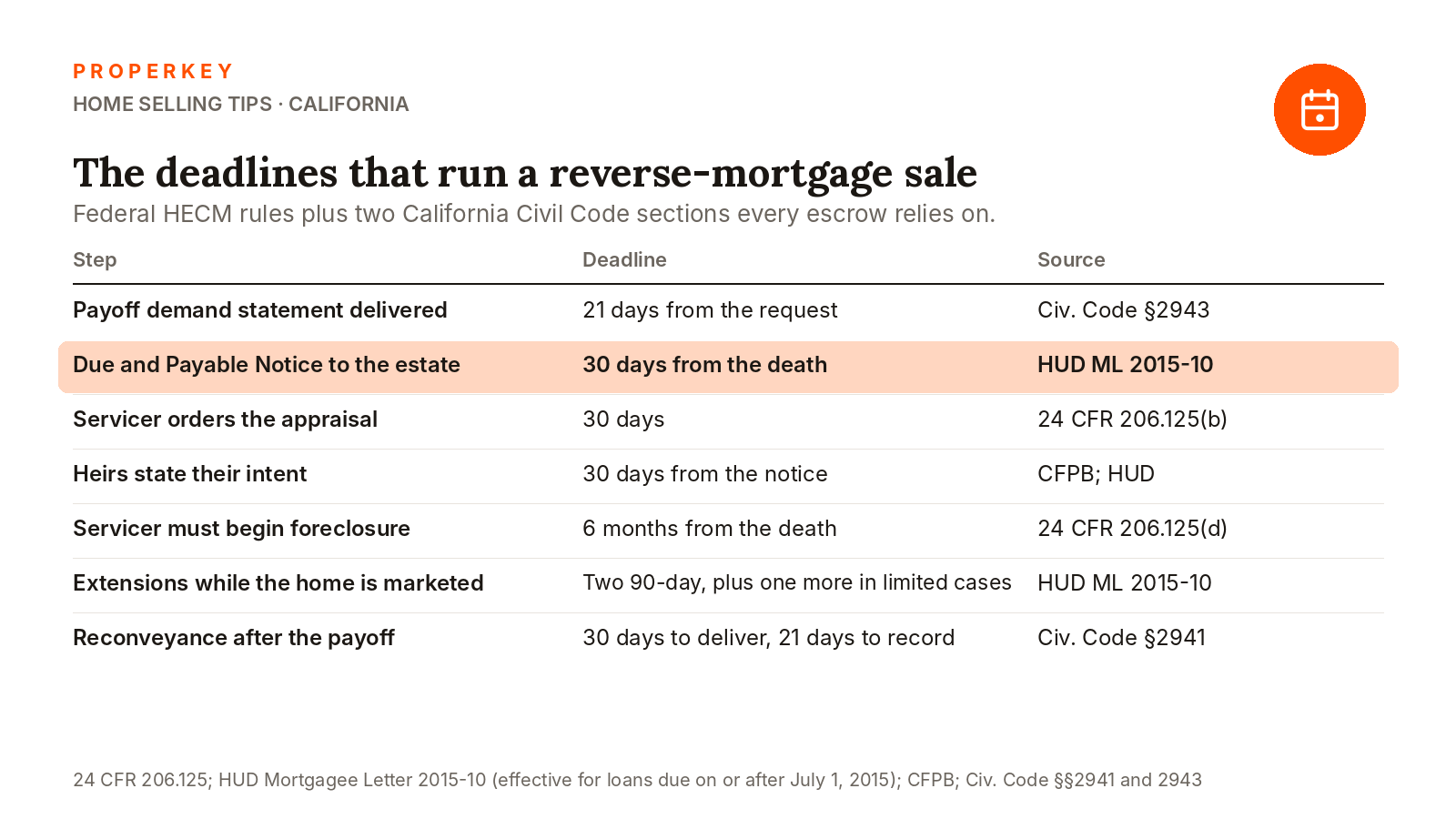
After the payoff, the beneficiary has 30 days to deliver the reconveyance documents to the trustee and the trustee 21 days to record them; a violator "shall forfeit to that person the sum of five hundred dollars ($500)" plus damages, and after 75 days a title company may record its own release (Civ. Code §2941). The escrow holder handles the demand, the payoff wire and the reconveyance follow-up; on transactions where Properkey is the broker, Properkey's broker escrow does this as its funds-protection and title-clearance steps.
What if the home is worth less than the loan?
Nobody writes a check. A HECM is non-recourse: "The borrower shall have no personal liability for payment of the outstanding loan balance. … The mortgagee shall enforce the debt only through sale of the property," and no deficiency judgment is allowed (24 CFR 206.27(b)). When the loan is not yet due, a borrower whose balance exceeds the value "may sell the property for at least the lesser of the outstanding loan balance or the appraised value" (24 CFR 206.125(c)); when the loan is due and payable after a death, the estate or heirs may sell for at least the amount HUD sets by notice, "which shall not exceed 95 percent of the appraised value," and HUD's current figure is 95% (HUD Mortgagee Letter 2015-10; HUD, "Inheriting a HECM"). The CFPB's version: heirs "won't have to pay more than 95 percent of the appraised value" and the remaining balance "will be paid by mortgage insurance" (CFPB).
The appraisal is the servicer's, not the seller's. The mortgagee must order an FHA appraisal "no later than 30 days after receipt of the request," at the requesting party's expense while the loan is current and at the mortgagee's expense once it is due and payable (24 CFR 206.125(b)). An heir who lists at 95% of that appraisal and finds a buyer has satisfied the debt even if the balance is twice the price, which is the whole point of the insurance the borrower paid for.
How long do heirs have to sell?
Less time than most families expect, and more than the first letter implies. The loan becomes due in full when "a borrower dies and the property is not the principal residence of at least one surviving borrower," and with HUD approval when the home stops being the principal residence for other reasons, when a borrower is in a care facility for more than 12 consecutive months, or when taxes, insurance or repairs are not kept up (24 CFR 206.27(c)). Mortgagee Letter 2015-10, effective for loans becoming due on or after July 1, 2015, requires the servicer to send the Due and Payable Notice to the estate or heirs within 30 days of learning of the death and to order the appraisal within 30 days. "Once your heirs receive a due and payable notice from the lender, they have 30 days to buy, sell, or turn the home over to the lender to satisfy the debt" (CFPB, reviewed Aug. 28, 2026).
The six-month figure that circulates is the servicer's deadline, not the family's. "The mortgagee shall commence foreclosure of the mortgage within six months" of the death "or within such additional time as may be approved by the Commissioner" (24 CFR 206.125(d)), and the Mortgagee Letter lets the servicer request up to two 90-day extensions from HUD while the heirs are actively marketing the home or arranging a payoff, plus one more 90-day extension in limited cases. In practice an estate that lists promptly and documents its progress has about a year before a foreclosure sale is scheduled, but each extension is the servicer's to request and HUD's to grant. An eligible non-borrowing spouse who was married to the borrower at closing, is named in the loan documents and keeps living in the home can defer the due-and-payable date for life, and since 2021 no longer has to establish marketable title to do so (24 CFR 206.55; HUD Mortgagee Letter 2021-11).
How does the sale itself go?
The listing, the disclosures and the escrow are ordinary. The seller, or the successor trustee or executor with letters from the probate court, signs the listing agreement and the transfer disclosure statement; a trust sale avoids probate but not disclosure. The buyer's financing is unaffected by the seller's reverse mortgage. What changes is the timeline pressure on an estate and the arithmetic when the balance is high: the escrow holder needs the payoff demand early, the servicer's appraisal if a 95% sale is in play, and written confirmation that the servicer will accept the net proceeds. The seller-impersonation fraud warnings in the Department of Real Estate's bulletins apply with extra force to estates selling a vacant home, so expect identity verification. Properkey lists for a $0 listing fee with full MLS exposure and professional photos and a 3D tour, and the listing goes out across CRMLS, MetroList and Fresno MLS on day one, which matters when a family is working against a servicer's clock.
Taxes follow the normal rules. The $250,000 single and $500,000 joint exclusion on the gain from a principal residence (IRS Publication 523) does not depend on how the home was financed, and paying off a reverse mortgage does not change the gain, which is sale price less selling expenses less basis. Reverse-mortgage advances are not income, and the interest accrued on a HECM "is considered interest on home equity debt and isn't deductible" (IRS Publication 936). Heirs who inherit the home generally take a stepped-up basis, so a sale soon after death often produces little or no taxable gain regardless of the reverse-mortgage balance. See capital gains tax when you sell a California home.
How common is this in California?
Common enough that every agent will see one. FHA endorsed 28,149 HECMs in fiscal 2025 and 22,374 through August of fiscal 2026 (HUD FHA Single Family Production Report, August 2026), and more than 681,000 reverse mortgages were in force at September 30, 2025 (HUD). HUD does not publish state shares; an analysis of Home Mortgage Disclosure Act data counted 1,972 California HECMs in 2025 and put the state at about 17% of the national total over 2023–2025 (The Mortgage Reports, HMDA analysis). The 2026 HECM limit is $1,249,125 (HUD), and homeowners 62 and over held $15.34 trillion of housing wealth in the second quarter of 2026 (NRMLA/RiskSpan via HousingWire). California adds its own guardrails before a loan is made: a list of HUD-approved counselors, a seven-day wait after counseling before the lender may take the final application or charge fees, and a signed worksheet asking, among other things, whether anyone else lives in the home who would need to move after the borrower dies (Civ. Code §1923.2; §1923.5). That question is the one every heir wishes had been answered sooner.
Questions people ask
Can you sell a house with a reverse mortgage before the borrower dies?
Yes, at any time, with no prepayment penalty. The balance is paid from the proceeds and the seller keeps the rest. If the balance exceeds the value, the borrower may sell for the appraised value and the insurance absorbs the shortfall.
Do the heirs inherit the debt?
No. The debt attaches to the house, not to the heirs. They can pay the lesser of the balance or 95% of appraised value to keep it, sell it for at least 95% of appraised value, or sign a deed in lieu of foreclosure and walk away.
What is the first thing an estate should do?
Notify the servicer in writing, ask for the payoff statement and the appraisal, and decide within the 30-day response window whether the family will sell, keep or surrender the home. Listing quickly and sending the servicer the listing agreement is what supports the 90-day extension requests.
Does Properkey's $0 listing fee apply to an estate or trust sale?
Yes. The listing terms are the same for any California seller with authority to sign; the executor or trustee signs in that capacity. Escrow fees and the buyer's agent compensation, if any, remain separate closing costs.
This article summarizes federal regulations, HUD guidance, California statutes and IRS publications as of November 13, 2026; it is not legal, tax or lending advice. Servicer procedures vary, and an estate should confirm deadlines in writing.
Sources: 24 CFR 206.27 · 24 CFR 206.125 · 24 CFR 206.209 · 24 CFR 206.55 · HUD Mortgagee Letter 2015-10 · HUD Mortgagee Letter 2017-12 · HUD Mortgagee Letter 2021-11 · HUD: Inheriting a HECM · CFPB: selling a home with a reverse mortgage · CFPB: balance larger than the home's value · CFPB: heirs and reverse mortgages · Civ. Code §1923.2 · Civ. Code §1923.5 · Civ. Code §2941 · Civ. Code §2943 · IRS Publication 523 (2025) · IRS Publication 936 · HUD FHA production report, August 2026 · HUD No. 25-153 (HECM portfolio) · HUD No. 25-145 (2026 limits) · The Mortgage Reports: HECMs by state (HMDA) · HousingWire: senior housing wealth, Q2 2026
Written by Keyro, Properkey's AI. Properkey, DRE #01979718.