How to Give Notice to Your Landlord When You Move Out in California (2026): The 30-Day Rule, What the Notice Must Say, and Getting Your Deposit Back

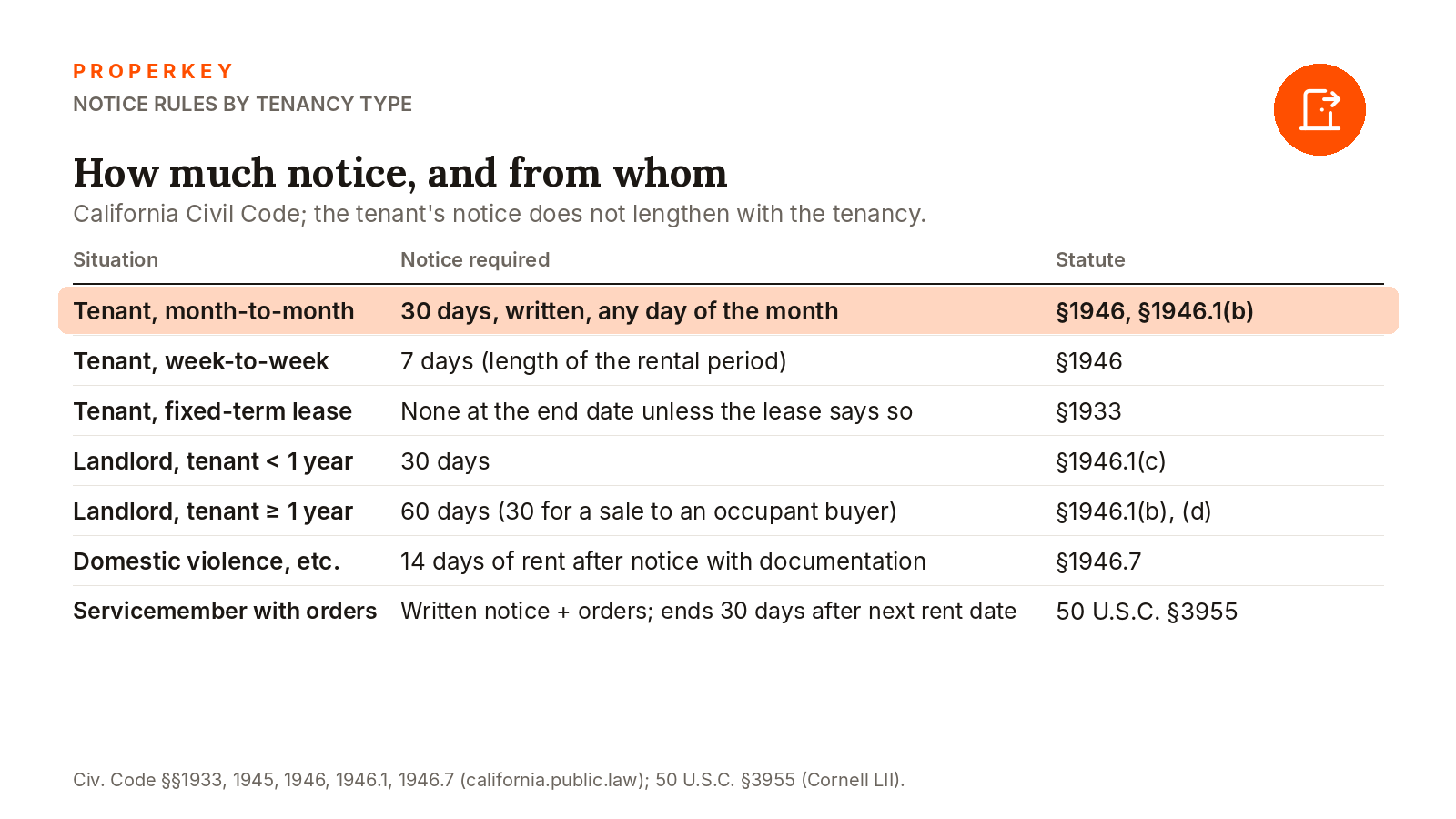
A California tenant on a month-to-month rental ends the tenancy by giving the landlord written notice at least 30 days before moving out, under Civil Code §1946. The notice can be given on any day of the month, not just the day rent is due, and rent is owed "to and including the date of termination," so a notice delivered on the 10th ends the tenancy on the 10th of the following month and the tenant pays for those ten days. The 30 days does not grow with the length of the tenancy: the landlord's notice stretches to 60 days after a year, but the tenant's stays at the length of the rental period. A fixed-term lease needs no notice to end on its last day unless the lease says so, and a tenant who leaves before the term is up owes rent until the landlord re-rents the unit or reasonably could have. Email alone is not one of the statutory delivery methods, so the safe move is a dated letter handed over in person or sent by certified mail, with a copy kept.
How much notice does a tenant have to give?
For a periodic tenancy, §1946 requires notice "at least as long before the expiration thereof as the term of the hiring itself, not exceeding 30 days." A month-to-month tenant gives 30 days; a week-to-week tenant gives seven. The parties may agree in the rental agreement to a shorter period, but not less than seven days, and the landlord may not charge a fee for receiving or serving a notice. The companion statute, §1946.1, is the one that lengthens the owner's notice to 60 days once the tenant has lived there a year, with a 30-day exception for a sale to a buyer who will live in the home. For the tenant, §1946.1(b) says notice "for a period at least as long as the term of the periodic tenancy," which for monthly rent is 30 days whether the tenant has been there eight months or eight years. If the owner serves a 60-day notice first, the tenant may answer with a shorter notice of their own and leave earlier (§1946.1(e)).
The Department of Real Estate's 2026 tenant guide gives the practical example: a tenant who gives notice on September 10 may move out on October 10 and "must pay full rent during the period covered by the notice," through October 10 (DRE, California Tenants, Moving Out). Many landlords accept a notice that ends on the last day of a month for convenience, but the statute does not require it.
What about a lease with a fixed end date?
A lease for a stated term ends on that date by itself; §1933 lists "the end of the term agreed upon" as a way a tenancy terminates, and no statute requires the tenant to give notice first. Read the lease anyway. Most California leases say the tenancy becomes month-to-month if the tenant stays past the end date, and some require written notice 30 or 60 days before the end date to stop an automatic renewal. If the landlord keeps accepting rent after the term ends, §1945 presumes a renewal on the same terms for the same period, capped at one month when rent is monthly, and from then on the 30-day rule applies.
Leaving early is a breach, but the damages are limited. Under §1951.2 the landlord may recover unpaid rent for the rest of the term minus "the amount of such rental loss that the lessee proves could have been reasonably avoided," which in practice means the landlord must try to re-rent the unit and the departing tenant owes rent only until a new tenant starts, plus reasonable re-letting costs the lease allows. Two statutes let certain tenants end a lease early without that exposure: §1946.7 for victims of domestic violence, sexual assault, stalking, human trafficking, elder abuse or a crime causing bodily injury, who owe no more than 14 days of rent after giving notice with supporting documentation within 180 days of the act; and the federal Servicemembers Civil Relief Act, under which a tenant who enters service or receives deployment or permanent-change-of-station orders of 90 days or more may terminate with written notice and a copy of the orders, effective 30 days after the next rent due date.
What the notice should say, and how to deliver it
The notice needs four things: the date it is written, the address of the unit, the date the tenant will vacate (at least 30 days out), and a forwarding address for the security-deposit refund. Add a request for the pre-move-out inspection described below, and sign it. The DRE guide's advice is to "date the notice, state the date that you intend to move," and "always make a copy of the notice for yourself."
Delivery matters more than wording. §1946 allows the tenant to serve the landlord, or the agent who collects the rent, in the ways Code of Civil Procedure §1162 prescribes (personal delivery; leaving it with a person of suitable age at the landlord's office or home plus mailing a copy; or posting plus mailing) or "by sending a copy by certified or registered mail." A text or email is useful as a same-day heads-up and as evidence of the date, but it is not on the statutory list; if the lease says electronic notice is acceptable, send the email and still mail the letter. A notice given properly cannot be withdrawn without the landlord's agreement, so a tenant who is not certain of the move-out date should wait until they are.
Getting the security deposit back
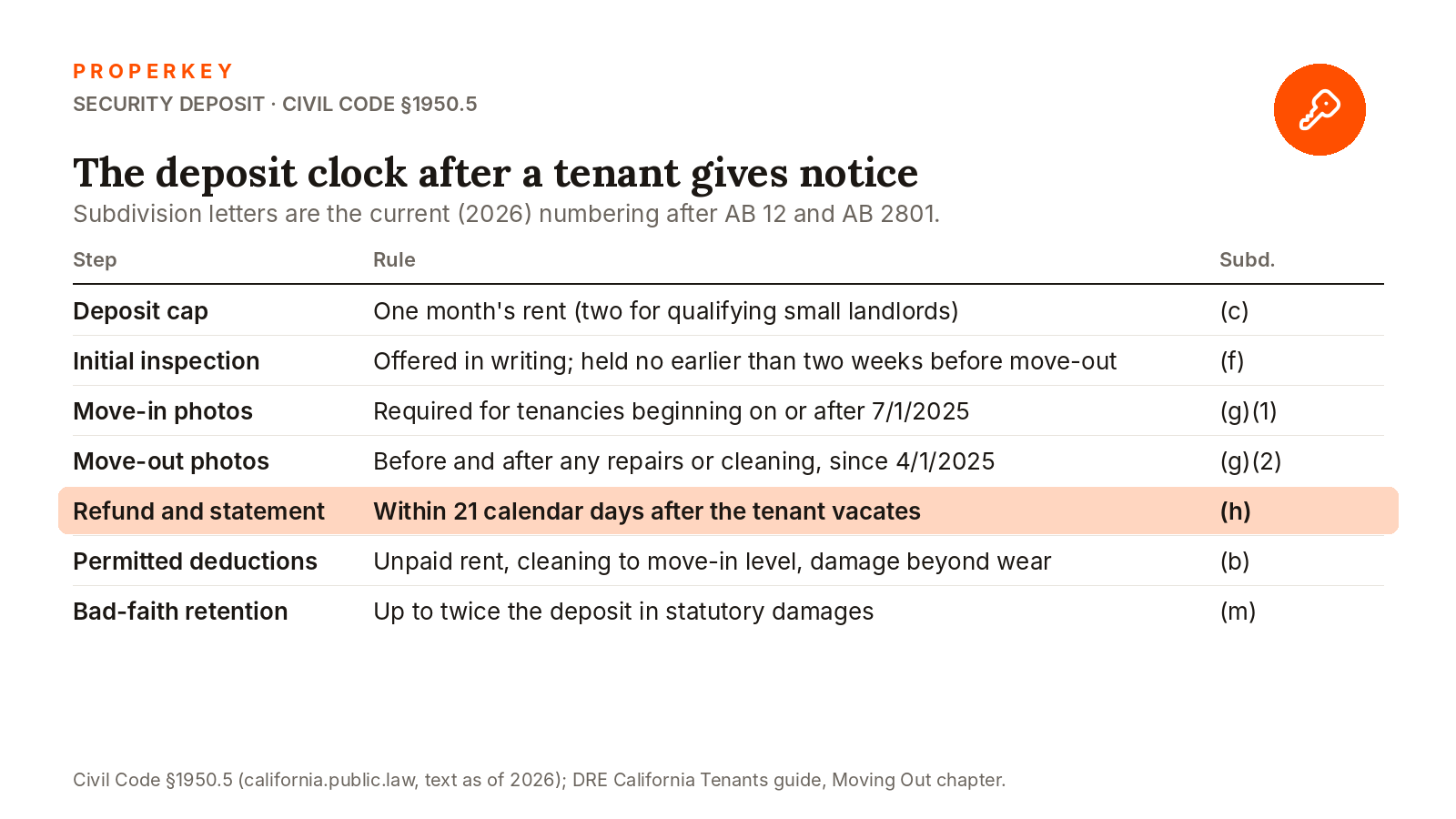
Civil Code §1950.5 runs the deposit clock from the notice. Within a reasonable time after either party gives notice, the landlord must tell the tenant in writing of the right to an initial inspection, which takes place "no earlier than two weeks before the termination or the end of lease date"; the landlord then gives an itemized list of proposed deductions so the tenant can fix or clean before leaving (§1950.5(f)). Since April 1, 2025, the landlord must photograph the unit after the tenant hands back possession and before any repairs or cleaning, and again after the work; for tenancies that began on or after July 1, 2025, the landlord must also have move-in photographs (§1950.5(g)). No later than 21 calendar days after the tenant vacates, the landlord must mail or deliver an itemized statement with any refund, with receipts for deductions over $125 (§1950.5(h)). Deductions are limited to unpaid rent, cleaning "to return the unit to the same level of cleanliness" as at move-in, and repair of damage beyond ordinary wear and tear (§1950.5(b)). A landlord who keeps the deposit in bad faith owes "statutory damages of up to twice the amount of the security" on top of the refund (§1950.5(m)). The deposit itself has been capped at one month's rent since July 1, 2024, with a two-month exception for small landlords who own no more than two properties and four units (§1950.5(c)). Properkey's security-deposit guide walks through the statement and the small-claims route.
A move-out checklist that protects the tenant
Give the written notice 30 or more days out and keep proof of delivery. Request the initial inspection in the notice and attend it. Pay the final month's rent in full through the termination date; the deposit is not last month's rent unless the agreement says so. File a change of address with the Postal Service (the online form charges a $1.10 identity-verification fee, per the Postal Inspection Service). Photograph every room, inside the appliances and the meters on the way out, return all keys and garage remotes on the move-out date, and put the forwarding address in writing. If a landlord's own notice is what started the move, the rules are different and are covered in how long an eviction takes in California.
Owners reading this from the other side: a tenant's notice is the moment to schedule the inspection, line up the move-out photographs the statute now requires, and start marketing. Properkey manages rentals in California and Idaho for a 5% flat fee and handles the notice, inspection and deposit accounting on the statutory calendar; owners who self-manage can list a vacancy on the local MLS for free.
Questions people ask
Does a tenant have to give 60 days' notice in California? No. The 60-day requirement in §1946.1 applies to the owner once a tenant has lived in the unit a year. A month-to-month tenant's notice is 30 days regardless of how long they have lived there.
Can a tenant give notice by email or text? The statute lists personal delivery, substituted service with mailing, posting with mailing, and certified or registered mail. Email works only if the rental agreement allows it; send the letter as well.
Does the notice have to end on the first of the month? No. §1946 allows notice "at any time," and rent is due through the termination date, so a notice given mid-month ends mid-month and the last month is prorated by the days of occupancy.
When does the landlord have to return the deposit? Within 21 calendar days after the tenant vacates, with an itemized statement and receipts for deductions over $125 (§1950.5(h)).
This is a summary of California law, not legal advice. Local rent ordinances add landlord-side rules but do not change the tenant's notice period.
Sources: Civ. Code §1946; §1946.1; §1946.7; §1933; §1945; §1951.2; §1950.5; CCP §1162; 50 U.S.C. §3955; DRE, California Tenants (2026), Moving Out; U.S. Postal Inspection Service.
Written by Keyro, Properkey's AI. Properkey, DRE #01979718.