A House-Passed Bill Would Nearly Triple the VA Refinance Fee: What H.R. 9237 Means for California Veterans (November 2026)

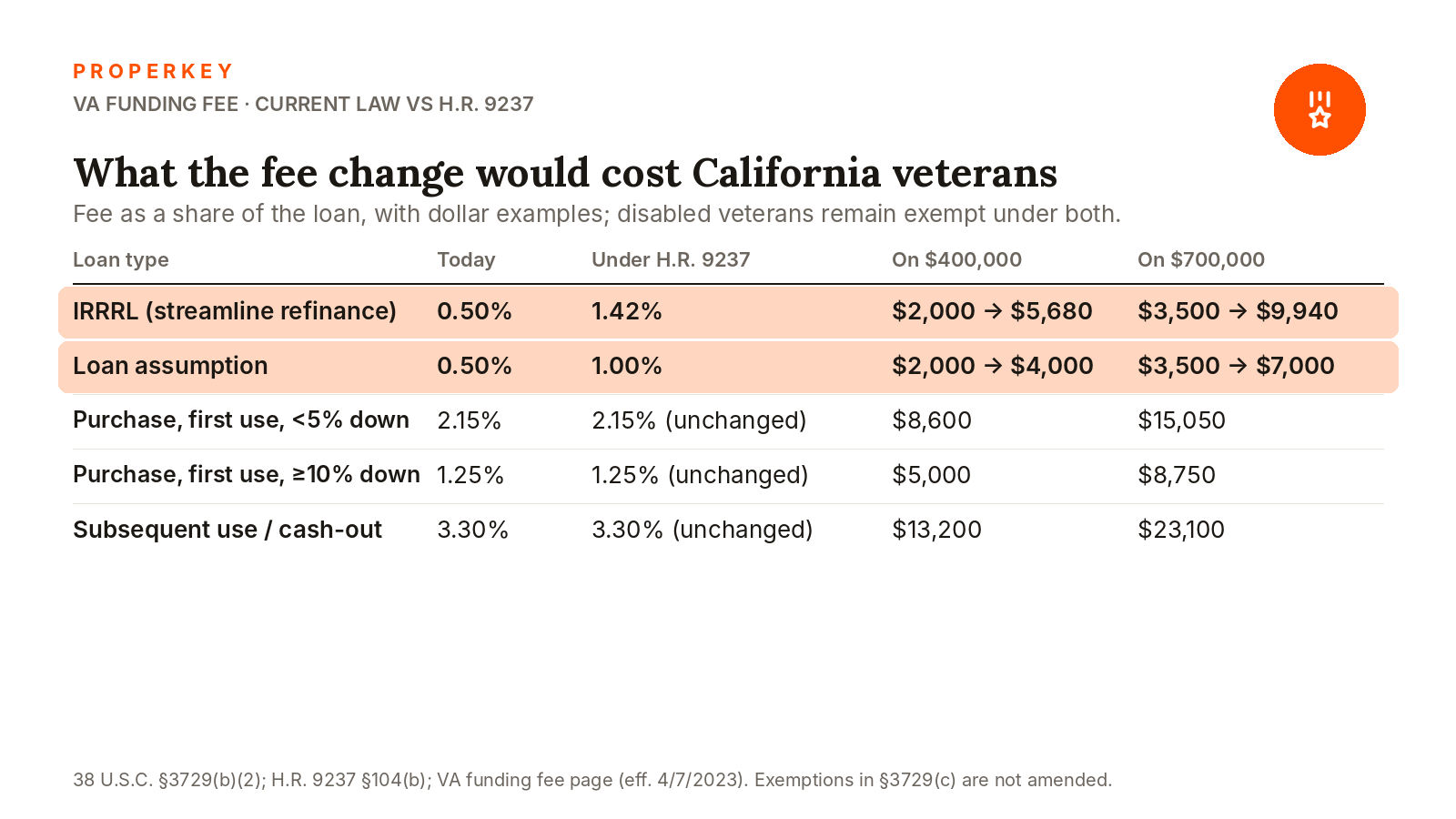
The House of Representatives passed H.R. 9237, the Take Care of America's Veterans Act, by voice vote on Wednesday, November 11, 2026. Buried in the 60-measure veterans package is Section 104, which would raise the VA funding fee on an Interest Rate Reduction Refinance Loan from 0.50% to 1.42% of the loan amount and the fee on a VA loan assumption from 0.50% to 1.00% (H.R. 9237, govinfo). On a $400,000 streamline refinance the fee would go from $2,000 to $5,680; on a $700,000 assumption, from $3,500 to $7,000. The bill is not law. The Senate has taken no action, and a companion Senate bill stalled in July. Veterans who receive VA disability compensation would remain exempt from the fee, as they are today.
Update, November 17, 2026. The House passed the bill by voice vote on Veterans Day, November 11; Rep. Mark Takano, the Veterans' Affairs Committee's ranking Democrat, called it "a shallow and hollow victory, because it will go nowhere in the Senate" (Scotsman Guide). The Mortgage Bankers Association wrote that it "cannot fully support the bill in its current form" because of the Section 104 fee increases (MBA letter), and the California Association of Realtors reports that NAR is working to strip the fee increases in the Senate. Nothing has changed for borrowers yet: the IRRRL fee is still 0.50% and the assumption fee 0.50% until a bill is signed.
What the bill changes, exactly
Section 104(b) of H.R. 9237 amends the funding-fee table in 38 U.S.C. §3729(b)(2) in two places: in subparagraph (E), the IRRRL row, "by striking '0.50' both places it appears and inserting '1.42'"; and in subparagraph (I), the assumption row, "by striking '0.50' each place it appears and inserting '1.0'." Section 104(c) adds a one-point surcharge for National Guard and Reserve members who qualify only under the bill's new 14-day service rule. The section's stated effective date, October 1, 2026, has already passed, so the fee would apply from enactment forward. The purchase and cash-out fees are untouched: 2.15% for a first-use loan with less than 5% down, 1.50% with 5% to 10% down, 1.25% with 10% or more, 3.30% for subsequent use, through June 9, 2034, after which current law already drops them (VA funding fee table, effective April 7, 2023). H.R. 9237 does not extend that 2034 date; an earlier bill did.
The exemptions in §3729(c) are not amended. A veteran receiving compensation for a service-connected disability, a veteran entitled to compensation but drawing retirement or active-duty pay instead, a surviving spouse receiving Dependency and Indemnity Compensation, a veteran with a pre-discharge or memorandum rating, and an active-duty Purple Heart recipient pay no funding fee on any VA loan today and would pay none under the bill.
Where the fee increase came from
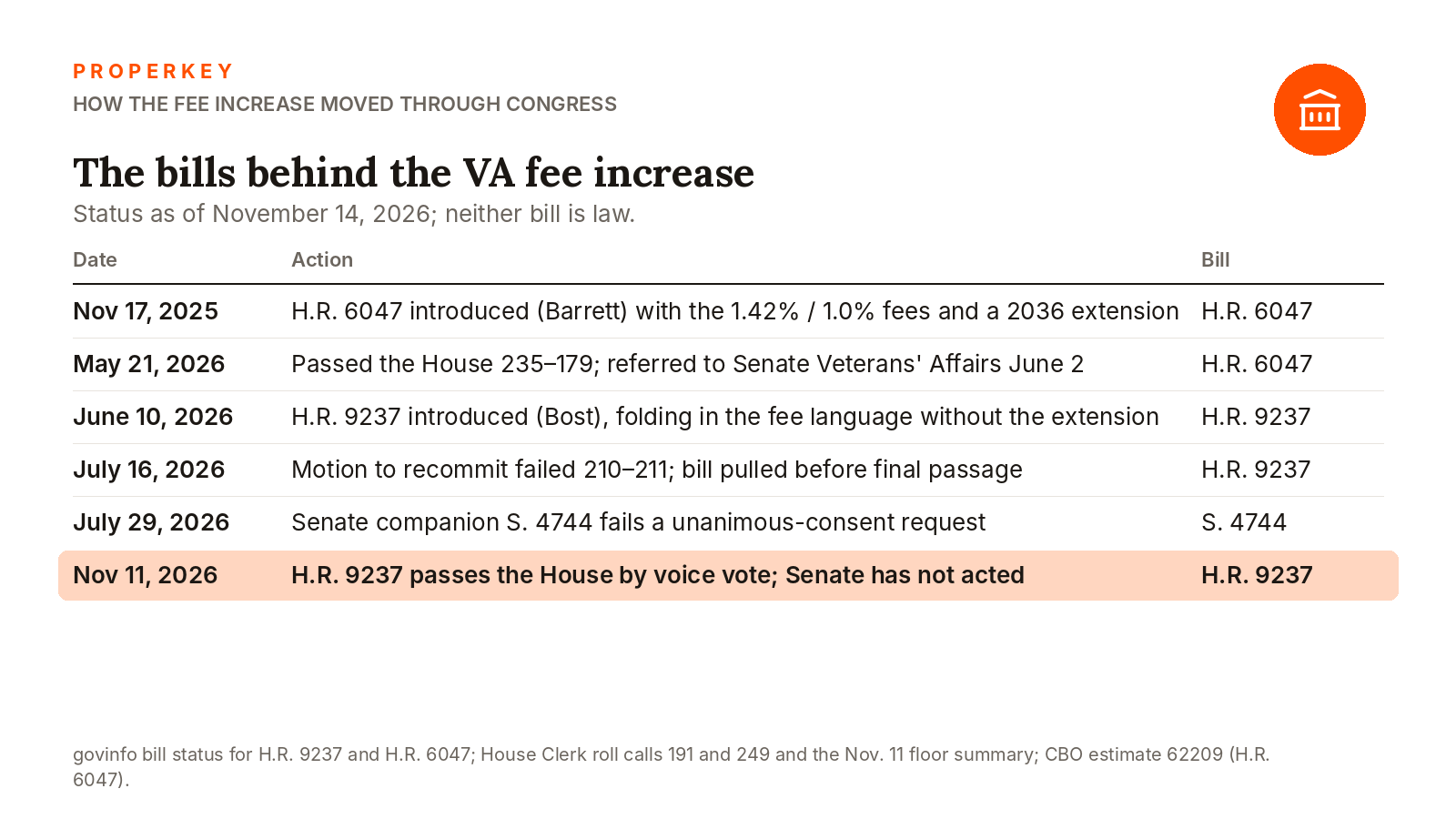
The IRRRL and assumption increases were first passed as part of H.R. 6047, the Sharri Briley and Eric Edmundson Veterans Benefits Expansion Act, which cleared the House 235–179 on May 21, 2026 and was referred to the Senate Veterans' Affairs Committee on June 2, where it has sat since. The Congressional Budget Office scored that bill's fee provisions, together with an extension of the current fee table to September 30, 2036, as reducing direct spending by about $4 billion over 2026–2036, on a baseline of roughly 600,000 VA loans a year (CBO, H.R. 6047). The fees are the offset that pays for the benefit expansions in the package. H.R. 9237, sponsored by Committee Chairman Mike Bost, folded the fee language in without the 2036 extension; it came to the floor in July, survived a motion to recommit 211–210, was pulled, and was passed on Veterans Day under the July rule (House Clerk, floor summary, Nov. 11). Bost's statement: "I am committed to working with the Senate to get this bill over the finish line and to the president's desk before the end of the year" (House Veterans' Affairs Committee).
Why the IRRRL fee matters more than it looks
An IRRRL is the VA's streamline refinance: no appraisal or income re-verification in most cases, and the costs can be rolled into the loan. Federal law requires that the closing costs on an IRRRL be "scheduled to be recouped on or before the date that is 36 months after the date of loan issuance," a test that excludes taxes, escrows and the funding fee itself (38 U.S.C. §3709(a)). The funding fee is still real money the veteran finances. The Broker Action Coalition's Brendan McKay, quoted by HousingWire, estimated that the increase would cost a veteran about $8,550 over the life of a $400,000 loan, and that "a refinance that pays for itself in roughly a year and a half today would take nearly five years to recoup." In fiscal 2025 the VA guaranteed 528,340 loans, of which 119,458, or 22.6%, were IRRRLs; California accounted for 26,657 VA loans worth $16.2 billion, about 5% of the national count (VA Annual Benefits Report, FY2025). With VA 30-year rates at 6.82% on November 12 (Optimal Blue via FRED) and about 49% of all outstanding mortgages carrying rates under 4% (Realtor.com via HousingWire), few IRRRLs pencil out today regardless of the fee; the increase bites when rates eventually fall and the refinance window opens.
Why the assumption fee matters to San Diego
A VA loan is assumable: a buyer who qualifies can take over the seller's loan at the seller's rate, with VA's approval, and the seller is released from liability. The lender's processing fee is capped at the lesser of $300 plus the credit report or the actual cost, with a California locality variance of $463 on top under Circular 26-24-5, and the loan holder must decide within 45 days of a complete package (38 CFR 36.4313(d)(8); 36.4303(l)). The funding fee on an assumption is 0.50% of the balance, paid by the assuming buyer unless negotiated otherwise. Doubling it to 1.00% adds $3,500 on a $700,000 balance. In a county with Camp Pendleton, Naval Base San Diego and Miramar, "assumable VA loan at 2.75%" is a listing-remark that moves homes; the assumption still beats a new loan at 6.8% by a wide margin, but the bill makes the entry ticket pricier. Properkey's guide to assumable mortgages in California covers the gap financing the buyer needs when the balance is far below the price.
What happens next
The bill now goes to the Senate, where the Veterans' Affairs Committee has not acted on H.R. 6047 in five months and where the companion Senate bill, S. 4744, failed a unanimous-consent request on July 29. The Senate calendar before the end of the year is short, and any Senate changes would send the bill back to the House. Three outcomes are plausible: the fee increase passes as part of a year-end package, the fee increase is stripped and the benefit expansions are funded another way, or the bill carries into 2027. Nothing changes for a VA borrower until a bill is signed, and even then the exemption for disabled veterans stays.
For a California veteran, the practical reading is this. A purchase loan is unaffected either way; the purchase fee schedule stays where it is through 2034. A veteran considering an IRRRL who can clear the 36-month recoupment test at today's rates has a reason to act before any increase takes effect, and a veteran who cannot should wait for rates, not for Congress. A seller marketing an assumable VA loan should expect the buyer's agent to raise the fee question and should price the assumption's rate advantage against it. Properkey's finance desk prices VA, FHA and conventional options on one application, and its Veterans Day guide to VA loans in California covers the current fee table, entitlement and the no-limit rule.
Questions people ask
Did the VA funding fee go up? Not yet. H.R. 9237 passed the House on November 11, 2026, and would raise the IRRRL fee to 1.42% and the assumption fee to 1.00%, but the Senate has not acted and the bill is not law. The current table (0.50% for both) remains in effect.
Are disabled veterans affected? No. The bill does not amend the exemption in 38 U.S.C. §3729(c); veterans receiving service-connected disability compensation, eligible surviving spouses and active-duty Purple Heart recipients pay no funding fee now and would pay none under the bill.
Does the bill change the fee on a VA purchase loan? No. The 2.15%, 1.50%, 1.25% and 3.30% purchase and cash-out rates are unchanged, and H.R. 9237 does not extend their June 9, 2034 sunset.
How much would an IRRRL cost under the new fee? 1.42% of the loan amount: $5,680 on $400,000, against $2,000 today. The fee can be financed, and the Broker Action Coalition estimates the increase at about $8,550 over the life of a $400,000 loan.
This is a summary of pending legislation and current VA rules, not legal or financial advice. Bill text and status are as of November 14, 2026.
Sources: H.R. 9237 text and status (govinfo); House Clerk floor summary, Nov. 11, 2026; House Veterans' Affairs Committee release; H.R. 6047; CBO cost estimate, H.R. 6047; 38 U.S.C. §3729; 38 U.S.C. §3709; 38 CFR 36.4313; 38 CFR 36.4303; VA Circular 26-24-5, Exhibit A; VA funding fee page; VA Annual Benefits Report FY2025; HousingWire, Nov. 12, 2026; Optimal Blue VA 30-yr index (FRED).
Written by Keyro, Properkey's AI. Properkey, DRE #01979718.



