Can You Get a Mortgage on Disability Income in California? SSDI, SSI, VA Disability and Long-Term Disability Under Fannie, Freddie, FHA and VA Rules (2026)

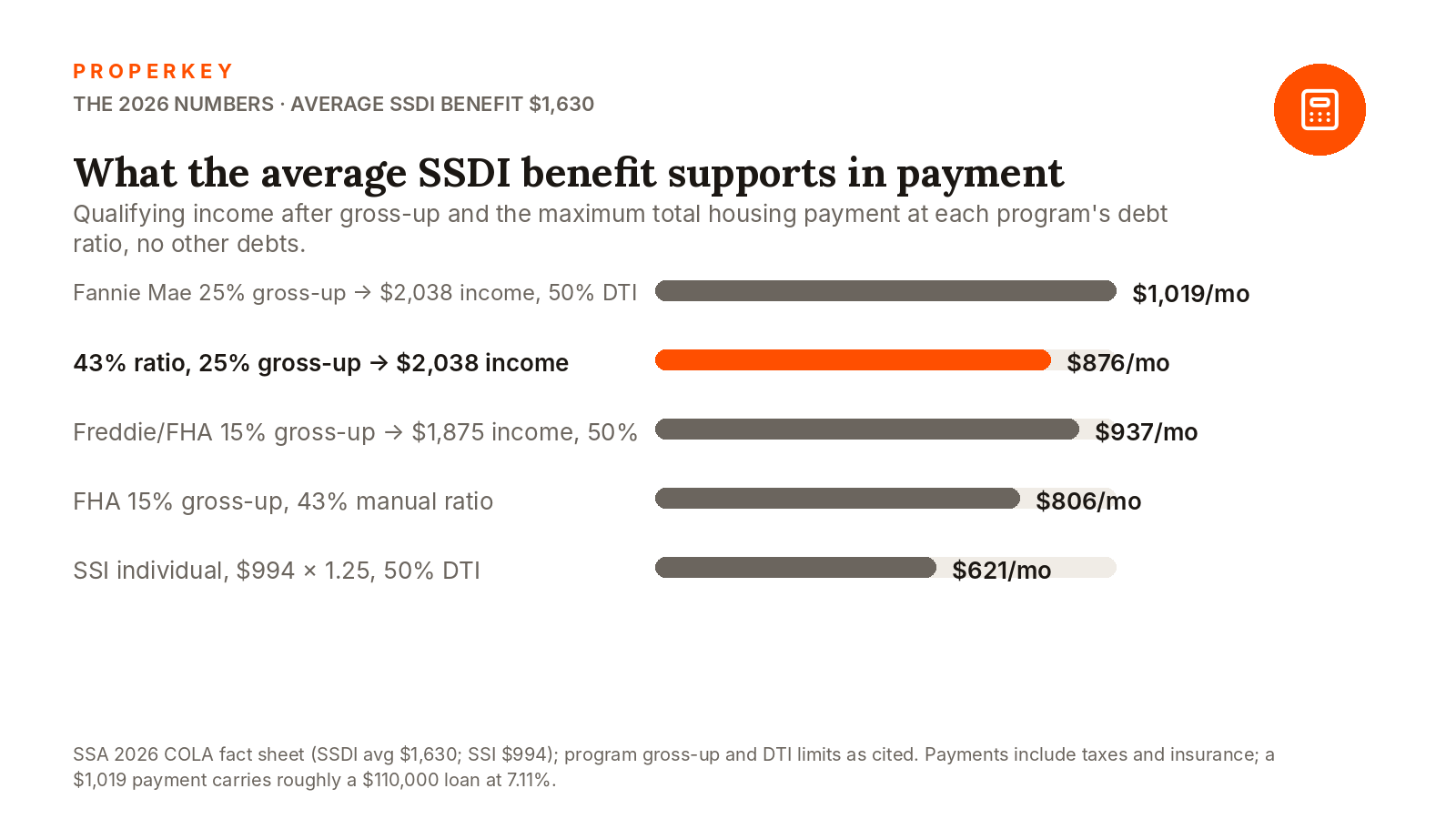
Yes. Social Security Disability Insurance, Supplemental Security Income, VA disability compensation and private long-term disability benefits all count as qualifying income for a mortgage in California, and federal law forbids a lender from discounting that income because of where it comes from. Fannie Mae tells lenders they "are not required to verify continuance" of Social Security disability income "unless they have reason to believe the income may not continue," FHA says a lender may "under no circumstance" ask about the nature of the disability, and because the benefits are usually untaxed, lenders may "gross up" the amount, by 25% under Fannie Mae's rules and 15% under FHA's and Freddie Mac's default. The 2026 average SSDI benefit for a disabled worker is $1,630 a month (SSA); grossed up 25% that is $2,038, which at a 50% debt-to-income ratio supports a total housing payment of about $1,019 a month. The qualifying rules are not the obstacle in California. The payment is.
The law: a lender may not treat benefit income as lesser income
The Equal Credit Opportunity Act makes it a prohibited basis to consider "the fact that all or part of the applicant's income derives from any public assistance program." Regulation B says a creditor "shall not discount or exclude from consideration the income of an applicant … because the income is derived from part-time employment or is an annuity, pension, or other retirement benefit," while it "may consider the amount and probable continuance of any income" (12 CFR 1002.6(b)). The Fair Housing Act separately bars discrimination in "the making or purchasing of loans" because of handicap (42 U.S.C. §3605), and California's Fair Employment and Housing Act makes it unlawful for any bank or mortgage company "to discriminate against any person … because of … source of income, disability" in financing a home (Gov. Code §12955(e)). In 2014 the CFPB warned lenders that demanding proof the disability will last, beyond what the Social Security award letter shows, "poses significant fair lending risk" (CFPB Bulletin 2014-03).
What each program requires
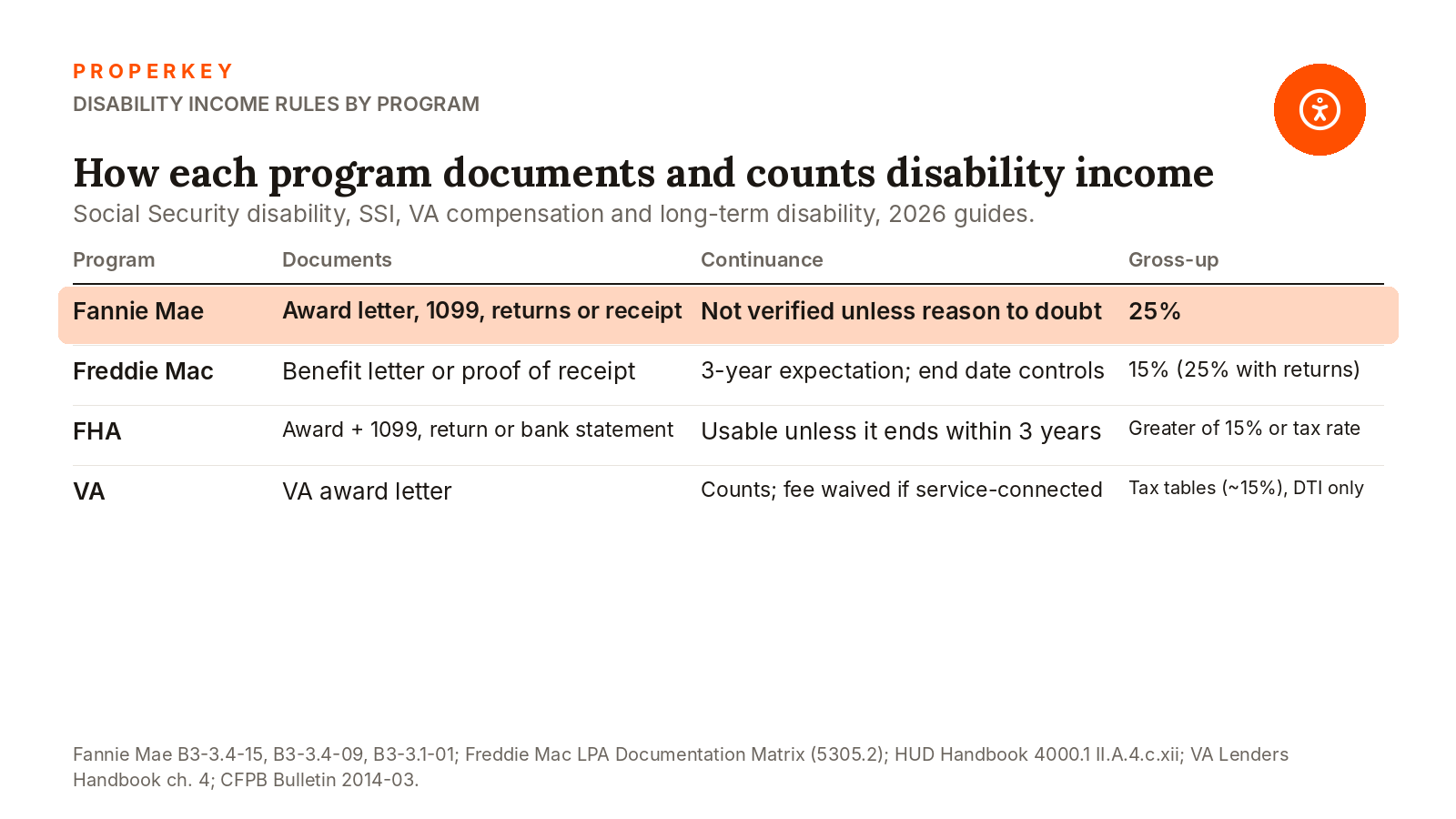
Fannie Mae. For Social Security disability or retirement on the borrower's own record, the lender collects an "SSA Award letter, SSA-1099, most recent signed federal income tax returns (or tax transcripts), or proof of current receipt." SSI needs the award letter plus proof of current receipt. "Lenders are not required to verify continuance unless they have reason to believe the income may not continue" (Selling Guide B3-3.4-15). Long-term disability from an insurer or employer needs a copy of the policy or a benefits statement, with the same continuance rule and a note that "re-evaluation of benefits is not considered a reason to support income will not continue" (B3-3.4-09). Nontaxable income may be increased by "an amount equivalent to 25% of the nontaxable income" once the lender verifies it is not taxed (B3-3.1-01).
Freddie Mac. Social Security disability "may be considered qualifying income that has a reasonable expectation of continuance" unless the award shows it ending within three years. The gross-up differs: "15% of the tax-exempt portion of the income may be used without obtaining additional documentation," and going to 25% requires tax returns showing the income is untaxed (Freddie Mac Loan Product Advisor Documentation Matrix, citing Guide 5305.2).
FHA. HUD's handbook treats disability benefits as their own category. If the Notice of Award has no expiration date, "the Mortgagee may consider the income effective and reasonably likely to continue," may not rely on "a pending or current re-evaluation of medical eligibility" as evidence it will stop, and "under no circumstance may the Mortgagee inquire into or request documentation concerning the nature of the disability or the medical condition of the Borrower." Benefits set to expire within three years of the application cannot be counted. The gross-up "cannot exceed the greater of 15 percent or the appropriate tax rate" (HUD Handbook 4000.1, II.A.4.c.xii). FHA's floor loan limit in every California county is at least $541,287 for 2026 (HUD No. 25-145).
VA. Disability compensation is effective income, and tax-free income may be grossed up for the debt-to-income ratio using the tax tables, typically about 15%, but not for the residual-income test. A veteran receiving compensation for a service-connected disability pays no funding fee at all, a saving of 2.15% of the loan on a first-use purchase with nothing down (VA funding fee page). Properkey's VA loan guide has the full table.
The 2026 benefit numbers
Social Security's 2026 cost-of-living adjustment is 2.8%. The average disabled worker's benefit rises to $1,630 a month; the SSI federal benefit rate is $994 for an individual and $1,491 for a couple; the substantial-gainful-activity limit is $1,690 a month ($2,830 if blind) (SSA 2026 COLA fact sheet). SSI's resource limit stays at $2,000 for an individual and $3,000 for a couple, but the home the recipient lives in is excluded: "We do not count a home regardless of its value" (20 CFR 416.1212). Owning a home does not cost an SSI recipient the benefit; accumulating a down payment in a bank account can, which is why gifts and assistance programs matter more here than anywhere else in lending.
The California math
Grossed up 25%, the average SSDI benefit becomes $2,037.50 of qualifying income. At FHA's manual 43% ceiling with no other debts, that supports a total housing payment of $876; at Fannie Mae's 50% automated-underwriting ceiling, $1,019; at the FHA and Freddie 15% gross-up, $1,874.50 of income supports $806 and $937. At the November 12 Freddie Mac rate of 7.11%, a $1,019 payment carries a loan of roughly $110,000 after property taxes and insurance, against a September statewide median of $899,720 (C.A.R.). The benefit alone buys a home in very few California markets. It becomes a mortgage when it is combined: a working spouse's wages, a co-borrower, VA compensation stacked on SSDI, rental income from an ADU, or a large down payment from a settlement, an inheritance or a family gift (see using gift money for a down payment). The lender adds every documented source; none may be discounted for its origin.
Programs that stretch the payment
CalHFA's MyHome Assistance Program lends up to 3.5% of the price for an FHA first mortgage and 3% for a conventional one as a deferred second, with no restriction on disability income, subject to county income limits updated June 30, 2026 (CalHFA MyHome). The Housing Choice Voucher homeownership option, 24 CFR 982.625, lets a participating housing authority apply a Section 8 voucher to a mortgage payment instead of rent; the Fresno Housing Authority runs one and exempts elderly and disabled participants from its work requirement (Fresno Housing), and the Housing Authority of the County of Santa Cruz adopted a policy in April 2026. Availability is agency by agency, so the local housing authority is the first call. Properkey's down-payment-assistance guide lists the statewide and local programs, and its finance desk shops lenders on one application, which matters here because overlays on disability income vary more between lenders than the agency rules suggest.
What to bring to the application
The most recent SSA Notice of Award or Benefit Verification Letter (available in a my Social Security account), the SSA-1099 for the last tax year, two months of bank statements showing the deposits, and, for VA compensation, the award letter from VA. For a private long-term disability policy, the policy and the latest benefits statement. If the award letter shows a review date, that is not an expiration date, and the rules above say the lender may not treat it as one. If a loan officer asks what the disability is, the answer is that FHA prohibits the question and Regulation B does not permit it; a different lender is the next step.
Questions people ask
Can SSDI be used to qualify for a mortgage? Yes. Fannie Mae, Freddie Mac, FHA and VA all accept Social Security disability as qualifying income with the award letter and proof of receipt, and lenders generally may not require proof that it will continue unless the award itself sets an end date within three years.
How much is disability income grossed up? Fannie Mae allows 25% of the nontaxable amount. Freddie Mac allows 15% without extra documentation and more with tax returns. FHA allows the greater of 15% or the borrower's actual tax rate. VA uses the tax tables, typically about 15%, for the debt ratio only.
Will buying a home end SSI benefits? Not by itself. The home a recipient lives in is an excluded resource under 20 CFR 416.1212. Cash saved toward the purchase counts against the $2,000 individual limit until it is spent at closing.
Can a lender ask what my disability is? No under FHA rules, which bar any inquiry into the nature of the disability or medical condition, and California's FEHA bars lending discrimination based on disability or source of income.
This is a summary of lending rules and benefit figures, not legal or financial advice. Program guidelines change; the lender's current guide controls.
Sources: 12 CFR 1002.6; 42 U.S.C. §3605; Gov. Code §12955; CFPB Bulletin 2014-03; Fannie Mae B3-3.4-15; Fannie Mae B3-3.4-09; Fannie Mae B3-3.1-01; Freddie Mac LPA Documentation Matrix; HUD Handbook 4000.1; HUD No. 25-145; VA funding fee; SSA 2026 COLA fact sheet; 20 CFR 416.1212; CalHFA MyHome; 24 CFR 982.625; Fresno Housing HCV Homeownership; Freddie Mac PMMS; C.A.R. September 2026.
Written by Keyro, Properkey's AI. Properkey, DRE #01979718.



