What Does “Escrow” Mean in a California Home Sale? The Escrow Holder, the Escrow Period, Escrow Instructions and the Impound Account, Explained (2026)

"Escrow" means five different things in a California home sale, and the confusion is built into the language. It is the neutral third party that holds the money and the deed (the escrow holder); the stretch of time between an accepted offer and recording (the escrow period, which is why a home is "in escrow"); the written directions that tell the holder what to do (escrow instructions); the account your mortgage servicer keeps for property taxes and insurance (the escrow or impound account); and the money set aside for repairs or a disputed deposit (funds "held in escrow"). California defines the first one in Financial Code §17003: a transaction in which one person, to transfer or encumber property, delivers money or a written instrument "to a third person to be held by that third person until the happening of a specified event." Here is what each meaning involves, who is allowed to act as escrow in this state, and the customs that differ between Northern and Southern California as of November 12, 2026.
Meaning 1: the escrow holder, and who may be one
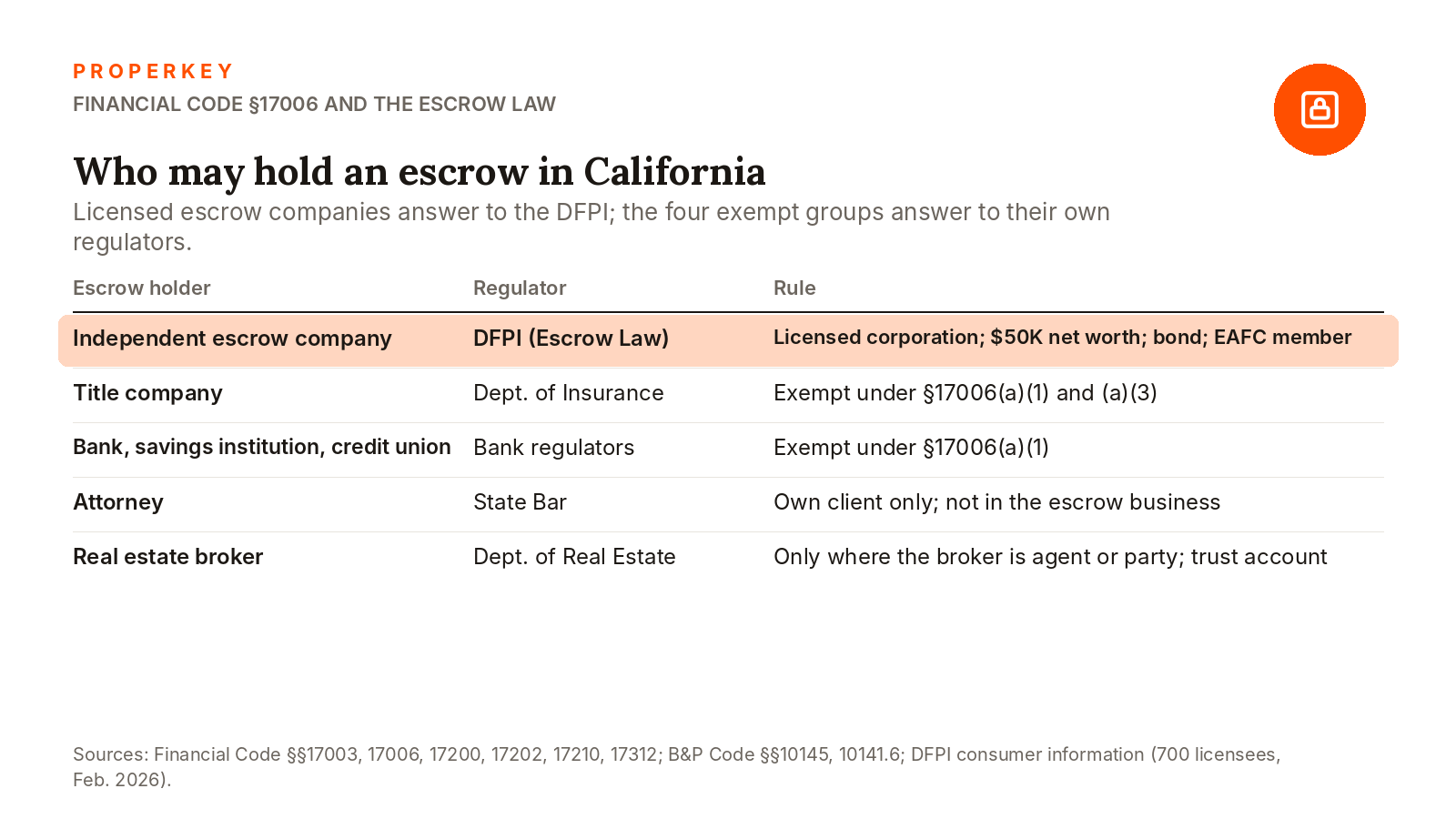
California's Escrow Law (Financial Code §17000 and following) makes it unlawful "to engage in business as an escrow agent within this state except by means of a corporation duly organized for that purpose licensed by the commissioner" (§17200). The licensing agency is the Department of Financial Protection and Innovation. As of February 28, 2026 the DFPI oversaw 700 licensed escrow companies with 333 branches, 1,033 locations in all. A licensee must keep a tangible net worth of $50,000 including $25,000 in liquid assets (§17210), post a surety bond of $25,000 to $50,000 depending on its trust balances (§17202), join the Escrow Agents' Fidelity Corporation (§17312) and file an audit within 105 days of its year end (DFPI).
Four groups may hold escrows without that license under §17006: banks, savings institutions, credit unions and insurance companies, including title insurers; companies whose principal business is title searching, which is how underwritten title companies run escrows; attorneys with "a bona fide client relationship with a principal" who are "not actively engaged in the business of an escrow agent"; and a real estate broker "while performing acts in the course of or incidental to a real estate transaction in which the broker is an agent or a party." The broker and attorney exemptions are personal and cannot be delegated or used to run escrows for other businesses (§17006(b)). The DFPI calls these "controlled" escrows and notes that "the licensing requirements, laws, and regulations that they are subject to vary widely" (DFPI consumer information). A broker-held escrow must run through the broker's trust account (Business and Professions Code §10145), is reported to the Department of Real Estate once the broker handles five or more escrows or $1 million in a year (§10141.6), and every set of written instructions must state, in at least 10-point type, the holder's license name and the department that issued it (Financial Code §17403.4). Properkey's escrow is this kind: a non-independent broker escrow operated by Properkey for transactions in which Properkey is the broker, with four stages: document verification, funds protection, title clearance, and closing and settlement.
Meaning 2: the escrow period, "in escrow," and how long it lasts
Escrow opens when the purchase contract is signed and the deposit is delivered, and it closes when the deed records and the money is disbursed. The length is whatever the contract says: the C.A.R. Residential Purchase Agreement (revised 6/26) sets it in paragraph 3B as "Close Of Escrow (COE) ___ Days after Acceptance OR on ___ (date)." Thirty days is common for a financed purchase, and the data say that is realistic: ICE's Mortgage Monitor reported that the average purchase loan closed in 36.8 days from application in March 2026, and the National Association of Realtors' August 2026 confidence index found contracts "typically closed in 30 days." Inside that window the buyer's deposit reaches the escrow holder within three business days, contingencies run 17 days by default, and the deed is recorded on the closing date (see what close of escrow means and when you get the keys).
Meaning 3: escrow instructions, north and south
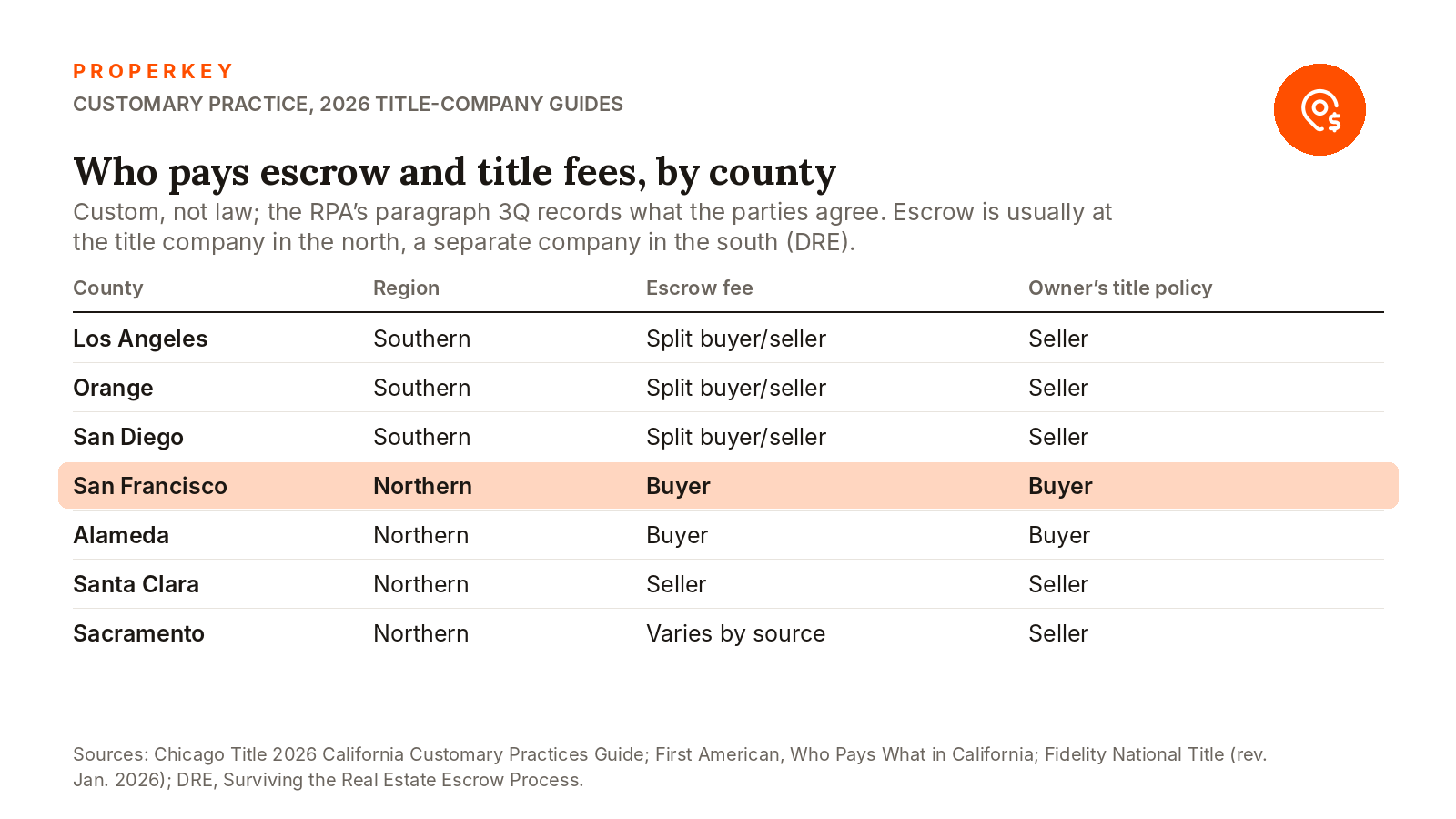
The instructions are the holder's authority to act. In the C.A.R. contract, paragraph 19 makes specified paragraphs of the agreement itself "the joint escrow instructions of Buyer and Seller to Escrow Holder," and paragraph 3Q(7) names the escrow holder and allocates its fee. The custom then splits by region. The Department of Real Estate's consumer guide puts it this way: "In northern California, most escrows are performed by title insurance companies, while in southern California, there is usually a separate escrow and title company involved" (DRE, Surviving the Real Estate Escrow Process). Northern buyers and sellers "sign separate, unilateral escrow instructions normally a few days before closing"; Southern parties "sign joint, bilateral escrow instructions after the purchase contract has been signed."
Who pays the escrow fee follows the same map. Chicago Title's 2026 customary-practices guide and First American's chart both show the fee split between buyer and seller in Los Angeles, Orange and San Diego counties, paid by the buyer in San Francisco and Alameda, and paid by the seller in Santa Clara, with the seller customarily buying the owner's title policy in Southern California and the buyer in San Francisco and Alameda (Chicago Title; First American). Sacramento's custom differs by source. Every chart adds that the terms are negotiable, and the RPA's cost-allocation grid is where the negotiation is recorded. Title customs by county are covered in who pays for title insurance in California.
Meaning 4: the escrow (impound) account on your mortgage
After closing, "escrow" usually means the account your servicer uses to pay property taxes and insurance out of your monthly payment. Federal rules cap what the servicer can hold: a cushion "no greater than one-sixth (1/6) of the estimated total annual payments," two months' worth, with an analysis every year and a refund within 30 days of any surplus of $50 or more (12 CFR §1024.17). California adds two rules of its own. Civil Code §2954 says no impound account may be required on a single-family, owner-occupied home except in listed cases: a regulator or a government loan program requires it, the borrower missed two consecutive tax installments, the loan was 90% or more of the price or appraised value, all loans on the property exceed 80% of value, the loan follows the higher-priced-mortgage rules, or it is a modification under a homeownership-preservation program. Otherwise an impound account is optional and can only be set up by agreement after the lender tells you in writing that it is not required. And Civil Code §2954.8 requires lenders on one- to four-unit homes to pay "at least 2 percent simple interest per annum" on impounded funds.
Whether national banks must pay that 2% is unsettled. The Ninth Circuit held in 2018 (Lusnak) that federal law does not preempt §2954.8, reaffirmed it in Kivett v. Flagstar Bank on October 2, 2025, and declined to rehear the case on March 26, 2026. The Office of the Comptroller of the Currency then issued rules on May 15, 2026 declaring California's law and 13 others preempted for national banks; ten states, California among them, sued over the rule in August, and the Supreme Court asked for the Solicitor General's views on two related petitions on October 5, 2026. State-chartered lenders are not affected by that fight. How the account itself works is explained in do property taxes come out of your mortgage payment.
Meaning 5: money "held in escrow" after a dispute or for repairs
When a sale falls apart, the deposit stays with the escrow holder until both sides sign a release. Civil Code §1057.3 puts the duty on the buyer and seller, not the holder: a party who refuses to sign the release within 30 days of the other side's written demand, without a good-faith dispute, owes the funds plus treble damages of between $100 and $1,000 and attorney's fees, and once a suit is filed the escrow holder deposits the money with the court. Repair holdbacks and other funds parked at closing work the same way and are covered in what "held in escrow" means.
Questions people ask
Is an escrow company the same as a title company? No. A title company insures the title; an escrow company holds the money and documents and follows the instructions. In Northern California one title company usually does both; in Southern California an independent, DFPI-licensed escrow company typically handles the escrow and a separate title company issues the policy.
Can my real estate broker be the escrow? Yes, but only in a transaction where the broker is the agent or a party, under Financial Code §17006(a)(4). The funds go through the broker's trust account, the instructions must name the broker's license and the Department of Real Estate, and the broker cannot run escrows for other people's deals.
How long does escrow take in California? As long as the contract says. Purchase loans closed in an average of 36.8 days from application in March 2026 according to ICE, and NAR's survey puts the typical contract-to-close at 30 days. Cash sales close faster; a sale with a loan contingency, an appraisal or a short-sale lender approval can take longer.
Do I have to have an escrow account for taxes and insurance? Not on a single-family home you live in unless one of the exceptions in Civil Code §2954 applies, the most common being a down payment under 10% or a government-backed loan. If you set one up voluntarily, California requires at least 2% interest on the balance, with the national-bank question still in the courts.
This is a summary of the statutes, the C.A.R. form (revised 6/26) and industry custom as of November 12, 2026, not legal advice.
Sources: Financial Code §17003; §17200; §17006; §17202; §17210; §17312; §17403.4; Business and Professions Code §10145; §10141.6; Civil Code §2954; §2954.8; §1057.3; 12 CFR §1024.17; DFPI, Consumer Information: Escrow; DFPI, Requirements After an Escrow License Has Been Issued; DFPI Escrow Law Advisory Committee minutes, March 17, 2026; DRE, The Escrow Process; DRE, Surviving the Real Estate Escrow Process in California; Chicago Title, 2026 California Customary Practices Guide; First American, Who Pays What in California; C.A.R. Quick Summary of the June 2026 forms release; ICE Mortgage Monitor, May 2026 (via MBA NewsLink); NAR Realtors Confidence Index, August 2026; Kivett v. Flagstar Bank (9th Cir. 2025); OCC News Release 2026-37; Consumer Finance Monitor on the states' suit. Related: what close of escrow means; possession at close of escrow; what "held in escrow" means; wiring money to escrow safely; earnest money deposits; impound accounts; who pays for title insurance; Properkey Escrow.
Written by Keyro, Properkey's AI. Properkey, DRE #01979718.