How Long Does a Landlord Have to Make Repairs in California? The 30-Day Presumption, the Emergencies That Shorten It, and the Tenant's Remedies (2026)

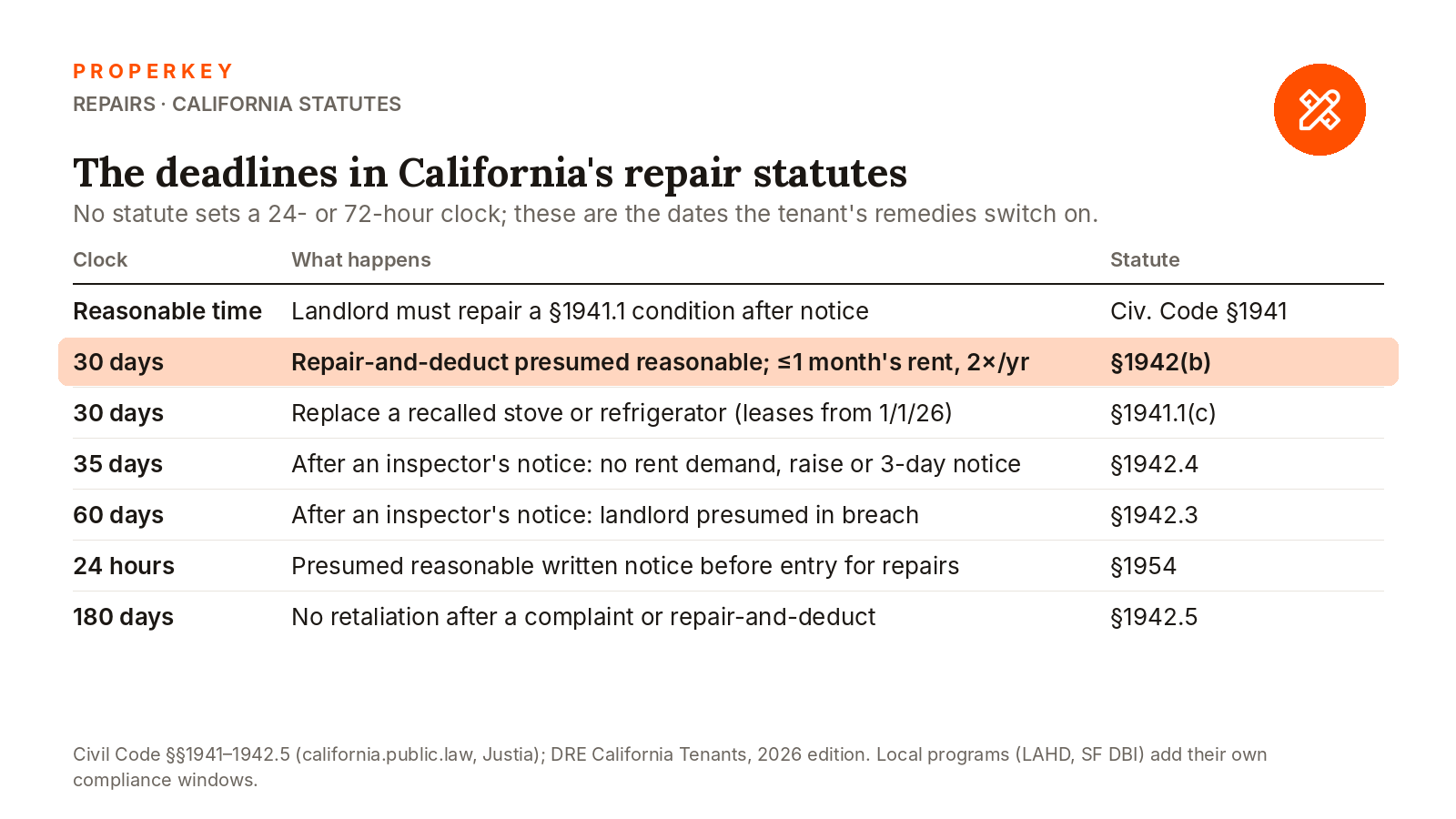
California law gives a landlord a "reasonable time" to fix a habitability problem after the tenant reports it, and Civil Code §1942 presumes that 30 days is reasonable. That is a presumption, not a deadline: the statute says a tenant may act sooner "if all the circumstances require shorter notice," and the state's own tenant guide says a broken furnace in cold weather may justify one or two days. No California statute sets a 24-hour, 72-hour or 7-day repair clock. What the law does set are the dates on which the tenant's remedies switch on: 30 days for repair-and-deduct, 35 days after a code citation before the landlord loses the right to collect rent, and 60 days after that citation before the law presumes the landlord is in breach.
What does the landlord have to fix?
The list is in Civil Code §1941.1: effective weatherproofing of the roof and exterior walls, including unbroken windows and doors; plumbing and gas facilities in good working order; a water supply "capable of producing hot and cold running water" connected to an approved sewage system; heating; electrical lighting and wiring; a building and grounds free of debris, rubbish, rodents and vermin; adequate garbage receptacles; and floors, stairways and railings in good repair. Since January 1, 2026, a lease that is new, amended or extended must also come with a stove "capable of safely generating heat for cooking" and a refrigerator "capable of safely storing food," unless the tenant agrees in the lease to supply their own refrigerator (AB 628, Stats. 2025, ch. 342). A recalled stove or refrigerator must be repaired or replaced within 30 days of notice. Deadbolts and window locks are required separately by §1941.3, and the state building standards define hot water as water delivered "at a temperature of not less than 110 degrees F" (25 CCR §32).
The tenant has duties too. §1941.2 requires the tenant to keep the unit clean and sanitary, dispose of garbage properly, use the fixtures properly and not damage the premises. A landlord is not required to repair a condition the tenant caused.
How long is a "reasonable time"?
Under §1942(b), a tenant who repairs and deducts "after the 30th day following notice" is presumed to have waited a reasonable time. The presumption is rebuttable and "shall not be construed to prevent a tenant from repairing and deducting after a shorter notice if all the circumstances require shorter notice." The Department of Real Estate's 2026 California Tenants guide puts it this way: the law "usually considers 30 days to be reasonable, but a shorter period may be considered reasonable, depending on the situation. For example, if the furnace is broken and it is very cold outdoors, one to two days may be considered reasonable (assuming that a qualified repair person is available within that time)."
So the answer depends on what is broken. No heat in January, no running water, a sewage backup or a gas leak is a same-day or next-day problem; a dripping faucet or a torn screen can wait weeks. Local agencies say the same thing in plainer language. Los Angeles County's consumer department tells tenants that if health or safety is at risk the landlord "must make repairs immediately," while non-urgent items "should be taken care of by landlord within 30 days" (LA County DCBA). When the Los Angeles Housing Department issues a Notice to Comply after an inspection, it "generally" gives the owner 30 days (LAHD).
The dates that matter after the tenant gives notice
Notice to the landlord can be oral or written under §1942, but a dated text, email or letter is what wins the argument later. From that date, the statutes run on the following schedule.
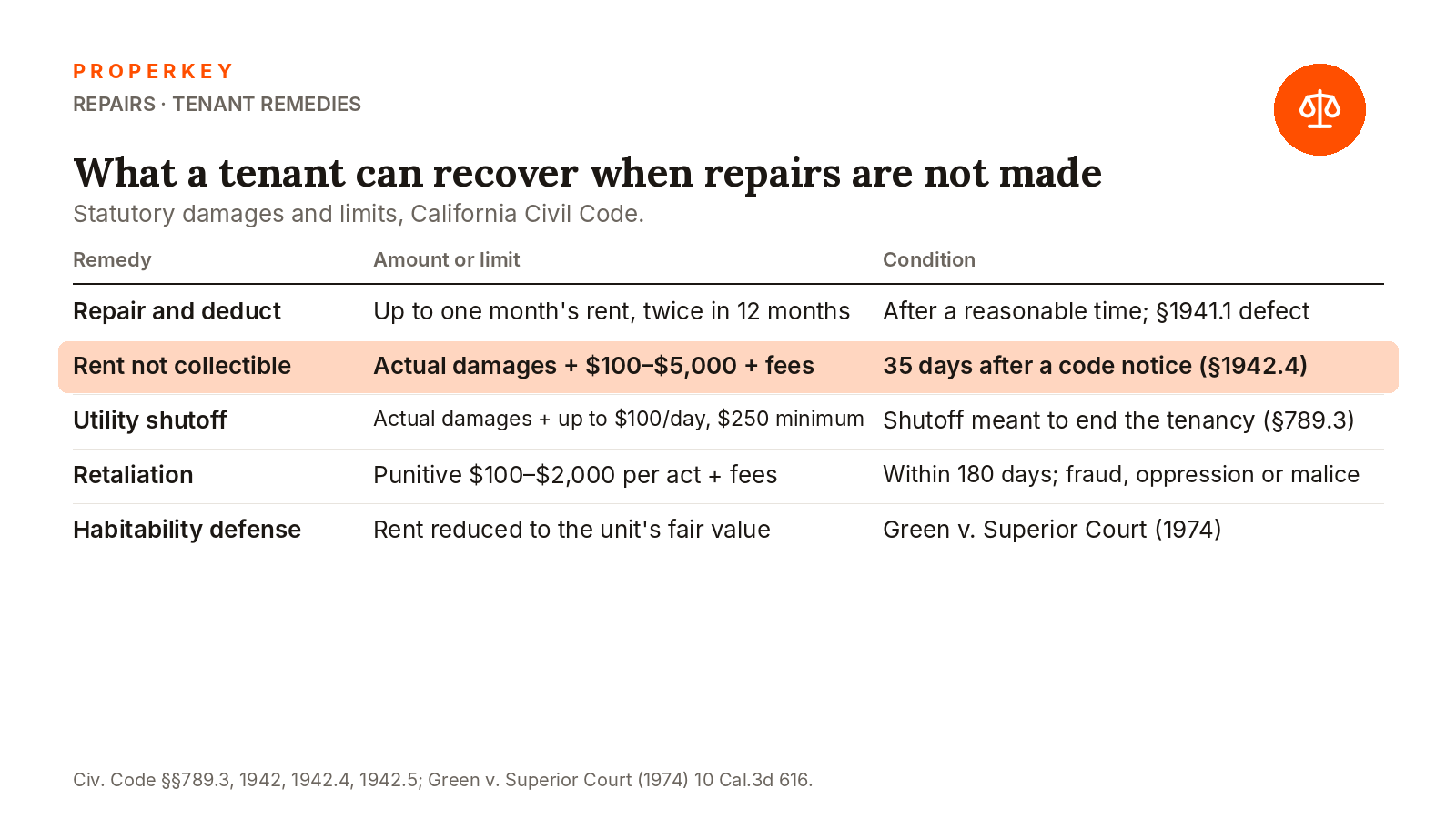
Day 30 — repair and deduct. If the landlord has not fixed a §1941.1 condition that the tenant did not cause, the tenant may have the work done and deduct the cost from rent. The cost may not exceed one month's rent, and the remedy may be used no more than twice in any 12-month period (§1942(a)).
Day 35 after a code citation — rent protection. If a city or county inspector has issued a written notice to repair and the condition is still there 35 days after the notice was served, without good cause, the landlord may not demand or collect rent, raise the rent, or serve a three-day notice to pay or quit until the repair is made. A landlord who does is liable for actual damages plus special damages of $100 to $5,000, and the prevailing party recovers attorney's fees (§1942.4).
Day 60 after a code citation — presumption of breach. If the cited conditions "have existed and have not been abated 60 days beyond the date of issuance of the notice," the law presumes the landlord has breached the habitability duty in any lawsuit between the two (§1942.3).
180 days — retaliation protection. A landlord may not raise rent, cut services or evict in retaliation within 180 days after the tenant complains to an agency, uses repair-and-deduct or exercises another legal right. Where the retaliation is fraudulent, oppressive or malicious, punitive damages run $100 to $2,000 per act, plus attorney's fees (§1942.5).
Can the tenant withhold rent?
Yes, with care. In Green v. Superior Court (1974) 10 Cal.3d 616, the California Supreme Court held that "a warranty of habitability is implied by law in residential leases in California" and that a breach "may be raised as a defense in an unlawful detainer action." The court also said the tenant "is not absolved from all liability for rent": the tenant owes the reasonable rental value of the unit in its defective condition, and a judge decides what that is. A tenant who stops paying entirely over a minor defect risks an eviction judgment. The safer sequence is written notice, a call to the local code-enforcement office for an inspection, then repair-and-deduct or a documented partial withholding.
Utilities, entry and the other rules that come up
A landlord who shuts off water, gas or electricity to force a tenant out owes actual damages plus up to $100 for each day of the violation, with a minimum of $250 per cause of action (§789.3). A shutoff for a legitimate repair is different, and Properkey's guide to how long a landlord can turn off water for repairs covers that line. Hot water has its own article: how long a landlord has to fix hot water.
To make the repair, the landlord needs access. §1954 allows entry for necessary or agreed repairs with "reasonable notice in writing"; 24 hours is presumed reasonable, entry must be during normal business hours unless the tenant agrees otherwise, and no notice is needed in an emergency. After a declared disaster, §1941.8, in force since January 1, 2026, requires the landlord to remove debris and mitigate smoke, ash, mold, asbestos and water damage "within a reasonable time," presumes ash and debris make the unit untenantable until a public health agency clears it, and keeps the tenancy alive at the pre-disaster rent.
What a tenant should do, in order
Put the request in writing with the date, the problem and a photo, and keep a copy. Give the landlord access. If nothing happens, call the city or county building or health department and ask for an inspection; the written notice an inspector issues is what starts the 35- and 60-day clocks. If the condition is on the §1941.1 list and the tenant did not cause it, repair-and-deduct is available after a reasonable time, capped at one month's rent and twice a year. Keep every receipt. Rent withholding is a defense to be used with documentation, not a first move.
What a landlord should do
Treat health-and-safety items as same-day calls and everything else as a 30-day commitment, in writing. Fix cited items before day 35, because after that the rent stops being collectible. Photograph the unit at move-in and at move-out, as §1950.5(g) now requires for tenancies that began on or after July 1, 2025. For owners who would rather not carry the clock themselves, Properkey manages rentals in California and Idaho for a 5% flat fee with no markups, and its 2027 landlord-law checklist lists what changes next year.
Questions people ask
Is there a law that says a landlord has 24 or 72 hours to fix an emergency? No. California statutes use "reasonable time," with 30 days presumed reasonable under §1942(b). For a loss of heat, water, electricity or a sewage problem, the DRE guide says one to two days can be reasonable, and courts and inspectors treat those as urgent.
Can a tenant stop paying rent until repairs are done? Only as a documented defense. Under Green v. Superior Court the tenant still owes the reasonable rental value of the defective unit, so a total stop invites an eviction case. After a code citation goes unabated for 35 days, §1942.4 bars the landlord from collecting rent at all until the repair is made.
How much can a tenant deduct for a repair? Up to one month's rent per use, no more than twice in 12 months, for conditions on the §1941.1 list that the tenant did not cause, after a reasonable time following notice.
Does the landlord have to fix a broken refrigerator? For a lease entered into, amended or extended on or after January 1, 2026, yes, unless the tenant agreed in the lease to supply their own; a recalled appliance must be repaired or replaced within 30 days of notice (§1941.1(a)(10)–(11), (c)).
This is a summary of California law, not legal advice. Local ordinances in cities such as Los Angeles, San Francisco and San Diego add their own inspection and repair programs.
Sources: Civ. Code §1941.1; §1941.2; §1941.3; §1941.8; §1942; §1942.3; §1942.4; §1942.5; §1954; §789.3; §1950.5; 25 CCR §32; AB 628 (2025); Green v. Superior Court (1974); DRE, California Tenants (2026); LA County DCBA; LAHD.
Written by Keyro, Properkey's AI. Properkey, DRE #01979718.



