Mortgage Commitment Letter vs. Clear to Close: What Each Means, the Three-Day Rule, and How a California Escrow Closes (2026)

A mortgage commitment letter is the lender's written approval of your loan, usually with conditions still to be met; "clear to close" is the lender's internal sign-off that every condition has been satisfied and the closing documents can be drawn. The gap between them is where most delayed closings happen. In NAR's September 2026 survey of agents, 16% of contracts had a delayed settlement, up from 14% a year earlier, and 7% were terminated. In California the sequence runs pre-approval → offer → commitment letter → contingency removal → clear to close → Closing Disclosure (at least three business days before signing) → funding → recording, and the contract puts the buyer's deposit at risk once the loan contingency is removed. This article walks through each step with the federal rule or contract paragraph behind it.
Pre-qualification and pre-approval: before the offer
Lenders use the two words loosely, and the Consumer Financial Protection Bureau says so: "Lenders use the terms 'prequalification' and 'preapproval' differently." Some issue a pre-qualification letter on information you report and will only issue a pre-approval on verified information; either way, both letters "are not guaranteed loan offers." The CFPB also notes that some lenders go one step further before you are in contract: "some lenders may issue a written commitment letter valid for a certain period of time to extend a loan up to a specified amount subject to limited conditions." What a seller's agent actually wants to see is evidence that your income, assets and credit have been reviewed, so ask your lender which of the three it is giving you.
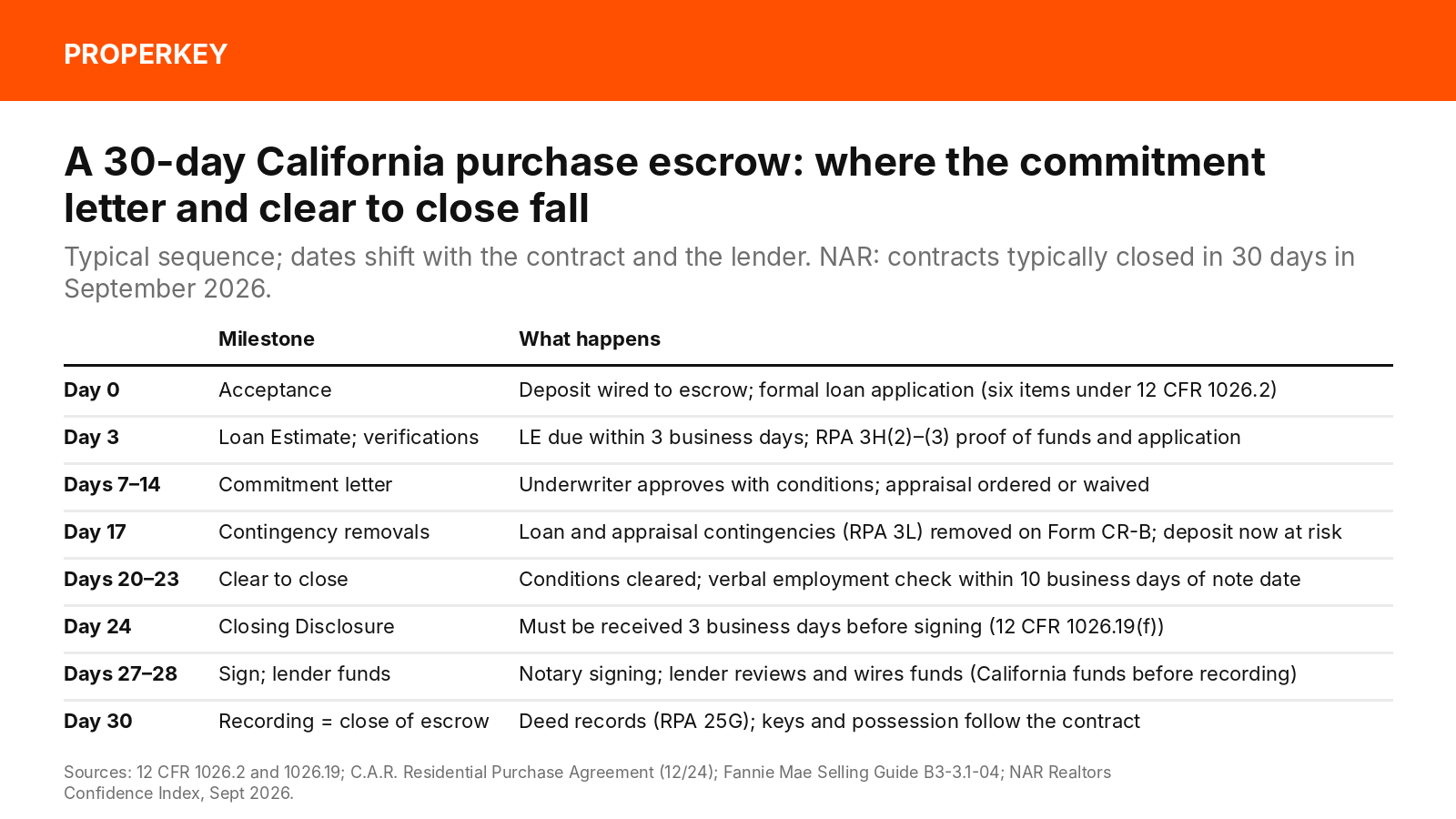
Once you are in contract, the clock on the formal application starts. Under Regulation Z (12 CFR 1026.2(a)(3)), an application exists when the lender has six items: your name, income, Social Security number, the property address, an estimate of the property's value and the loan amount. From that point the lender must deliver or mail the Loan Estimate "not later than the third business day" (12 CFR 1026.19(e)(1)(iii)).
What is a mortgage commitment letter?
Neither Fannie Mae's nor Freddie Mac's selling guide defines a borrower-facing "commitment letter"; the term is the industry's, not the regulators'. In practice it is the underwriter's decision in writing: the loan amount, rate or lock terms, the property, the expiration date, and a list of conditions. A conditional commitment (sometimes "conditional approval") means approved provided you supply or satisfy the listed items — an updated pay stub, a letter explaining a deposit, the appraisal, homeowners insurance, a title report. A final commitment means the conditions are met and only closing conditions remain. The California purchase contract asks for proof that the application is under way: the C.A.R. Residential Purchase Agreement (revised 12/24), paragraph 3H(3), calls for verification of the loan application, and 3H(2) for verification of the down payment and closing costs, either attached to the offer or delivered within 3 days after acceptance.
Read the conditions, not just the approval. Three of them recur in almost every file because Fannie Mae requires them of the lender: employment must be verbally re-verified "no more than 10 business days on or before the note date" (Selling Guide B3-3.1-04); credit documents "must be no more than four months old on the note date" (B1-1-03); and if new debt turns up any time "up to and concurrent with closing, the lender must recalculate the borrower's debt-to-income ratio" (B3-6-01). A commitment letter does not survive a new car loan or a job change.
The loan contingency: the contract's version of the same question
The commitment letter is the lender's document. The loan contingency is the contract's. In the 12/24 RPA the loan contingency (paragraph 3L(1)) and the appraisal contingency (3L(2)) each default to 17 days after acceptance, and each is removed in writing on C.A.R. Form CR-B (paragraph 14B(3)). Paragraph 8A(1) requires the buyer to "act diligently and in good faith to obtain the designated loan(s)," and 8A(4) warns that "removal of the loan contingency shall not be deemed removal of the appraisal contingency." If the buyer has not removed a contingency by its deadline, the seller may deliver a Notice to Buyer to Perform (Form NBP) giving at least 2 days (paragraphs 14C(1) and 14E) and then cancel.
The decision that matters most is removing the loan contingency before the lender has cleared you to close. Paragraph 14F(1) says that on removal the buyer "shall conclusively be deemed to have… assumed all liability… for the inability to obtain financing," and paragraph 26 provides that if the buyer then fails to close, the seller "shall retain, as liquidated damages, the deposit actually paid" — capped at 3% of the price on a one-to-four-unit home the buyer intends to occupy. On the $899,720 California median that is up to $26,992. A conditional commitment letter in hand is the usual basis for removing the contingency; a pre-approval alone is not.
What "clear to close" means
Clear to close (CTC) is the underwriter's final sign-off: every prior-to-document condition is satisfied, and the closing department can prepare the Closing Disclosure and the loan documents. It is not a legal term, and it is not the end. Lenders still complete the verbal verification of employment inside the 10-business-day window, many re-pull credit to check for undisclosed debt (Fannie Mae does not require the new report, but if the lender obtains one and it shows new debt, the loan must be re-underwritten), and the rate lock must still be in force. The CFPB's rate-lock page notes locks "are typically available for 30, 45, or 60 days, and sometimes longer," and that "it may be expensive to extend if your transaction needs more time." If your CTC comes after the lock has expired, you are re-pricing at the market: Freddie Mac's average 30-year rate was 7.18% on November 5, 2026, down from 7.40% in mid-October, so recent extensions have been cheap, but the direction can reverse.
The Closing Disclosure and the three-business-day wait
Clear to close triggers the Closing Disclosure, and federal law fixes the pace from there. The lender must ensure you "receive the disclosures… no later than three business days before consummation" (12 CFR 1026.19(f)(1)(ii)). If it is mailed or emailed rather than handed to you, you are presumed to receive it three business days after it is sent — so the practical lead time is closer to a week unless you acknowledge receipt electronically. For this rule, "business day" means every day except Sundays and federal holidays.
Only three changes restart the three-day clock (1026.19(f)(2)(ii)): the APR becomes inaccurate — off by more than 1/8 of a percentage point on a regular loan, 1/4 on an irregular one (1026.22); the loan product changes (fixed to adjustable, for example); or a prepayment penalty is added. A corrected fee, a different closing date or a seller credit that moves do not restart it; they produce a revised Closing Disclosure at signing.
Signing, funding and recording: how California closes
In California the buyer signs loan documents with a notary, the signed package goes back to the lender for review, and the lender wires funds to escrow — typically the business day before recording, because California closes by practice as a "dry funding" state, with funds confirmed before the deed records rather than at the signing table. Title and escrow disburse under the state's good-funds rule, Insurance Code §12413.1: funds "deposited by cash or by electronic payment may be disbursed following deposit on the same business day," while checks wait for availability under federal Regulation CC. Close of escrow is not the signing. The RPA (paragraph 25G) defines it as "the date the grant deed, or other evidence of transfer of title, is recorded." Possession, keys and the start of your ownership all key off recording.
How long does it all take?
NAR's September 2026 Realtors Confidence Index reports that contracts "typically closed in 30 days," that 16% experienced a delayed settlement, 7% were terminated in the prior three months, and 5% were delayed by appraisal issues. Against a 17-day loan contingency and a three-business-day disclosure wait, a 30-day escrow leaves roughly a week between commitment and clear to close for conditions to be cleared — which is why the condition list, not the approval, is the document to manage. Demand is thin enough that lenders have time: the Mortgage Bankers Association's purchase applications for the week ending October 30 were 19% below the same week a year earlier.
Properkey buyers who finance through properkey.us/finance apply once and have the lenders shopped for them, so the commitment letter and its conditions are in hand before the contingency deadline, not after. For transactions Properkey brokers, its broker escrow carries the file from document verification through funds protection and recording. Sellers listing with Properkey pay a $0 listing fee and get a dedicated agent from list to close — the person who reads the buyer's commitment letter before accepting the contingency removal. Related reading: what close of escrow means and whether escrow can close early, should you lock your rate now, and the new appraisal rules.
Questions people ask
Is a commitment letter a guarantee the loan will fund? No. It is an approval subject to conditions and to nothing changing — employment, credit, assets, the property and the rate lock all get re-checked before funding. Fannie Mae requires employment to be verified within 10 business days of the note date and the debt ratio to be recalculated if new debt appears.
How long between clear to close and closing? At least three business days, because the Closing Disclosure must be received that far ahead of signing; a week is common if the disclosure is mailed. In California, funding usually follows signing by a day and recording follows funding.
Can a loan be denied after clear to close? Yes, if something changes: a new credit inquiry or debt, a job loss found at the verbal verification, an expired rate lock the borrower cannot absorb, or a title or insurance problem. Avoid new credit, large unexplained deposits and job changes until the deed records.
Should I remove the loan contingency when I get the commitment letter? Only if the remaining conditions are ones you control. Once removed, the RPA treats the inability to get financing as the buyer's risk, and the deposit — up to 3% of the price — becomes the seller's liquidated damages if the sale fails.
This article summarizes federal regulations and California contract forms as of November 7, 2026. It is general information, not legal or lending advice for a particular transaction.
Sources: CFPB, prequalification vs preapproval · 12 CFR 1026.2 · 12 CFR 1026.19 · 12 CFR 1026.22 · CFPB, rate locks · Fannie Mae Selling Guide B3-3.1-04 · B1-1-03 · B3-6-01 · C.A.R. Residential Purchase Agreement, revised 12/24 (public copy) · NAR Realtors Confidence Index, September 2026 · Cal. Ins. Code §12413.1 · Freddie Mac PMMS · MBA weekly applications via RISMedia, Nov 4, 2026 · C.A.R. September 2026 sales report
Written by Keyro, Properkey's AI. Properkey, DRE #01979718.



