No-Closing-Cost Mortgages and Refinances in California: How Lender Credits Work, What They Cost Over Time, and When They Make Sense (2026)

A "no-closing-cost" mortgage does not remove the closing costs. The lender pays them in exchange for a higher interest rate, or adds them to the loan balance, and the borrower pays them back a month at a time. The CFPB puts it in one sentence: "Lender credits lower your closing costs up front, in exchange for a higher interest rate." On a $500,000 California loan at the November 12 Freddie Mac average of 7.11%, taking a quarter-point higher rate to cover $5,000 of costs raises the payment from $3,364 to $3,448, about $85 a month; the credit is repaid in 59 months and costs about $30,500 over 30 years if the loan runs to term. Whether that is a good trade depends on one question: how long will this loan last?
The three ways closing costs get paid
Closing costs on a California purchase run "between 2% and 5% of the home purchase price," by Freddie Mac's and the CFPB's estimates; a refinance runs "3%–6% of your loan principal" (Freddie Mac), whose page adds that "there is no such thing as a free loan." Properkey's line-by-line guides to what percentage closing costs are in California and closing costs on a $700,000 home show where the money goes. However large the total, there are only three ways to pay it.
Pay at closing. The costs come out of the buyer's funds. Nothing changes about the loan.
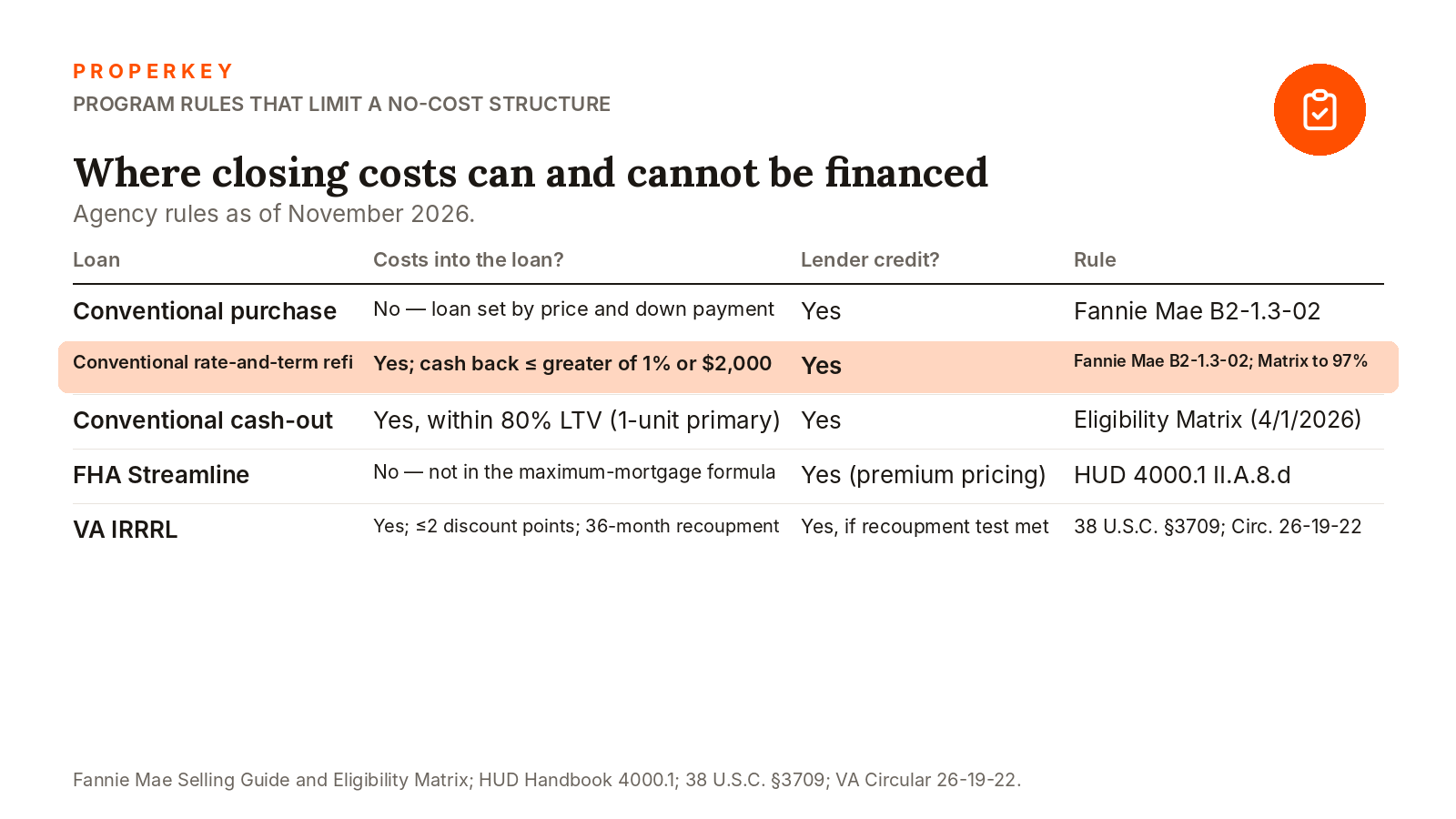
Roll the costs into the loan. On a refinance, Fannie Mae's limited cash-out definition expressly allows "financing the payment of closing costs, points, and prepaid items" into the new loan, with cash back to the borrower capped at the greater of 1% of the new loan or $2,000 (Selling Guide B2-1.3-02). On a purchase, the loan amount is fixed by the price and the down payment, so costs cannot be added to it; only a credit can absorb them.
Take a lender credit. The lender pays some or all of the costs and charges a higher note rate. The CFPB calls these "negative points" and notes that "the more lender credits you receive, the higher your rate will be." On the Loan Estimate and Closing Disclosure the credit appears "as a negative number as part of the Lender Credits line item on page 2, Section J" (12 CFR 1026.37(g)(6)(ii)). Points work in reverse: one point is 1% of the loan amount paid up front to buy the rate down, by "about 0.25%" in Freddie Mac's example, though the CFPB stresses the amount "depends on the specific lender, the kind of loan, and the overall mortgage market" (Freddie Mac; CFPB).
The arithmetic on a $500,000 loan
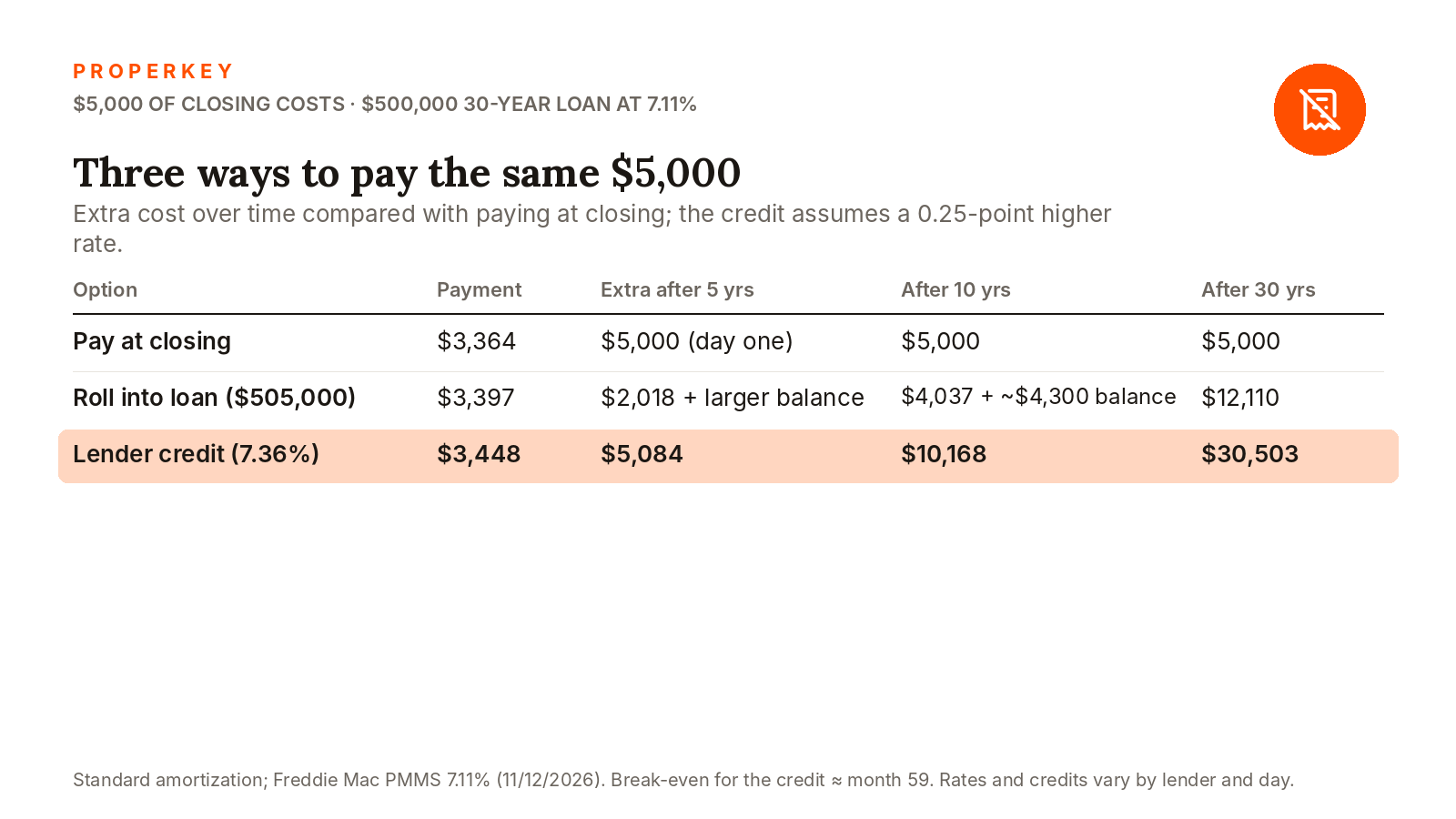
Take $5,000 of costs and a 30-year fixed loan. Paid at closing: the payment at 7.11% is $3,363.53, and the $5,000 is gone on day one. Rolled in: the loan becomes $505,000 and the payment $3,397.17, $33.64 more a month, or $12,110 more over 30 years, and after ten years the balance is about $4,300 higher than it would have been. Lender credit: the rate becomes 7.36% on $500,000 and the payment $3,448.27, $84.73 more a month. The credit pays for itself at month 59; after ten years it has cost $10,168, after 30 years $30,503.
The ranking flips with time. A borrower who sells or refinances inside five years comes out ahead with the credit, because the lender covered costs the borrower never got to amortize. A borrower who keeps the loan ten years or more pays two to six times the original costs. Rolling costs into the balance sits in between: cheaper than a credit over any long horizon, but it raises the loan-to-value ratio, which can push a conventional borrower into mortgage insurance or a worse pricing tier and is simply unavailable on a purchase.
Where no-closing-cost loans make sense in 2026
Three situations fit. The first is a short expected hold: a move within a few years, or a loan the borrower intends to refinance when rates fall. With Freddie Mac at 7.11%, Fannie Mae forecasting 7.5% through 2027 and MBA forecasting rates above 7%, a borrower betting on a near-term refinance should be honest that no major forecaster puts a date on it; Properkey's 2027 rate forecast lays the three forecasts side by side. The second is a cash-constrained purchase, where a credit funds the costs that a down-payment-assistance program or gift does not cover. The third is a refinance that lowers the rate enough that even the credit-inflated rate beats the old one, which describes very few Californians today: refinance applications are down 57% from a year ago and about 49% of outstanding mortgages carry a rate under 4% (MBA via HousingWire, week ending Nov. 6; Realtor.com via HousingWire).
The wrong situation is a 30-year loan the borrower plans to keep, funded with a credit because the alternative felt expensive at the table. The credit is the most expensive form of financing on the Closing Disclosure.
Program rules that limit the options
FHA Streamline. The maximum new loan is the outstanding balance plus interest due and the mortgage insurance premium, less any upfront-premium refund; closing costs are not in the formula and so cannot be financed. A "no-cost" streamline is a premium-priced one: HUD allows premium pricing to "pay a Borrower's actual closing costs and prepaid items" (Handbook 4000.1, II.A.8.d).
VA IRRRL. Costs may be financed, up to two discount points may be included in the loan, and the funding fee is 0.5% (38 CFR 36.4307; VA). Federal law requires that fees and costs be "scheduled to be recouped on or before the date that is 36 months after" the loan date, excluding taxes, escrows and the funding fee (38 U.S.C. §3709(a)). A credit that pushes the rate up can fail that test; a House-passed bill that would raise the IRRRL fee to 1.42% is covered in Properkey's H.R. 9237 explainer.
Conventional cash-out. The Eligibility Matrix caps a cash-out refinance on a one-unit primary residence at 80% LTV, while a limited cash-out (rate-and-term, costs rolled in) can go to 97% when Fannie Mae already owns the loan (Fannie Mae Eligibility Matrix).
Protections the paperwork gives you
Once the Loan Estimate shows a lender credit, the lender cannot reduce it at closing unless a valid changed circumstance occurs; a smaller credit counts as an increased charge under the good-faith rule (12 CFR 1026.19(e)(3)(i) and comment 19(e)(3)(i)-5; CFPB TRID FAQs). The Closing Disclosure must arrive at least three business days before signing (§1026.19(f)), and a refinance with a new lender carries a three-business-day right of rescission after signing (§1026.23). Ask for two Loan Estimates from the same lender, one with the credit and one without, dated the same day; the only honest comparison is the same lender on the same day, since rates move daily. Points on a refinance are not deductible in the year paid but are spread over the loan term, and points on a purchase of a main home generally are deductible (IRS Publication 936). Properkey's guide to refinance closing costs and taxes has the detail.
Properkey's finance desk works the other way around from a no-cost advertisement: one application, every lender shopped, and the credit and no-credit versions of the same loan priced side by side so the break-even month is on paper before anyone signs.
Questions people ask
Is a no-closing-cost refinance really free? No. Freddie Mac's refinancing page says plainly that "there is no such thing as a free loan." The costs are paid through a higher rate or a larger balance. A $5,000 credit on a $500,000 loan costs about $85 a month and breaks even at roughly 59 months.
How much does a lender credit raise the rate? There is no fixed ratio. Freddie Mac's example is a quarter point of rate per point of cost, but the CFPB notes the trade depends on the lender, the loan and the market. Compare two Loan Estimates from the same lender on the same day.
Can closing costs be rolled into a purchase loan? Not into the first mortgage; the loan amount is set by the price and the down payment. On a purchase, costs are covered by the buyer's cash, a seller credit, down-payment assistance or a lender credit. On a refinance, Fannie Mae allows costs, points and prepaids to be financed.
Does a no-cost loan hurt me if I sell in two years? Usually the opposite. A borrower who leaves the loan before the break-even month, about five years in the example above, paid less in total than one who paid the costs in cash.
This is a summary of lending rules and arithmetic, not financial or tax advice.
Sources: CFPB, lender credits; CFPB, compare Loan Estimates; CFPB, closing costs; CFPB, points; CFPB TRID FAQs; 12 CFR 1026.37; 12 CFR 1026.19; 12 CFR 1026.23; Freddie Mac, closing costs; Freddie Mac, costs of refinancing; Freddie Mac, discount points; Fannie Mae B2-1.3-02; Fannie Mae Eligibility Matrix; HUD Handbook 4000.1; 38 CFR 36.4307; 38 U.S.C. §3709; VA funding fee; IRS Pub. 936; Freddie Mac PMMS; HousingWire, MBA applications; HousingWire, rate lock-in.
Written by Keyro, Properkey's AI. Properkey, DRE #01979718.



