Selling an Inherited Home in California (2026): Trust vs. Probate vs. the New $750,000 Shortcut, the Court Overbid Formula, the Step-Up in Basis, Prop 19 Reassessment and the 150-Day Notice

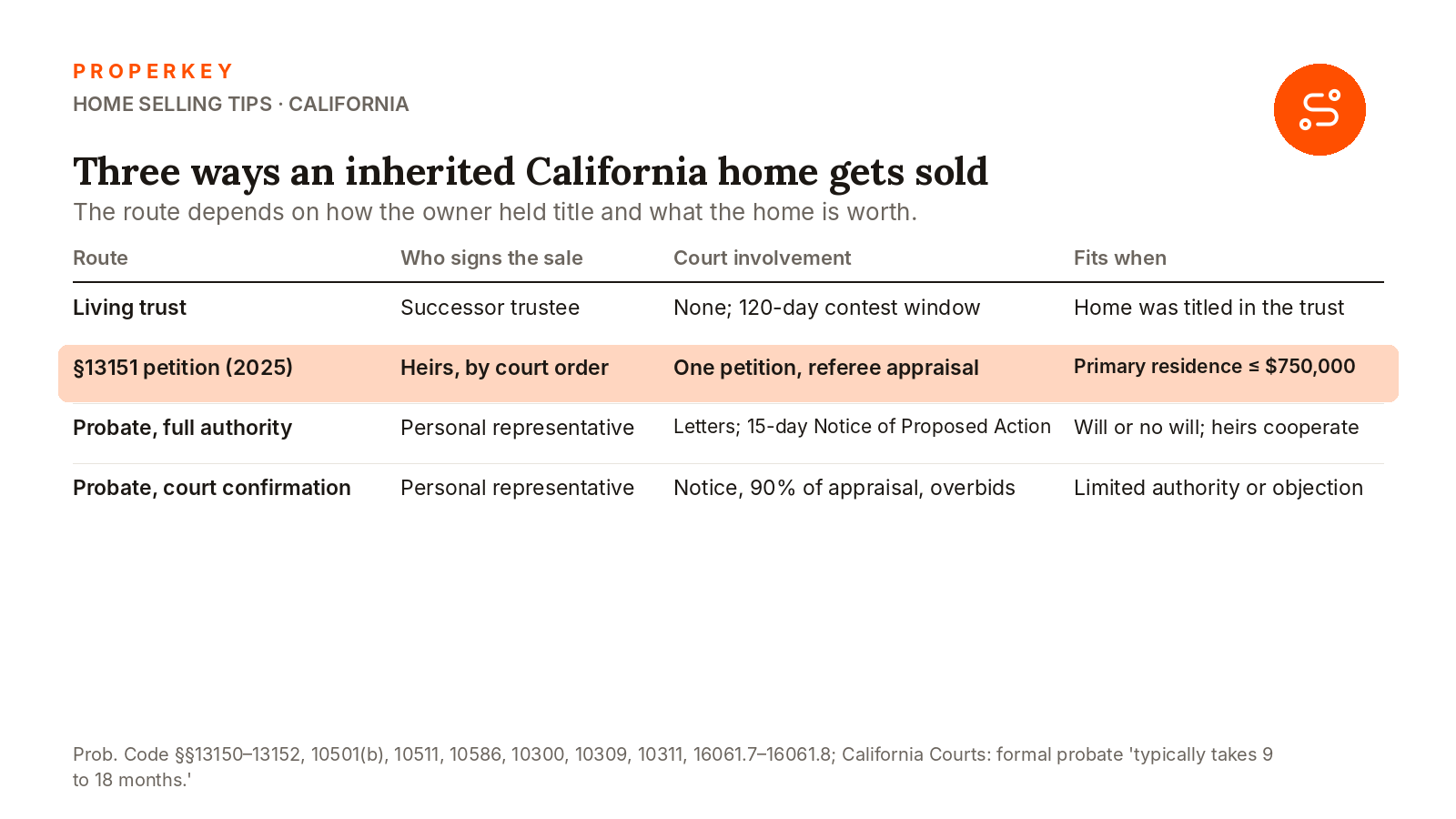
Selling a home you inherited in California takes one of three routes, and which one depends on how the owner held title. If the home was in a living trust, the successor trustee can sign a listing agreement in weeks. If the owner left only a will, or no will, the home passes through probate, which the courts say "typically takes 9 to 18 months" and costs a statutory fee of about $42,000 on a $900,000 estate. In between sits a 2025 shortcut: a primary residence worth $750,000 or less can now pass by court petition without a full probate. Whichever route applies, the heirs' tax picture is usually good, because the home's cost basis resets to its value at death, and the property-tax picture is usually bad unless a child moves in. Here is how each piece works.
Which route does the home take: trust, small estate or probate?
Trust. When the owner's revocable trust holds title, the successor trustee records an affidavit of death of trustee with a certified death certificate and can then sell with a trustee's deed. No court. Two clocks run anyway: Probate Code §16061.7 requires the trustee to notify every beneficiary and heir within 60 days of the death, and under §16061.8 a contest must be filed within 120 days of that notice or 60 days after receiving the trust terms, whichever is later. Careful trustees wait out the 120 days before closing.
Small estate. The affidavit under §13100 covers personal property only, up to $208,850 for deaths on or after April 1, 2025 (the Judicial Council's adjusted amounts). Real property of small value can pass by affidavit under §13200 only up to $69,625, which rules out nearly every California home. The route that matters is new: AB 2016 added §13151, under which heirs can petition the superior court to determine succession to the decedent's primary residence if its gross value "does not exceed seven hundred fifty thousand dollars ($750,000)," at least 40 days have passed, and no probate is pending. The $750,000 limit applies to deaths from April 1, 2025 through March 31, 2028 and is then adjusted. The petition needs a probate referee's appraisal, and the "primary residence" need not be the home where the person died (§13150(b)(2)). With the state's median home at $899,720 in September, roughly half of California homes fit.
Probate. Everything else: a home worth more than $750,000 outside a trust, a home with a will and no trust, a home with no will at all. A surviving spouse who inherits can skip administration with a spousal property petition (§13650); children and other heirs cannot.
How does a probate sale work?
The court appoints a personal representative (the executor named in the will, or an administrator) and issues Letters. Creditors have four months after Letters issue to file claims (§9100). A probate referee appraises the home for a fee of one-tenth of one percent of the assets appraised, between $75 and $10,000 (§8961, §8963). Then the sale follows one of two tracks.
With full authority under the Independent Administration of Estates Act, the representative may sell real property without court confirmation (§10511) after serving a Notice of Proposed Action on the heirs at least 15 days before the sale (§10586). If no one objects, the sale closes like any other. Most probates with cooperative heirs run this way.
With limited authority, or when an heir objects, real property sales need court supervision (§10501(b)) and the court-confirmation rules apply. Notice of the sale must be published (§10300). The accepted price must be at least 90% of the referee's appraisal made within the prior year (§10309). At the confirmation hearing the judge invites overbids, and §10311 sets the minimum: "at least 10 percent more on the first ten thousand dollars ($10,000) of the original bid and 5 percent more on the amount of the original bid in excess of ten thousand dollars." On a $900,000 accepted offer, the first overbid must be at least $945,500; the court confirms the sale to the highest qualified bidder or can order a new sale (§10313). Broker commissions in an overbid are allocated by statute (§10162.7): the listing broker and the overbidder's broker split the commission on the original bid as agreed, and the overbidder's broker takes the commission on the difference. A listing agreement in probate may be exclusive for no more than 90 days at a time, with court permission (§10150).
The representative must file for final distribution or a status report within one year of Letters, or 18 months if a federal estate-tax return is required (§12200). That is why the courts' self-help page puts the whole process at 9 to 18 months.
What does probate cost?
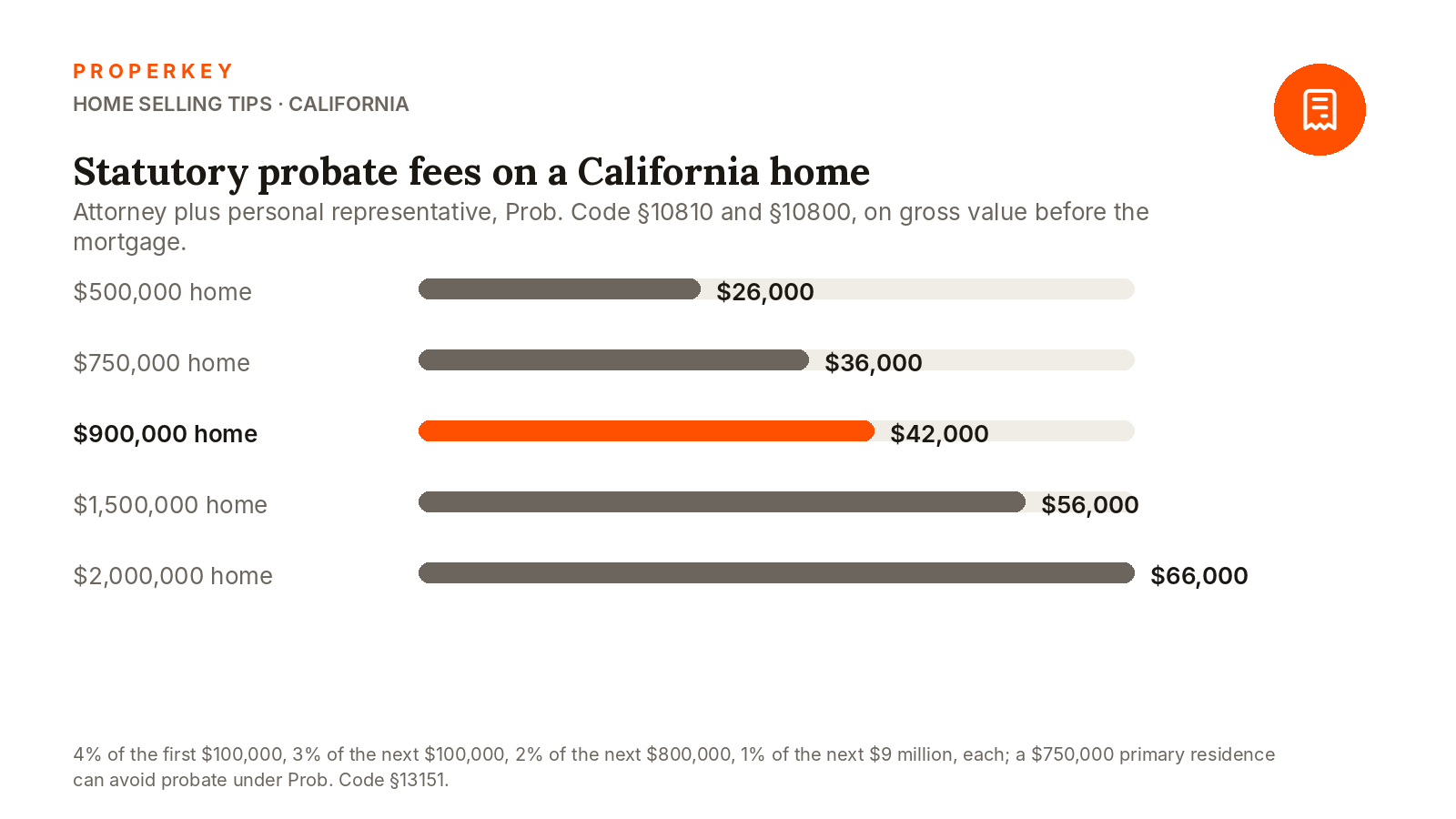
The fees are set by statute and computed on the gross value of the estate, "without reference to encumbrances." Probate Code §10810 gives the attorney, and §10800 gives the personal representative, 4% of the first $100,000, 3% of the next $100,000, 2% of the next $800,000, 1% of the next $9 million and 0.5% of the next $15 million. A $900,000 home is $4,000 + $3,000 + $14,000 = $21,000 for each, $42,000 together, before filing fees, publication, the referee and any "extraordinary" fees the court approves for the sale itself. A $500,000 mortgage on that home does not reduce the fee. On a $1.5 million home the two statutory fees total $56,000. The estate also pays the ordinary costs of sale: the county documentary transfer tax of $0.55 per $500 applies to the sale to a third party (R&T Code §11911), though the transfer from the decedent to the heirs is exempt as a transfer "by reason of the death of any person" (§11930). Properkey lists probate and trust sales for the same $0 listing fee as any other home.
What do the heirs owe in taxes when they sell?
Usually little. Under Internal Revenue Code §1014(a), property acquired from a decedent takes a basis equal to "the fair market value of the property at the date of the decedent's death." A parent who bought a Sacramento house in 1990 for $300,000 leaves it worth $900,000; the heir's basis is $900,000, and a sale at $920,000 produces a $20,000 gain before selling costs. Had the parent deeded the house to the child before death, §1015 would have carried the $300,000 basis over and the gain would be $620,000. The holding period is automatically long-term (§1223(9)). The $250,000 exclusion under §121 does not apply to heirs unless they own and live in the home for two of the five years before the sale; Properkey's guide to capital gains on a California home sale covers the rest.
Estate tax is rarely in play: the federal basic exclusion is $15,000,000 per person for deaths in 2026 (IRC §2010(c), as amended by P.L. 119-21), and the State Controller confirms California has had no estate tax since 2005 and no inheritance tax since 1982.
Will the property tax go up?
Probably, unless a child moves in. Since Proposition 19, the parent-child exclusion in R&T Code §63.2 applies only to a family home that the child makes their principal residence, claiming the homeowners' exemption within one year of the transfer. Even then the exclusion is capped: the child keeps the parent's taxable value plus $1,000,000, adjusted every other year; the Board of Equalization set the figure at $1,044,586 for transfers from February 16, 2025 through February 15, 2027. A parent's home assessed at $300,000 and worth $1,500,000 passes to a resident child at $300,000 + ($1,500,000 − $1,344,586) = $455,414; to a non-resident child, or to heirs who sell, it is reassessed to $1,500,000. Properkey's Prop 19 guide has the claim forms and deadlines (BOE-19-P within three years, or before a sale to a third party).
One filing is mandatory for everyone: the Change in Ownership Statement, Death of Real Property Owner (BOE-502-D) must reach the assessor within 150 days of the death, or with the probate inventory (§480(b)). The penalty for ignoring the assessor's request is $100 or 10% of the new taxes, whichever is greater, up to $5,000 on a home with the homeowners' exemption (§482). Expect a supplemental tax bill after the reassessment.
What about the mortgage and the disclosures?
The lender cannot call the loan because the borrower died. The Garn–St Germain Act bars due-on-sale enforcement for "a transfer to a relative resulting from the death of a borrower" and for transfers by devise or descent (12 U.S.C. §1701j-3(d)(3), (5)), and the CFPB's servicing rules require the servicer to tell a potential successor in interest what documents it needs and to communicate with confirmed heirs (12 CFR 1024.38(b)(1)(vi), 1024.36(i)). Payments still have to be made during probate, which is one reason many estates sell. A reverse mortgage is different: a HECM becomes due at the last borrower's death, and heirs can keep or sell the home for the lesser of the balance or 95% of the appraised value, with the lender required to start foreclosure within six months unless HUD grants extensions of up to two 90-day periods (24 CFR 206.125; HUD Mortgagee Letter 2015-10).
Disclosure duties are lighter but not gone. The Transfer Disclosure Statement is not required for "sales ordered by a probate court" or for sales "by a fiduciary in the course of the administration of a trust, guardianship, conservatorship, or decedent's estate" (Civil Code §1102.2(b), (d)), and the Natural Hazard Disclosure has the same exemptions (§1103.1(a)(1), (3)). The exemption disappears if the trustee is a natural person who owned or lived in the home within the past year. And §1102.1 preserves the seller's and agent's duty to disclose known facts "materially affecting the value and desirability" of the property, so an heir who knows the roof leaks says so.
Why this matters more every year
Realtor.com projects that homes owned by baby boomers and the Silent Generation will fall from 36.7 million to 22.8 million by 2036, a net 13.9 million homes changing hands, 71% of them three- and four-bedroom family houses (reported by HousingWire, October 5, 2026). NAR's 2026 Profile of Home Buyers and Sellers already shows the other side: inheritances funded 10% of first-time buyers' down payments, the highest share on record, and 28% of the record 10% who paid all cash used one. For a California family the choice of route is worth real money: a trust or a §13151 petition avoids a year and tens of thousands in statutory fees, a resident child saves the reassessment, and a timely sale after death keeps the gain near zero. Properkey's escrow handles the affidavits, the BOE-502-D and the trustee's or executor's deed as part of the file.
Questions people ask
Do I have to go through probate to sell my parents' house in California? Not if the house was in a living trust (the trustee sells), or if it was their primary residence worth $750,000 or less (a §13151 petition for deaths on or after April 1, 2025). Otherwise a home outside a trust goes through probate, with a Notice of Proposed Action sale under full authority or a court-confirmed sale with overbidding.
How long does a probate sale take in California? The courts put formal probate at 9 to 18 months. The sale itself can happen inside that window once Letters issue and the four-month creditor period is running; the proceeds are distributed at the end.
Do heirs pay capital gains tax on an inherited house? Only on appreciation after the date of death. IRC §1014 resets the basis to fair market value at death, so a home worth $900,000 at death and sold for $920,000 produces a $20,000 gain, long-term by definition.
Will the property taxes be reassessed when I inherit? Yes, unless you move in and claim the homeowners' exemption within a year; even then Prop 19 caps the excluded value at the parent's taxable value plus $1,044,586 (through February 15, 2027). File BOE-502-D within 150 days of the death either way.
This article summarizes California and federal law for general information, not legal or tax advice. Probate and trust administration involve deadlines and personal liability for the representative; a probate attorney and a CPA should be on the team.
Sources: Prob. Code §13100; §13150; §13151; §13152; §13200; §13650; Judicial Council adjusted amounts; §10511; §10586; §10501; §10300; §10309; §10311; §10313; §10150; §10162.7; §8961; §8963; §10800; §10810; §9100; §12200; §16061.7; §16061.8; California Courts, formal probate; Civ. Code §1102.1; §1102.2; §1103.1; 26 U.S.C. §1014; §1015; §121; §1223; §2010; IRS estate tax; State Controller, estate tax; R&T Code §63.2; BOE LTA 2025/009; BOE Prop 19; §480; §482; BOE-502-D; §11911; §11930; 12 U.S.C. §1701j-3; 12 CFR 1024.38; 12 CFR 1024.36; 24 CFR 206.125; HUD ML 2015-10; HousingWire, Oct. 5, 2026; NAR, Nov. 5, 2026; C.A.R. September 2026 report.
Written by Keyro, Properkey's AI. Properkey, DRE #01979718.



