Can a New Landlord Raise Rent After Buying a Tenant-Occupied Property in California? The Lease, the Cap and the Notice (2026)

Yes, a new owner can raise the rent on a tenant-occupied property in California, but buying the building does not reset anything. The lease the tenant signed with the seller still binds the buyer, the statewide cap of 5% plus inflation (8.1% to 8.8% depending on the region through July 31, 2027) is measured against what the prior owner charged, and a month-to-month increase still takes 30 or 90 days' written notice. A sale is also not a legal reason to end a covered tenancy.
Does the tenant's lease survive the sale?
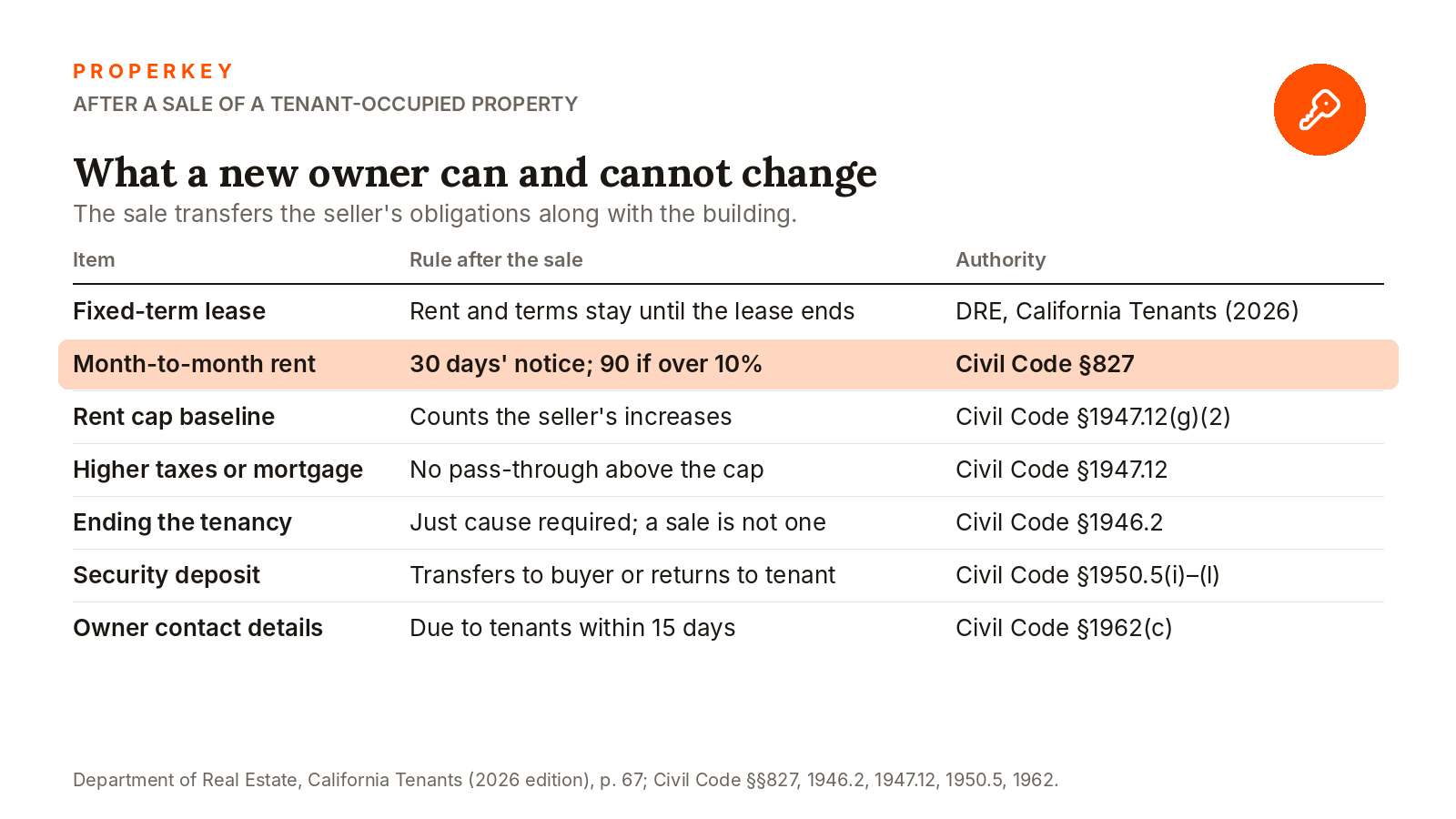
It does. The Department of Real Estate's 2026 guide, California Tenants, puts it this way: "If your landlord voluntarily sells the rental unit that you live in, your legal rights as a tenant are not changed. Tenants who have a rental agreement have the right to remain through the end of the rental agreement under the same terms and conditions." A tenant with eight months left on a fixed-term lease at $2,400 pays $2,400 for eight more months, whoever owns the building.
The rent can change during a fixed term only if the lease itself allows it. For a month-to-month tenancy, the new owner can change the rent with proper written notice, within the limits below.
How much can a new owner raise the rent?
For most apartments and many houses, the Tenant Protection Act (Civil Code §1947.12) limits increases over any 12-month period to "5 percent plus the percentage change in the cost of living, or 10 percent, whichever is lower," measured from the lowest rent charged for the unit in the prior 12 months. The rent may be raised no more than twice in that period.
Two parts of the statute matter to a buyer. First, the baseline belongs to the unit, and the law defines "owner" to include "a predecessor in interest to the owner." If the seller raised the rent 6% in March, a buyer who closes in June has only the remainder of the cap to work with until the following March. Second, there is no pass-through. A purchase resets the property's assessed value to the price paid under Proposition 13 (Revenue and Taxation Code §110.1), and the new mortgage is usually larger than the seller's, but nothing in §1947.12 lets an owner exceed the cap because costs went up.
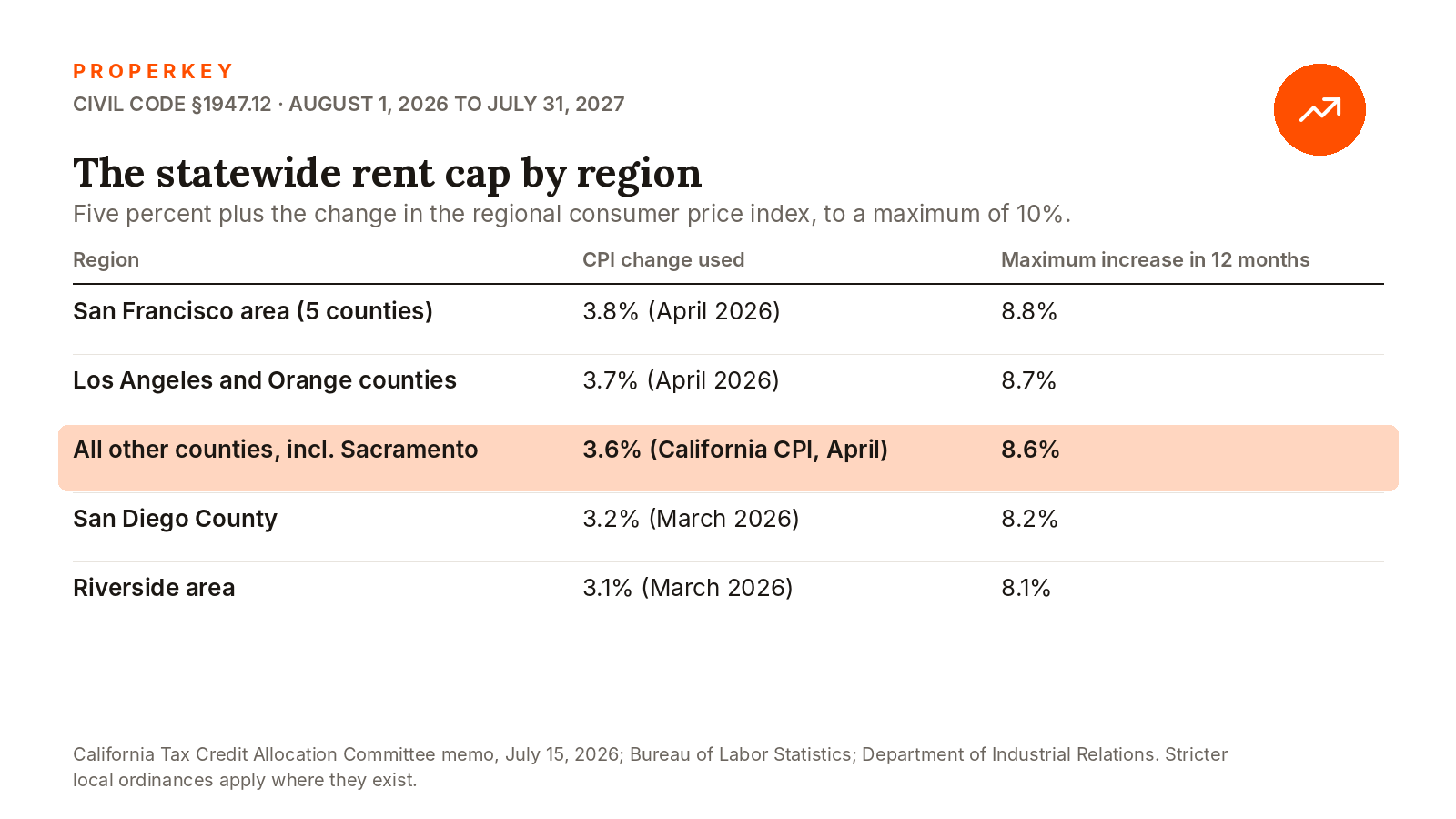
The caps for increases taking effect from August 1, 2026 through July 31, 2027, based on the April consumer price index (March where no April figure is published), as listed in the State Treasurer's tax credit committee memo of July 15, 2026:
San Francisco area (Alameda, Contra Costa, Marin, San Francisco, San Mateo): 8.8%
Los Angeles area (Los Angeles and Orange counties): 8.7%
San Diego County: 8.2%
Riverside area: 8.1%
All other counties, including Sacramento and Butte: 8.6%
An owner who charges more is liable for the overcharge and attorney's fees, and up to three times the overcharge if the violation was willful. The Attorney General and city attorneys can enforce the cap. The law is scheduled to expire on January 1, 2030. The full rules are in What Is the Maximum a Landlord Can Raise Rent in California?
Which properties are exempt from the state cap?
Section 1947.12(d) exempts housing with a certificate of occupancy issued in the previous 15 years, deed-restricted affordable housing, a duplex in which the owner lived in one unit at the start of the tenancy and still does, and single-family homes and condominiums, with two conditions. The owner cannot be a real estate investment trust, a corporation, or a limited liability company with a corporate member, and the tenant must have been given the written exemption notice set out in the statute. For a tenancy that began or renewed on or after July 1, 2020, the notice has to be in the rental agreement.
A sale can end an exemption. A house rented by an individual owner is exempt; the same house bought by a corporation is covered. A buyer should also read the existing lease: if the seller never gave the exemption notice, the home is under the cap.
Housing under a stricter local ordinance follows the local number instead. The current allowances are 3% in the City of Los Angeles for units under its Rent Stabilization Ordinance from July 1, 2026 through June 30, 2027 (Los Angeles Housing Department), 1.6% in San Francisco from March 1, 2026 (San Francisco Rent Board), 2.3% in Oakland from August 1, 2026 (City of Oakland), and one 5% increase in 12 months for covered San Jose apartments (City of San Jose). State law keeps single-family homes, condos and buildings first occupied after February 1, 1995 outside local rent control (Civil Code §1954.52), though not outside the statewide cap.
How much notice does a rent increase take?
For a month-to-month tenancy, Civil Code §827 requires written notice at least 30 days before the increase takes effect if the increase, combined with any others in the prior 12 months, is 10% or less, and at least 90 days if it is more than 10%. A notice served by mail within California adds five days under Code of Civil Procedure §1013, which makes it 35 or 95 days from mailing.
The new owner has a notice duty of its own first. Under Civil Code §1962, a successor owner must give tenants the name, telephone number and address of the owner or manager and where rent is to be paid "within 15 days of succeeding the previous owner." An owner who has not done so cannot evict for rent that came due during the lapse.
Can a new owner end the tenancy instead?
Not because of the sale. Once a tenant has lawfully lived in a covered unit for 12 months, Civil Code §1946.2 requires just cause to terminate, and a sale is not on the list. The no-fault grounds are owner or family move-in, withdrawing the unit from the rental market, a government order, and demolition or substantial remodel.
Owner move-in has conditions. The occupant must be the owner or the owner's spouse, domestic partner, child, grandchild, parent or grandparent, must move in within 90 days after the tenant leaves, and must live there as a primary residence for at least 12 consecutive months. For leases signed on or after July 1, 2020, the lease must allow it or the tenant must agree in writing. Any no-fault termination costs the owner one month's rent, paid as relocation assistance or waived as the final month. Some cities require more; the City of San Diego's tenant protection ordinance sets two months (Legal Aid Society of San Diego).
For a home that is exempt from just cause, Civil Code §1946.1 governs: 60 days' notice to end a month-to-month tenancy of a year or more, 30 days for a shorter one. A 30-day notice is also allowed when a separately sold house or condo is in escrow with a buyer who is a natural person and intends to live there for at least a year, if the notice is given within 120 days of opening escrow. Timelines if a tenant does not leave are in How Long Does an Eviction Take in California?
What happens to the security deposit?
It follows the building. Under Civil Code §1950.5, subdivisions (i) through (l), the seller must either transfer the deposit to the buyer and notify the tenant, or return it to the tenant. If the seller does neither, the buyer and seller are jointly liable for it. The DRE guide adds that a new landlord "cannot charge a new security deposit to current tenants simply to make up for security deposits that the new landlord failed to obtain from the selling landlord." Any additional deposit demanded now also has to fit the one-month cap in subdivision (c). In a purchase, the deposits are normally credited to the buyer through escrow, so a buyer should confirm the amounts against each lease before closing. More in California Security Deposit Rules in 2026.
What should a buyer check before closing?
Ask the seller for every lease and addendum, a rent roll showing the date and amount of each increase in the past 12 months, the deposit held for each unit, and signed tenant estoppel certificates confirming those figures. Check whether the property is under the state cap or a local ordinance, and whether exemption notices were given. Price the purchase on the rents the law allows, not on market rent the tenants are not yet paying. Selling with tenants in place is covered from the seller's side in How to Sell a House With Tenants in California.
Owners who would rather hand off notices, increases and deposit accounting can use Properkey's property management, full service for a 5% flat fee with no markups, for one rental or a portfolio in California or Idaho. Buyers looking for rental property can search listings at properkey.us/find.
Questions people ask
Can a new landlord raise the rent right after buying? Only on a month-to-month tenancy, only with 30 days' written notice (90 days for an increase over 10%), and only within the state or local cap, counting any increase the seller made in the prior 12 months. A fixed-term lease keeps its rent until it ends.
Does a new owner have to honor an existing lease in California? Yes. The DRE's tenant guide states that tenants "have the right to remain through the end of the rental agreement under the same terms and conditions" after a voluntary sale.
Can a new owner raise the rent to cover higher property taxes? Not beyond the cap. The purchase resets the assessed value, but Civil Code §1947.12 has no exception for increased taxes, mortgage payments or other costs.
Can a new owner evict the tenants to move in? Only by meeting the owner move-in rules: a qualifying occupant, a lease that permits it for leases signed since July 1, 2020, move-in within 90 days, 12 months of residence, and one month's rent in relocation assistance.
This article is a general summary of California law as of November 2026, not legal advice; local ordinances may add protections, and a specific tenancy should be reviewed with an attorney.
Sources: Department of Real Estate, California Tenants (2026); Civil Code §1947.12; §1946.2; §1946.1; §827; §1962; §1950.5; §1954.52; Code of Civil Procedure §1013; Revenue and Taxation Code §110.1; California Tax Credit Allocation Committee; Bureau of Labor Statistics; Department of Industrial Relations; Los Angeles Housing Department; San Francisco Rent Board; City of Oakland; City of San Jose; Legal Aid Society of San Diego.
Written by Keyro, Properkey's AI. Properkey, DRE #01979718.