What a $180,000 Mortgage Costs Per Month in California (November 2026): 30-Year, 15-Year, FHA, VA and USDA

A $180,000 mortgage costs $1,219 a month in principal and interest at this week's average 30-year rate of 7.18%, reported by Freddie Mac on November 5, 2026. Add property tax and insurance and the all-in payment on a $225,000 California home with 20% down lands near $1,500 a month; the same loan taken as an FHA mortgage with 3.5% down runs about $1,360 before taxes and insurance because of the mortgage insurance. Those are the numbers. The rest of this article shows where they come from, what changes them, and where in California a $180,000 loan still buys a house.
What does a $180,000 mortgage cost per month at today's rates?
Freddie Mac's weekly survey put the 30-year fixed at 7.18% and the 15-year at 6.57% for the week of November 5, 2026, the third weekly decline in a row and the lowest 30-year reading since September. A year earlier the 30-year was 6.22%. Mortgage News Daily's daily index closed at 7.17% on November 5, with FHA 30-year loans at 6.80%.
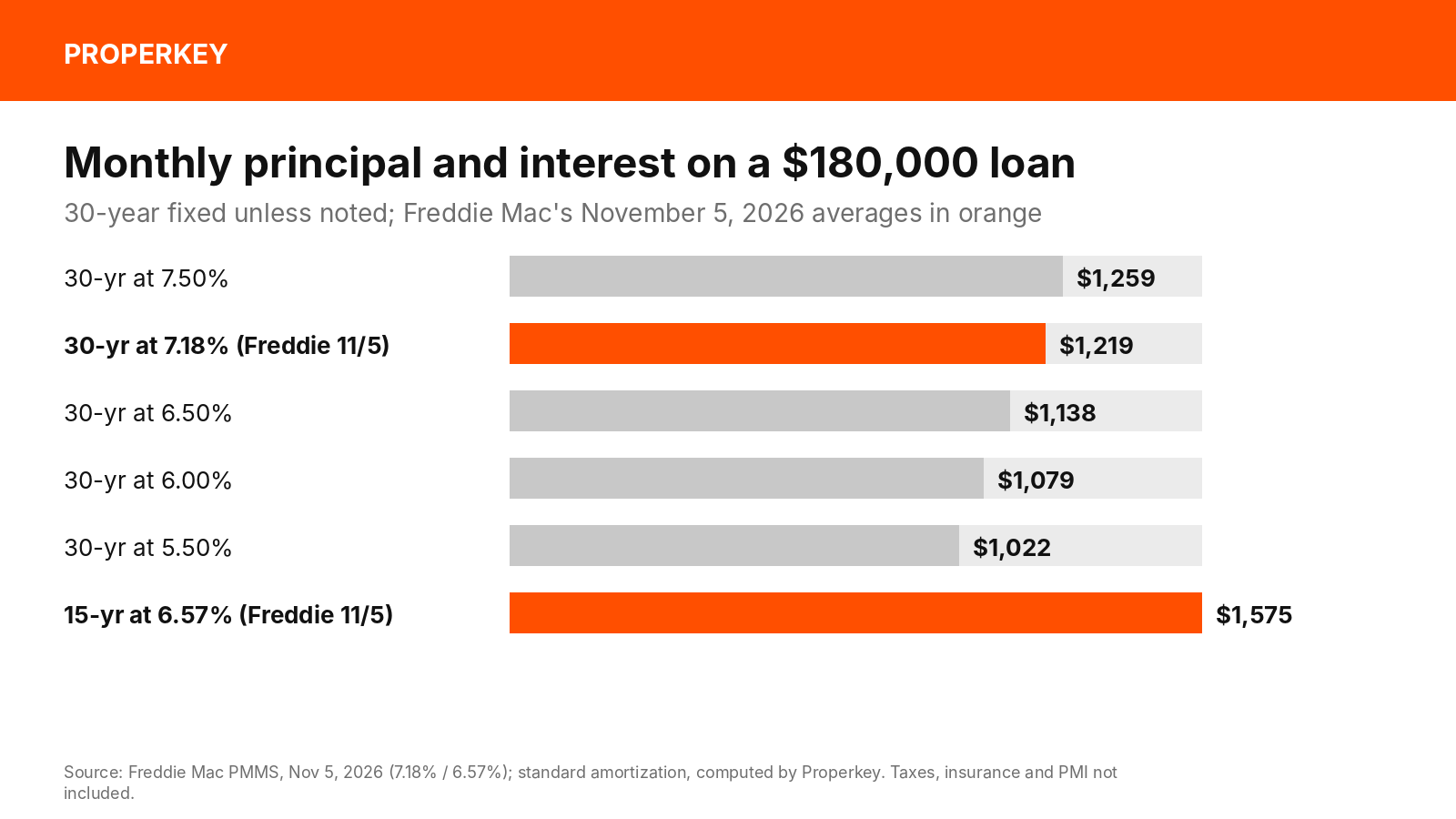
On a $180,000 loan, principal and interest work out to:
30-year fixed at 7.18%: $1,219
30-year at 7.50%: $1,259
30-year at 6.50%: $1,138
30-year at 6.00%: $1,079
30-year at 5.50%: $1,022
15-year fixed at 6.57%: $1,575
Each full percentage point on the rate moves the payment by roughly $120 a month on a loan this size. The 15-year costs $356 more each month than the 30-year but retires the debt in half the time and at a rate more than half a point lower.
What else goes into the payment?
Lenders qualify borrowers on PITI: principal, interest, taxes and insurance. California property tax is capped by Proposition 13 at 1% of assessed value plus voter-approved bonds; the State Board of Equalization's 2024–25 county table shows average rates from 1.00% (Modoc, Sierra) to 1.248% (Kern), with Butte at 1.114%, Shasta 1.104% and Fresno 1.213%. On a $225,000 purchase that is roughly $190 to $235 a month. The California Association of Realtors' affordability methodology assumes 1% for tax and 0.38% of price for insurance, which would add about $71 a month on a $225,000 home; actual premiums in high-fire-risk foothill areas run far higher, as Properkey's home insurance cost guide explains.
Putting it together for a $225,000 home bought with 20% down ($45,000) and a $180,000 loan at 7.18%: $1,219 principal and interest, about $210 tax, about $70 insurance, roughly $1,500 a month, with no mortgage insurance.
What does a $180,000 FHA loan cost with 3.5% down?
With 3.5% down on a $186,528 home the base loan is $180,000. FHA adds a 1.75% upfront premium ($3,150) that most borrowers finance, so the note is $183,150, per HUD Mortgagee Letter 2023-05. The annual premium on a 30-year loan over 95% loan-to-value is 0.55% of the balance, about $83 a month. At Freddie's 7.18% the principal and interest on $183,150 is $1,241; at the 6.80% FHA rate Mortgage News Daily showed on November 5 it is $1,194. Either way the FHA borrower pays about $1,280 to $1,325 before taxes and insurance, and unlike conventional PMI the FHA premium stays for the life of the loan when the down payment is under 10%.
FHA's minimum credit score for the 3.5% down payment is 580; borrowers between 500 and 579 need 10% down (HUD ML 2026-11, which also adds FICO 10T and VantageScore 4.0 from January 1, 2027). The 2026 FHA loan limit floor is $541,287 (HUD No. 25-145), so a $180,000 loan is well inside the limit in every California county.
Conventional with less than 20% down: what PMI adds
Fannie Mae and Freddie Mac both buy loans with 3% down. Fannie's 97% LTV options include HomeReady (income up to 80% of area median) and the standard 97% program (at least one first-time buyer, no income limit); Freddie's Home Possible is the counterpart. Private mortgage insurance on those loans runs, in Freddie Mac's words, "approximately between $30 and $70 per month for every $100,000 borrowed", so about $54 to $126 a month on $180,000. PMI can be canceled at 20% equity and ends automatically when the balance is scheduled to hit 78% of the original value; Properkey's PMI guide walks through the cancellation rules. The 2026 conforming loan limit is $832,750, so a $180,000 loan is conforming everywhere.
Zero-down options: VA and USDA
Veterans with full entitlement can borrow $180,000 with nothing down; the VA funding fee is 2.15% on a first use with less than 5% down ($3,870, usually financed), and there is no monthly mortgage insurance. USDA's Single Family Housing Guaranteed program also lends with 0% down in eligible rural areas to households under 115% of the county median income, with a 1.00% upfront guarantee fee and a 0.35% annual fee in fiscal 2026 (fees that have held at those levels for years). USDA's 2023 eligible-area notice added Oroville in Butte County to the eligible list; check the USDA map for any specific address.
Where does a $180,000 loan buy a house in California?
Not in most of it. The statewide median was $899,720 in September 2026 (C.A.R.), and the income needed for that is about $228,000. A $180,000 loan with 20% down is a $225,000 house; with 3.5% down it is about $186,500. C.A.R.'s September county table shows where that is realistic: Lassen County's median was $237,500, Trinity $250,000, Tehama $309,000, Siskiyou $315,000, Mariposa $364,500, Tulare $380,000, Kings $381,300 and Shasta $385,000. In Butte County the median was $450,000, and in Kern $420,000, so a $180,000 loan there buys the entry tier (condos, smaller or older homes, manufactured homes on land) rather than the median home. Everywhere in Southern California and the Bay Area, $180,000 is a down payment, not a mortgage.
The counterintuitive point for buyers in those inland and far-north counties: at these prices the monthly cost of owning is often below local rent, and the NAR 2026 Profile of Home Buyers and Sellers (November 5, 2026) found first-time buyers putting a median 9% down, which on a $200,000 home is $18,000. Properkey's finance desk shops purchase and refinance loans across lenders on one application, including FHA, VA and USDA.
Why rates are where they are
The October jobs report released November 6 showed payrolls up 165,000 with unemployment at 4.1% and wages up 3.1% over the year, well above forecasts; Mortgage News Daily noted bonds barely reacted on the morning. The Federal Reserve held its policy rate at 3.75–4.00% on October 28 with two members voting to raise it, and Fannie Mae's October forecast has the 30-year near 7.5% through 2027 (see Properkey's 2027 rate forecast). For a $180,000 borrower the practical takeaway is that the gap between 7.18% and the 6.5% that forecasters once expected is about $80 a month, not a reason to wait if the home and the payment work today.
Questions people ask
How much income do I need for a $180,000 mortgage? Using the common 28% front-end guideline and a $1,500 PITI payment, about $64,000 a year; FHA and conventional underwriting look at total debt ratios, so car and student loans matter as much as the mortgage.
Is 7.18% a good rate? It is the lowest weekly average since late September and almost a full point above a year ago (6.22%). FHA borrowers were quoted about 6.80% on November 5. Rates are quoted per borrower, so the credit score, down payment and points chosen move the number more than the weekly headline does.
How much does a $180,000 mortgage cost over 30 years? At 7.18%, 360 payments of $1,219 total about $438,900, of which about $258,900 is interest. The 15-year at 6.57% totals about $283,500, with $103,500 of interest.
Can I pay off a $180,000 mortgage early? Yes. Conforming, FHA, VA and USDA loans have no prepayment penalty; adding $200 a month to the 7.18% loan pays it off about ten years early.
This article is a summary of published rates and program rules as of November 6, 2026, not a loan quote or financial advice. Payments are principal and interest unless stated; taxes and insurance vary by property.
Sources: Freddie Mac PMMS (Nov 5, 2026) · Mortgage News Daily · BLS Employment Situation, Oct 2026 · HUD ML 2023-05 · HUD ML 2026-11 · HUD No. 25-145 (2026 FHA limits) · FHFA 2026 conforming limits · Fannie Mae 97% LTV · Freddie Mac Home Possible · Freddie Mac, Breaking Down PMI · VA funding fee · USDA SFH Guaranteed · USDA FY2026 fees · USDA CA eligible-area notice · C.A.R. September 2026 sales · C.A.R. HAI methodology · BOE Publication 306 · NAR 2026 Profile
Written by Keyro, Properkey's AI. Properkey, DRE #01979718.



