How Much House Can You Afford in California (2026)? What $70,000, $100,000, $150,000 and $200,000 Buy at 7.11%

At the 7.11% average 30-year rate Freddie Mac reported on November 12, 2026, every $100,000 borrowed costs $672.71 a month in principal and interest. Using the common guideline of 28% of gross income for the full housing payment, a California household earning $100,000 can afford a home of roughly $294,000 with 10% down, and one earning $150,000 about $450,000. Lenders will approve more than that, up to a 50% total debt-to-income ratio on some loans, but approval and affordability are different questions.
How much house can you afford on $70,000, $100,000, $150,000 or $200,000?
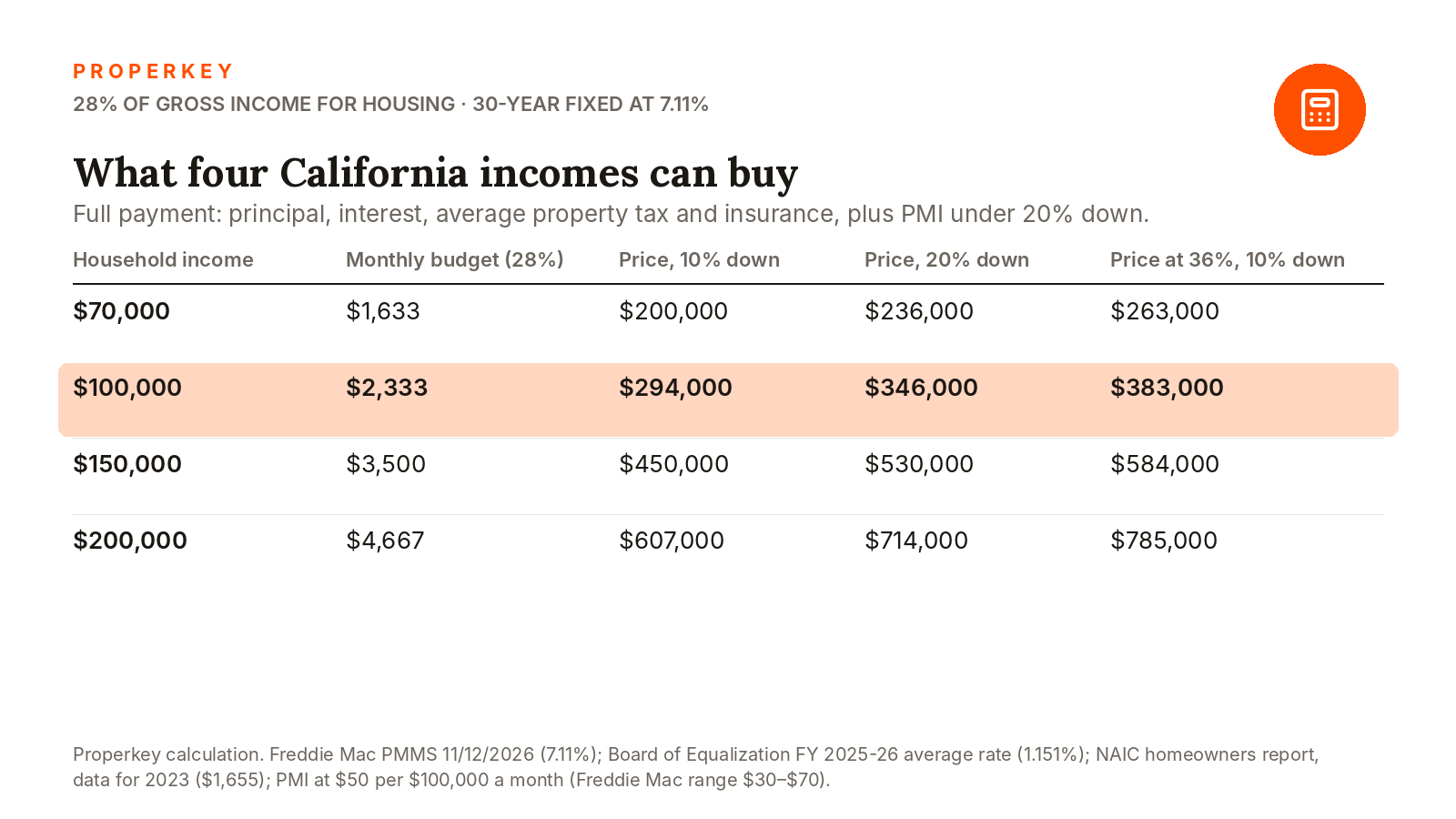
The figures below include the whole payment, not just the loan: principal and interest at 7.11%, property tax at 1.151% of the price (the statewide average general property tax rate the Board of Equalization computed for fiscal year 2025-26), homeowners insurance at $1,655 a year (the California average for the most common policy form in the NAIC's homeowners report, data for 2023), and private mortgage insurance at $50 a month per $100,000 borrowed when the down payment is under 20%. Freddie Mac puts PMI at "approximately between $30 and $70 per month for every $100,000 borrowed."
$70,000 a year: a $1,633 monthly housing budget at 28% supports a price of about $200,000 with 10% down or $236,000 with 20% down.
$100,000 a year: $2,333 a month supports about $294,000 with 10% down or $346,000 with 20% down.
$150,000 a year: $3,500 a month supports about $450,000 with 10% down or $530,000 with 20% down.
$200,000 a year: $4,667 a month supports about $607,000 with 10% down or $714,000 with 20% down.
Stretch the housing share to 36% of gross income, which works only for a buyer with no car loan, student loan or card balances, and the 10%-down prices rise to about $263,000, $383,000, $584,000 and $785,000. These are estimates built on statewide averages. Property tax bills run higher where voters have approved local bonds, a foothill home can cost several times the average to insure, and HOA dues and Mello-Roos assessments come out of the same budget.
What does that buy in California?
The statewide median price of an existing single-family home was $899,720 in September, according to the California Association of Realtors. County medians ranged from $450,000 in Butte and $555,000 in Sacramento to $620,000 in Riverside, $994,670 in Los Angeles and $1,050,000 in San Diego. California's median household income was $100,149 in the Census Bureau's 2024 American Community Survey.
Put those together and the gap is plain. The median household, at the 28% guideline with 10% down, can afford about a third of the median house. An income of $150,000 reaches the Butte County median. C.A.R.'s own measure, the third-quarter Housing Affordability Index, found that 19% of California households could afford the $894,630 median home, which took a minimum income of $228,000 and a monthly payment of $5,700. Condos and townhomes were within reach of 31% of households at a $640,000 median. Properkey's county-by-county breakdown is in How Much Income You Need to Buy a Home in California.
How much will a lender actually approve?
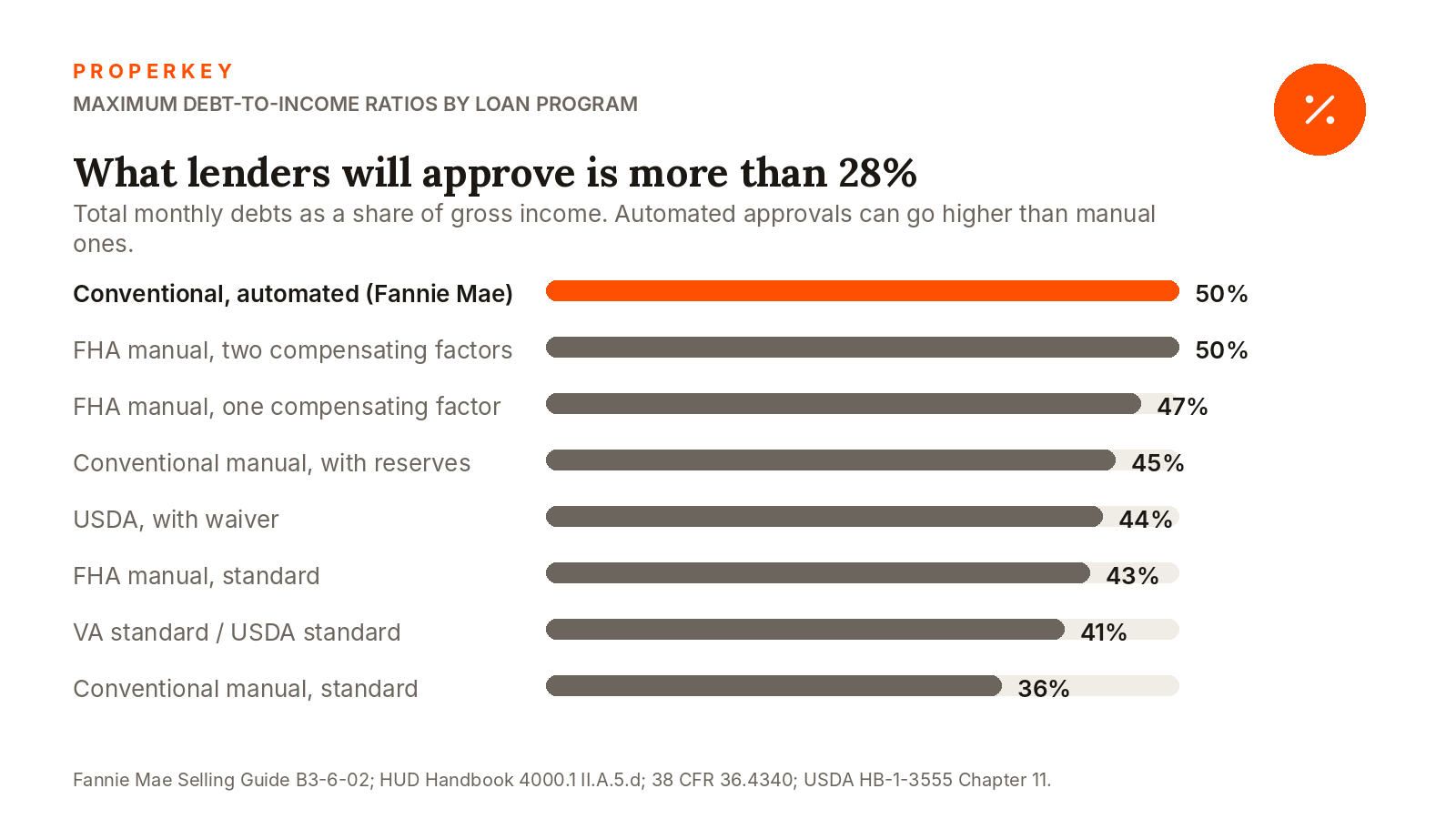
More than the 28% guideline suggests. Lenders qualify borrowers on the debt-to-income ratio, which the Consumer Financial Protection Bureau defines as all monthly debt payments divided by gross monthly income. The limit depends on the loan program:
Conventional (Fannie Mae): up to 50% total DTI for loans approved through its automated underwriting system; 36% for manually underwritten loans, or up to 45% with the credit score and reserves its eligibility matrix requires (Selling Guide B3-6-02).
FHA: 31% housing and 43% total for manual underwriting, rising to 37/47 with one compensating factor and 40/50 with two; borrowers with scores of 500 to 579 are held to 31/43 (HUD Handbook 4000.1). Automated approvals carry no fixed ratio in the handbook.
VA: a 41% total-debt standard plus a residual-income test, $1,117 a month left over for a family of four in the West on loans of $80,000 or more (38 CFR 36.4340).
USDA: 29% housing and 41% total; up to 32/44 for manually underwritten files with a 680 score and a documented compensating factor (HB-1-3555, Chapter 11).
The difference is large. At 28% for housing, a $100,000 income supports $2,333 a month. A buyer approved at a 50% total ratio with $500 of other monthly debt could be cleared for $3,667, enough for a home priced well above $400,000 with 10% down. The 28% figure itself is a lender convention, not a regulation; Fannie Mae's consumer site says the cost of housing "should be 25% – 30% of your gross (pre-tax) income." How the ratios work program by program is covered in How Much of Your Income Should Go to Your Mortgage?
How do the rate and the down payment change the answer?
A fixed payment buys less loan as rates rise. Three thousand dollars a month of principal and interest carries a loan of about $445,960 at 7.11%. The payment on the same loan a year ago, when Freddie Mac's average was 6.24%, would have been about $257 lower.
The down payment matters twice: it shrinks the loan, and at 20% it removes PMI. On a $100,000 income, moving from 10% to 20% down lifts the affordable price from about $294,000 to $346,000. Most buyers put down less. The typical first-time buyer put down 9% and the typical repeat buyer 19% in the National Association of Realtors' 2026 buyer profile. How PMI is priced and removed is explained in How Much Private Mortgage Insurance Costs, and the state's assistance programs in Down Payment Assistance in California.
Which loan limits apply?
A conforming loan in 2026 can be as large as $832,750 on a one-unit home in most counties, including Butte, and $1,249,125 in high-cost counties such as Los Angeles, Orange, San Francisco and Santa Clara; San Diego County's limit is $1,104,000 (Federal Housing Finance Agency). FHA's 2026 limits run from $541,287 to $1,249,125 (Mortgagee Letter 2025-23). Above those amounts the loan is a jumbo with its own underwriting. The 2027 limits are due from FHFA in late November; see 2027 Conforming Loan Limits.
For a figure based on an actual credit file and current pricing rather than averages, Properkey's finance service takes one application for a purchase or refinance and shops the lenders. Homes for sale in a given price range can be searched at properkey.us/find.
Questions people ask
How much house can I afford on a $100,000 salary in California? About $294,000 with 10% down or $346,000 with 20% down if the full payment is held to 28% of gross income at a 7.11% rate, with average property tax and insurance. A lender may approve a higher price, because conventional loans allow total debts of up to 50% of income.
What income do I need to buy the median California home? C.A.R. calculated a minimum of $228,000 for the $894,630 median in the third quarter of 2026, assuming 20% down and a 6.80% effective rate. Butte County required about $113,200 and San Diego County about $274,000.
Is the 28/36 rule a law? No. It is a lender convention. Federal rules stopped using a fixed 43% debt-to-income cap for qualified mortgages when the price-based definition took effect on March 1, 2021, and each loan program now sets its own limits.
Do property taxes and insurance count toward what I can afford? Yes. Lenders count principal, interest, property tax, homeowners insurance, mortgage insurance and HOA dues as the housing payment. On a $450,000 home, tax at the statewide average rate adds about $432 a month.
This article is a general summary using statewide averages, not lending or financial advice; an actual approval depends on the borrower's credit, debts, property and loan program.
Sources: Freddie Mac Primary Mortgage Market Survey; Board of Equalization; NAIC; Freddie Mac My Home; C.A.R. September 2026 sales report; C.A.R. Housing Affordability Index, Q3 2026; U.S. Census Bureau; CFPB; Fannie Mae Selling Guide; HUD Handbook 4000.1; 38 CFR 36.4340; USDA HB-1-3555; FHFA; HUD Mortgagee Letter 2025-23; National Association of Realtors.
Written by Keyro, Properkey's AI. Properkey, DRE #01979718.



