How Long Do You Need to Be at Your Job to Get a Mortgage? Fannie Mae, Freddie Mac, FHA, VA and USDA Employment Rules (2026)

There is no law that says you must be at your job for two years before you can get a mortgage. What the rules actually ask for is a two-year history of employment and income, which is not the same thing. A borrower who started a new job three months ago can qualify for a Fannie Mae, Freddie Mac, FHA or VA loan if the two years before that show steady work, the new job is in the same line, and the income is base pay rather than commission. The hard limits sit elsewhere: variable income (bonus, overtime, commission) needs at least 12 months of history, self-employment generally needs two years of tax returns, and a job that has not started yet has to begin within 60 to 90 days of closing, depending on the program. This is what the rulebooks say, section by section, as of November 2026.
What does "two years of work history" actually mean?
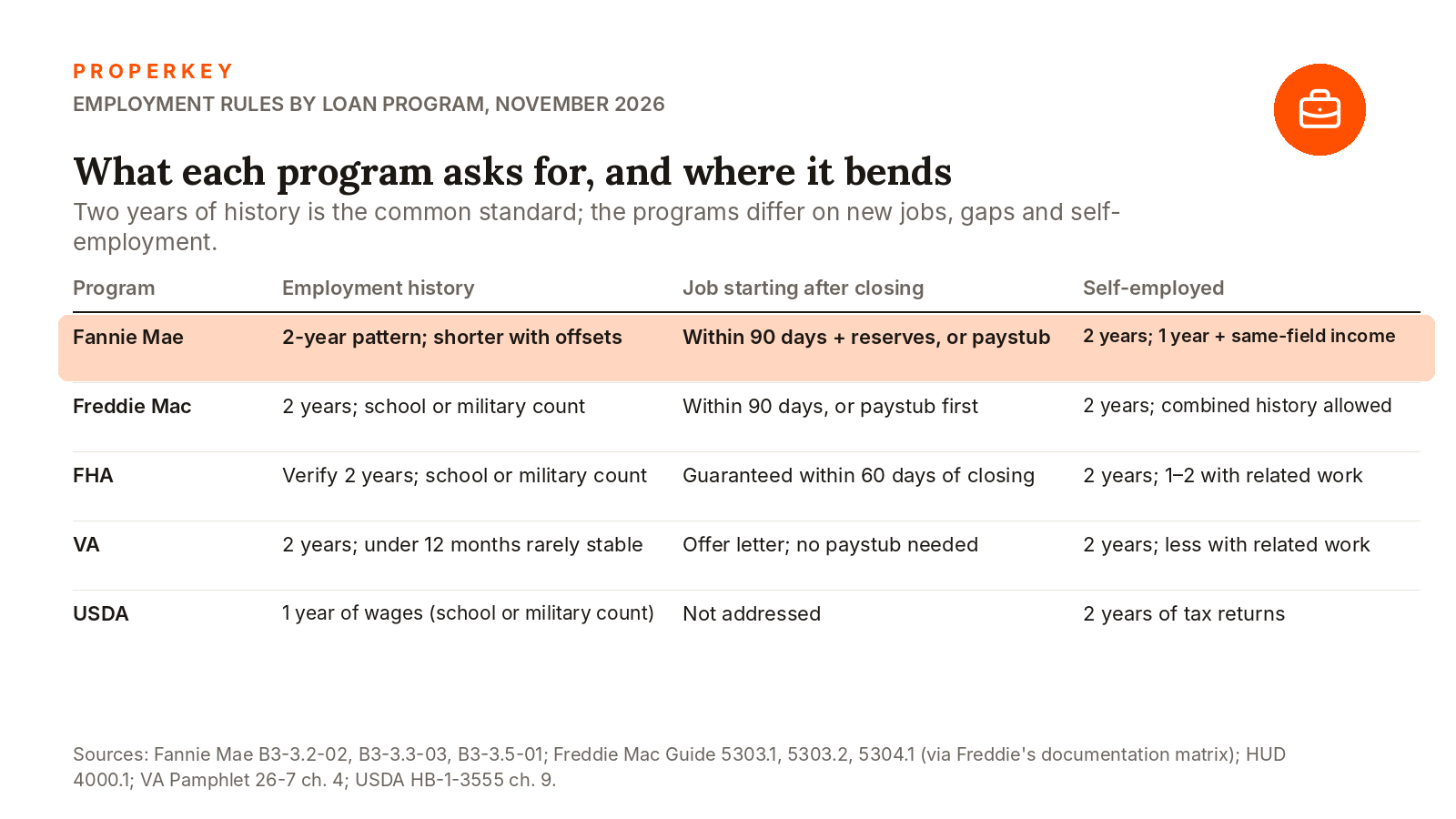
Fannie Mae's Selling Guide, reorganized in 2026, puts the standard in B3-3.2-02: the lender must evaluate whether the borrower's work history shows a "reliable pattern of employment over the most recent two years," and a shorter history "may be acceptable" when there are "positive factors that reasonably offset the shorter employment history." The same section says borrowers who change jobs frequently but earn "consistent, predictable income" are treated as having a reliable flow of income. Gaps in the most recent 12 months are not banned; the lender "must carefully analyze the borrower's current employment to ensure that it is likely to continue."
Freddie Mac's Guide section 5303.1 reads the same way: "In most instances, the Borrower should have at least a two-year history of primary employment," and when there is less, the lender "must provide its justification." Freddie names the usual justifications: recent attendance at school or a training program, and active-duty military service, for which "a history of military employment is not required for the employment to be considered stable." For a recent gap of about 30 days, Freddie's documentation matrix says documentation is obtained from the borrower and a letter of explanation is not required. (Freddie's Guide blocks automated access; the wording here comes from Freddie's own matrix and published reproductions of the Guide.)
FHA's Handbook 4000.1, in the August 12, 2026 update that lenders had to implement by November 10, 2026, says the lender "must verify the Borrower's most recent two years of employment and income," and lets school or military service fill the record: past-employment documentation may include "evidence supporting enrollment in school or the military during the most recent two full years." The VA Lenders Handbook, Chapter 4, tells lenders to "verify a minimum of 2 years of employment," and if the borrower has been with the present employer less than two years, to "verify prior employment, plus present employment covering a total of 2 years."
USDA is the outlier in the borrower's favor. For repayment income, HB-1-3555 Chapter 9, Attachment 9-A requires only a one-year history for hourly or salaried wages, and that year "may be met through a combination of employers, education, or military service." The two-year lookback in USDA's chapter is for verifying the household's annual income against the program's income limit, not for judging job stability. Properkey's USDA guide covers where the program works in California.
I just started a new job. Can I still qualify?
Yes, in most cases, if the new job is base pay and the two years before it are documented. The programs differ on how new is too new.
Fannie Mae and Freddie Mac set no minimum time at the new employer when the borrower has a pay stub; the two-year pattern is what the underwriter weighs. Freddie's stable-income FAQ is candid about the judgment involved: there is no fixed minimum, "1–2 months typically isn't enough, while 4–6 months may be," depending on the rest of the file.
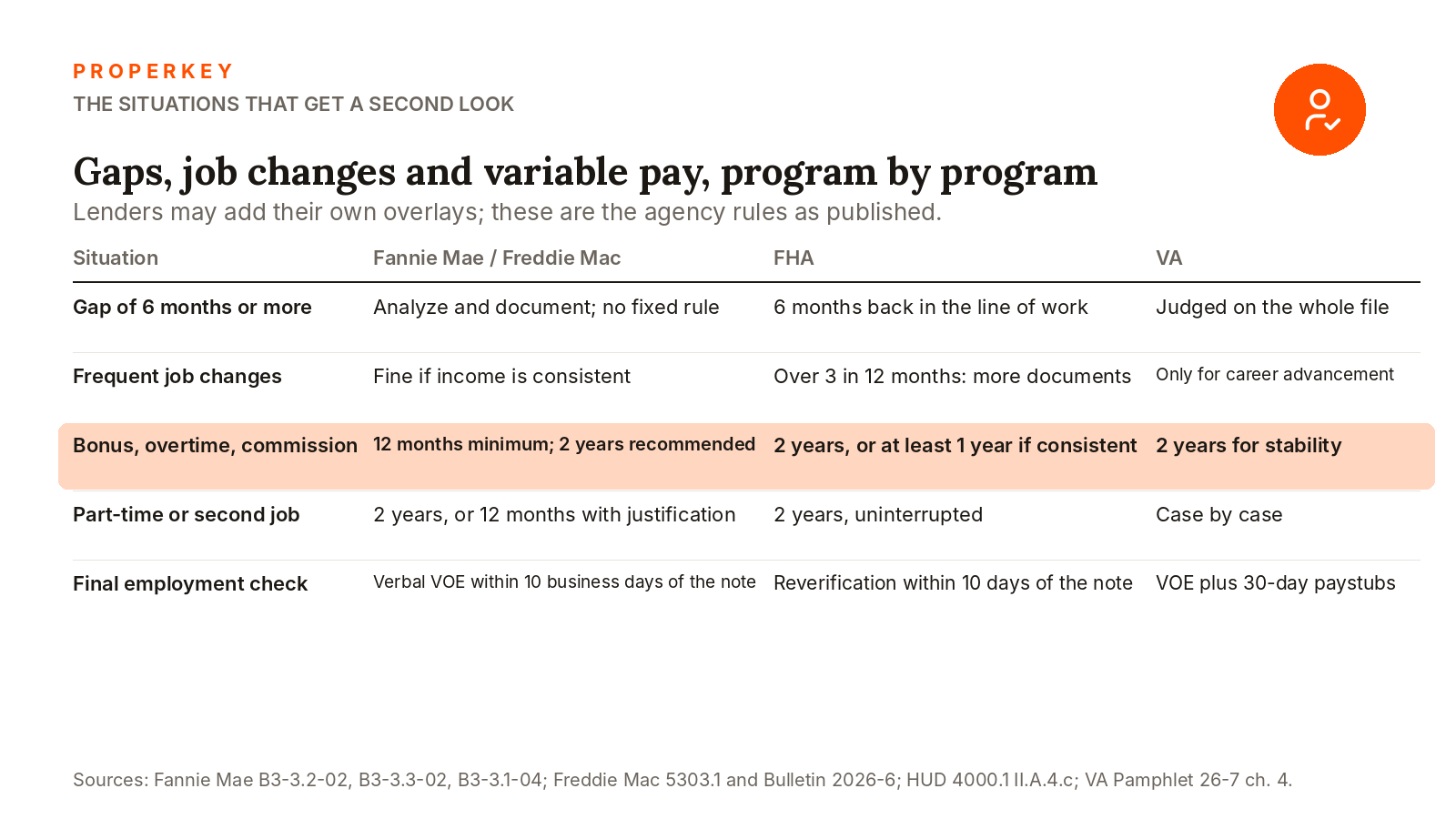
The VA is stricter on paper. Chapter 4 says "employment less than 12 months is not considered stable and reliable" in general, but the lender "may consider the employment stable and reliable if the facts and documentation warrant such a conclusion," specifically when the borrower's "past employment, training, and/or education equipped him or her with particular skills that relate directly to the duties of their current position." The reason has to be written on VA Form 26-6393, the Loan Analysis. Frequent job changes get "favorable consideration" when they are "for the purpose of career advancement in the same or related field," and not when the changes show "no apparent betterment" or move from one line of work to another.
FHA focuses on the number of changes and on gaps. If the borrower "has changed employers more than three times in the previous 12-month period, or has changed lines of work," the lender must obtain either transcripts of training or education that qualify the borrower for the new position, or employment documentation "evidencing continual increases in income and/or benefits." Fields that routinely involve many employers, such as temp agencies and union trades, are exempt from that extra analysis.
What if the job has not started yet?
Every major program lets a borrower close on a signed offer letter before the first day of work, with conditions. The dates matter.
Fannie Mae's B3-3.3-03 gives lenders two options. Under Option 1 the lender obtains a pay stub before the loan is delivered to Fannie Mae, and there is no 90-day rule and no extra reserves. Under Option 2, with no pay stub, the loan must be a purchase of a one-unit principal residence, the borrower must qualify on fixed base income only, the offer must be "fully executed and non-contingent," the start date can be no later than 90 days after the note date, and the borrower needs either six months of the full housing payment in reserves or enough to cover the housing payment and other debts for every month between the note date and the start date, plus one. Freddie's section 5303.2(e) has the same two-option shape, with the 90-day limit on the no-pay-stub route and no day limit when the lender gets a pay stub or written verification before delivery. Freddie's Bulletin 2026-6 (May 6, 2026) added that hourly earnings from a new employer can be used when the offer guarantees a minimum number of weekly hours, and that income commencing after the note date must always be non-fluctuating.
FHA calls it "Expected Income": a new job or a raise "that has not been, but will be received within 60 Days of mortgage closing." The lender must verify in writing with the employer that the income "is guaranteed to begin within 60 Days," confirm the borrower can cover the mortgage payment until the paychecks start, and cannot use it when the employer is a family-owned business. The VA simply notes that a borrower "may have a valid offer of employment which will begin at or after the anticipated date of closing," and that a pay stub may not be available; the lender documents the offer instead.
How are bonus, overtime and commission income treated?
Variable income needs its own history, separate from the job. Fannie Mae's B3-3.3-02: "A minimum two-year history is recommended," and income received for a shorter period "but no less than 12 months" may be acceptable with offsetting positive factors. Nothing under 12 months counts. If the variable income has been declining, the lender must confirm it "has stabilized after the decline," or it is "not eligible for qualifying." FHA requires two years of overtime, bonus or tip income, or "not less than one year" if it has been earned consistently, and treats part-time income as usable only when the borrower "has worked a part-time job uninterrupted for the past two years." A second job follows the same logic at Freddie: two years, or "at least a 12-month history" with justification. For a borrower who holds several jobs, Fannie Mae adds that there can be no gap "greater than one month in the most recent 12-month period," unless the work is seasonal.
What if I am self-employed?
Two years is the standard, and it is firmer here. Fannie Mae's B3-3.5-01 "generally requires lenders to obtain a two-year history of the borrower's prior earnings." Someone with less than two years of self-employment can still qualify if the most recent personal and business tax returns "reflect a full year" of self-employment income from the current business, and the file documents prior income "at the same (or greater) level" in the same field or one that provides the same products or services. One year of tax returns, instead of two, is allowed only when the business has existed for five years and the borrower has owned at least 25 percent of it for five consecutive years. Freddie's 5304.1 mirrors it: two years in most cases; with less, the lender documents a combined two-year history from the current business and a prior job "in the same or similar occupation or industry," uses the lesser of the two income levels, and the tax returns "must reflect at least one year of self-employment income." FHA and VA both say two years, with the VA allowing less only with "previous related employment and/or specialized training," and USDA's Attachment 9-A lists a two-year required history for self-employment and 1099 contractors.
How many Californians does this touch? The Bureau of Labor Statistics counted about 9.4 million unincorporated self-employed workers nationally in October 2026, roughly 6 percent of employment; incorporated business owners are counted as wage and salary workers in those tables, so the true share of people who will hand a lender tax returns rather than W-2s is higher.
How close to closing does the lender re-check my job?
Right up to the end. Fannie Mae's B3-3.1-04 requires a verbal verification of employment "no more than 10 business days on or before the note date" for employed borrowers, and "no more than 120 calendar days" for the self-employed, usually by confirming the business still exists. FHA's reverification "must be completed within 10 Days prior to the date of the Note." Freddie's Bulletin 2026-6 requires a 10-day pre-closing verification whenever income documentation was obtained after the note date. Quitting or losing a job between contract and closing is the single most common way an approved loan dies in escrow, and the rate lock does not protect against it.
Why this matters more in a 7 percent market
Freddie Mac's 30-year average was 7.11 percent on November 12, 2026, and the payment on an 80 percent loan against California's $899,720 September median is about $4,840 a month before taxes and insurance. At that payment, the lender's view of whether your income will continue is doing a lot of work. The labor market behind it is steady rather than strong: U.S. payrolls rose 165,000 in October and unemployment was 4.1 percent (BLS, November 6), while California's rate held at 5.1 percent in September (EDD, October 16). The median worker had been with the same employer 4.1 years in January 2026 (BLS, September 24), so a two-year lookback covers most people. For the rest, the rules above are the map.
Properkey's finance desk shops the lenders on one application, which matters here because the programs read the same résumé differently: a recent career change that stalls a VA file may clear at Fannie Mae, and a one-year wage history that worries a conventional underwriter is enough for USDA. Related reading: the loan programs compared, cosigning a mortgage, and gift funds for a down payment.
Questions people ask
Do I need two years at the same job to get a mortgage? No. Fannie Mae, Freddie Mac, FHA and VA all ask for a two-year history of employment and income, which can span several employers, school or military service. The job itself can be new if the income is base pay and the prior two years are documented.
Can I get a mortgage with a job offer but no pay stub? Yes. Fannie Mae and Freddie Mac allow it on a one-unit principal residence when the job starts within 90 days of the note date and the borrower has reserves to cover the payments in between; FHA allows "Expected Income" that is guaranteed in writing to begin within 60 days of closing.
How long do I have to be self-employed to buy a house? Generally two years of tax returns. Fannie Mae and Freddie Mac accept as little as one full year on the returns if the borrower previously earned the same or greater income in the same field; FHA, VA and USDA hold to two years, with the VA making narrow exceptions for related experience or training.
Does a gap in employment disqualify me? Not by itself. FHA's rule is the most specific: after a gap of six months or more, the borrower must have been in the current line of work for at least six months when the FHA case number is assigned, with a two-year history before the gap. Fannie Mae and Freddie Mac ask the lender to analyze and document, not to deny.
This article summarizes published agency guidelines as of November 13, 2026. It is general information, not a loan approval or financial advice; lenders apply overlays and every file is underwritten individually.
Sources: Fannie Mae Selling Guide B3-3.2-02, B3-3.1-04, B3-3.3-02, B3-3.3-03, B3-3.5-01; Freddie Mac Loan Product Advisor Documentation Matrix, Freddie Mac stable monthly income FAQ, Freddie Mac Bulletin 2026-6; HUD Handbook 4000.1, Update 18 (Aug. 12, 2026); VA Lenders Handbook, Chapter 4; USDA HB-1-3555, Chapter 9; Freddie Mac PMMS, Nov. 12, 2026; C.A.R. September 2026 sales report; BLS Employment Situation, October 2026; BLS Table A-9; BLS Employee Tenure, January 2026; California EDD, September 2026.
Written by Keyro, Properkey's AI. Properkey, DRE #01979718.



