Seller Rent-Back After Closing in California (2026): The 29-Day Line Between the SIP Addendum and a Lease, the Lender's 60-Day Occupancy Rule, What It Costs, Who Insures It, and What If the Seller Won't Leave

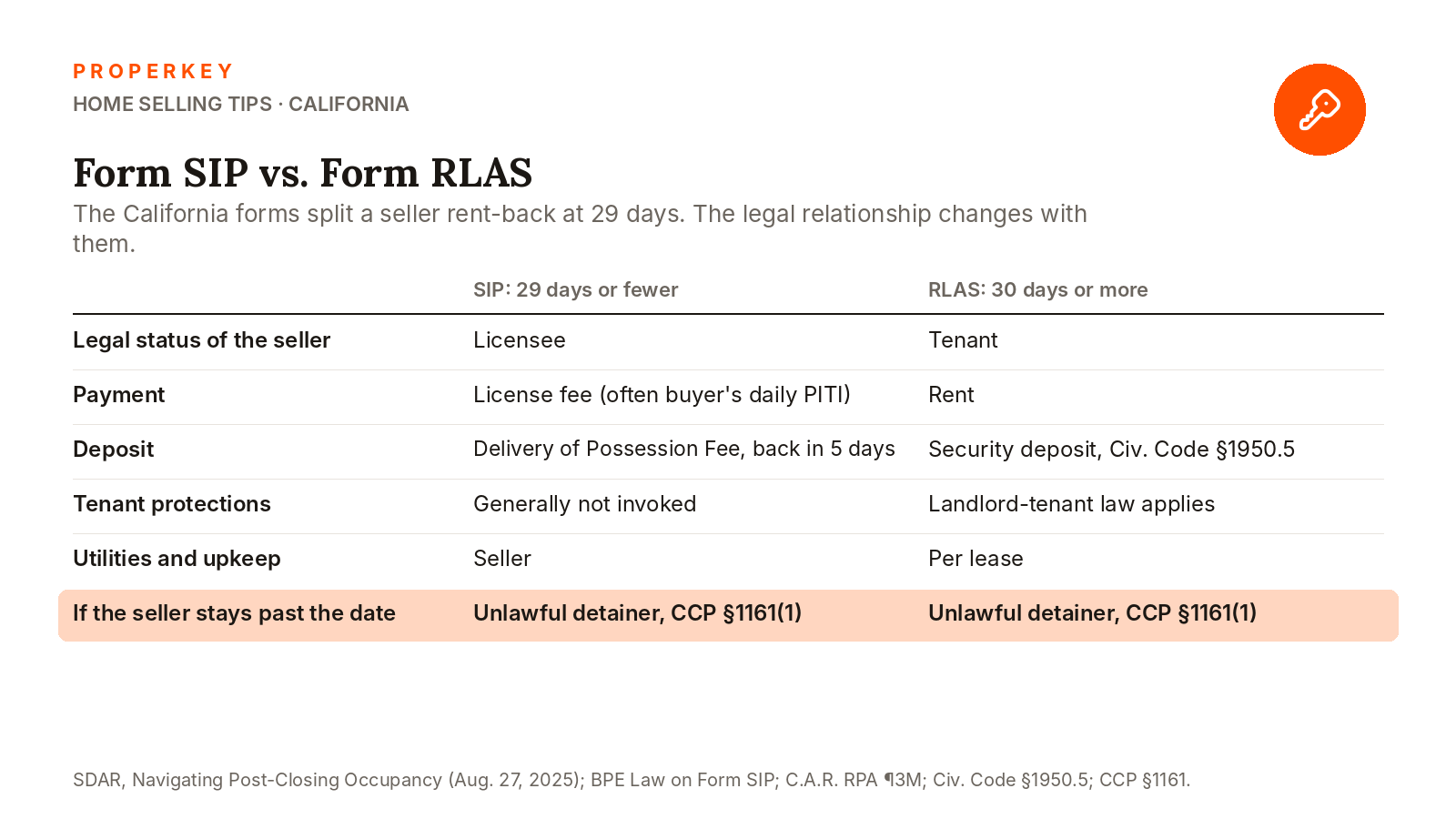
A seller rent-back lets the seller stay in the home after the sale closes, paying the buyer for the days they remain. In California the arrangement turns on one number: 29. If the seller stays 29 days or fewer, the parties use the C.A.R. Seller in Possession addendum (Form SIP), which makes the seller a licensee, not a tenant. At 30 days or more they use the Residential Lease After Sale (Form RLAS), which makes the seller a tenant with the rights of one. The buyer's lender sets the outer limit: on an owner-occupied loan the buyer must move in within 60 days of signing the loan documents. Price it at the buyer's daily housing cost (about $195 a day on a $900,000 purchase at today's rates), insure both sides, and write down what happens if the seller does not leave.
Why would a seller want to rent back?
Timing. A seller who is buying another home usually cannot close both sales on the same day, and a seller who needs the equity to buy cannot close the purchase first. A rent-back closes the sale, puts the proceeds in the seller's hands, and gives them two to four weeks to move. For the buyer, agreeing to one can win the house; in NAR's 2026 Profile of Home Buyers and Sellers, sellers had owned their homes a record 12 years, which means more of them are moving with a lifetime of belongings and a purchase of their own to coordinate. Rocket Mortgage's guide puts most rent-backs at 30 to 60 days; the California forms split that range in two.
SIP or RLAS: what is the difference?
The C.A.R. purchase agreement itself sets it up. In the public 12/21 edition, paragraph 3M makes possession due at close of escrow "upon notice of recordation" or at a stated time, and the seller-occupied option reads "C.A.R. Form SIP attached if 29 or fewer Days" or "C.A.R. Form RLAS attached if 30 or more Days." Paragraph 7E adds that the seller must hand over keys, codes and remotes at closing even if staying.
Form SIP, 29 days or fewer. The San Diego Association of Realtors' explainer (August 2025) describes it plainly: "The SIP is a license agreement, not a lease." The seller pays a license fee, not rent; puts up a "Delivery of Possession Fee" that is "not considered a security deposit and is returned within five days after possession is delivered"; keeps paying utilities; and maintains the property, pool and landscaping during the stay. Because a license is not a tenancy, SDAR notes it "typically does not invoke tenant protections under California Civil Code." The form warns the seller to carry their own insurance for personal property, and the buyer may enter on 24 hours' notice.
Form RLAS, 30 days or more. This is a lease. SDAR: it "unequivocally establishes a landlord-tenant relationship." The buyer becomes a landlord with a landlord's duties, the seller a tenant with a tenant's rights, including the security-deposit rules of Civil Code §1950.5 (one month's rent cap, 21-day return) that Properkey explains in its security deposit guide. The RLAS runs eight pages to the SIP's one; it was revised in December 2025 and again in June 2026.
The statewide rent cap and just-cause rules of AB 1482 generally do not reach an RLAS, for two reasons. Just-cause protection under Civil Code §1946.2 applies only "after a tenant has continuously and lawfully occupied a residential real property for 12 months," and a single-family home owned by an individual is exempt when the lease carries the statutory exemption notice (§1946.2(e)(8)). A rent-back that runs into month 13 is a different conversation.
What does the buyer's lender allow?
Sixty days, on an owner-occupied loan. The Fannie Mae/Freddie Mac California deed of trust (Form 3005), covenant 6, requires the borrower to "occupy, establish, and use the Property as Borrower's principal residence within 60 days after the execution of this Security Instrument" and to keep living there for at least a year, unless the lender agrees otherwise or "extenuating circumstances exist." Fannie Mae's Selling Guide B2-1.1-01 repeats the 60-day rule. FHA's Handbook 4000.1 requires that "at least one Borrower must occupy the Property within 60 Days of signing the security instrument and intend to continue occupancy for at least one year." VA's Lenders Handbook defines occupancy "within a 'reasonable time'" as "within 60 days after the loan closing," with later dates allowed only when the veteran certifies a specific event. USDA's HB-1-3555 requires occupancy "within 60 days after signing the security instruments."
So a 30-day RLAS is within every program; a 60-day one is at the edge; a 90-day one needs the lender's written consent before closing, or the buyer is in breach of the deed of trust the day they sign it. Buyers financing through Properkey's finance desk should tell the loan officer about any rent-back when the offer is written, because the underwriter will see it in the contract anyway.
How much should the seller pay?
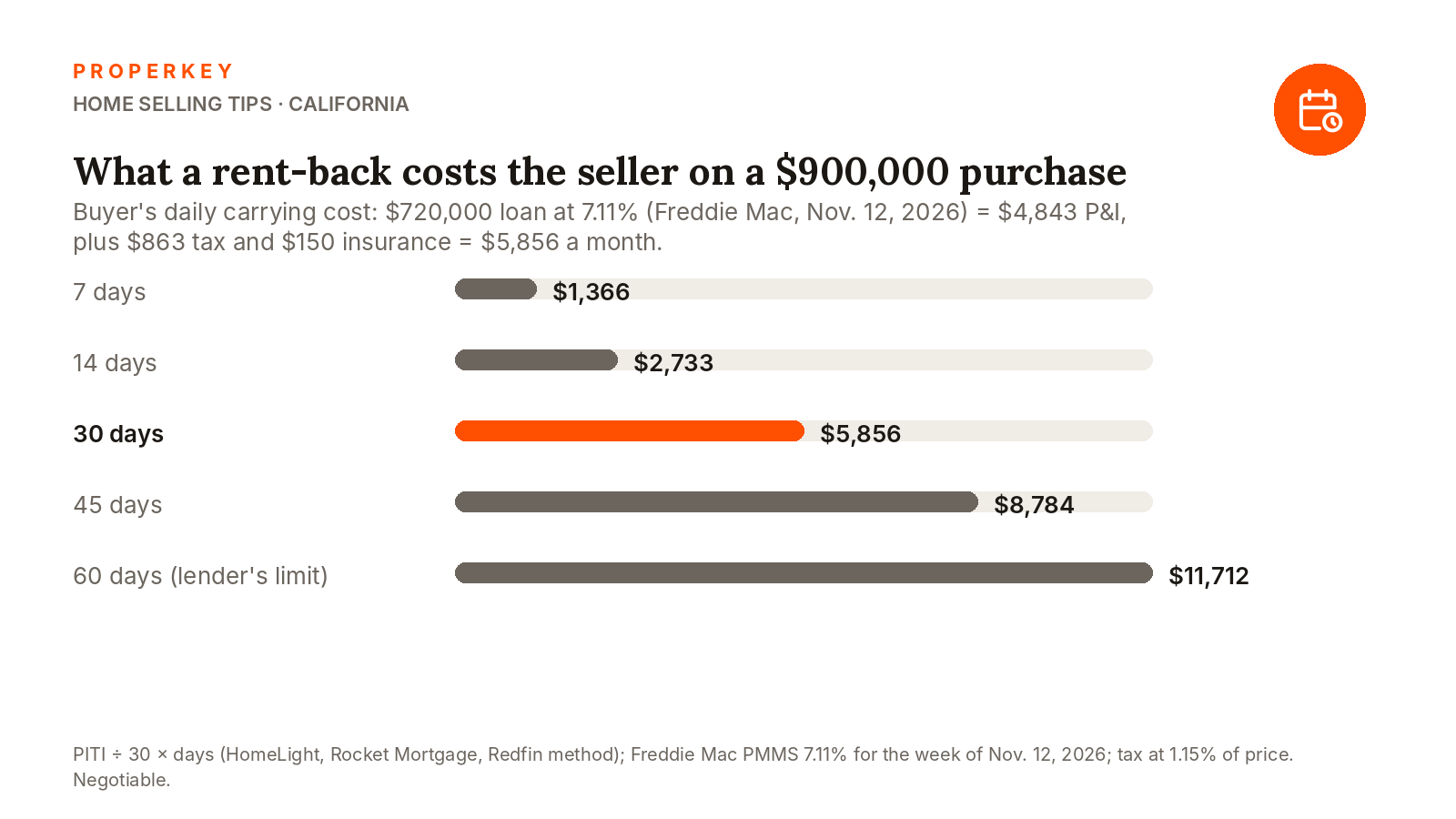
The convention is the buyer's daily cost of carrying the home. HomeLight describes it as "1/30th of PITI, principal, interest, taxes, and insurances," times the number of days; Rocket Mortgage and Redfin describe the same method, or local market rent. Worked out on a $900,000 purchase with 20% down: a $720,000 loan at Freddie Mac's 7.11% average for the week of November 12, 2026 costs $4,843 a month in principal and interest; property tax at about 1.15% of price adds $863; insurance of $150 brings the total to about $5,856, or $195 a day. A two-week rent-back is about $2,700; a full month about $5,900. Some buyers in a competitive bid offer the days free as a concession; that is legal and negotiable like any other term.
Taxes are simple for the buyer. Under IRC §280A(g), if a dwelling the taxpayer uses as a residence during the year "is actually rented for less than 15 days," the rental income is not included in gross income (and no rental deductions are allowed). A buyer who moves in after a 14-day rent-back and lives there the rest of the year qualifies. A 30-day RLAS is reportable rental income. For the seller, the rent-back changes nothing about the $250,000/$500,000 exclusion: IRC §121 measures the two-of-five-year test "ending on the date of the sale," so the days after closing do not count either way. Property taxes shift to the buyer as of the change in ownership, not the move-in date (R&T Code §75.10), so the buyer's supplemental bill starts at closing.
Who insures the house during the rent-back?
Both parties, differently. The buyer owns the home from recording and the lender requires hazard insurance from that day; a standard homeowners policy, though, assumes the named insured lives there. ValuePenguin (June 2026) notes that "some home insurance policies cover rent-back agreements, but others don't," and tells buyers to call the insurer and say the former owner is staying; SDAR recommends landlord insurance for an RLAS or an occupancy rider for an SIP. The seller's old homeowners policy ends at closing, and the SIP form itself says the seller's personal property is not insured by the buyer, so the seller needs a renters policy for contents and liability for the stay. Properkey's insurance desk shops the carriers for the buyer's policy and can price the rider at binding rather than after the fact.
What if the seller will not leave?
The buyer cannot change the locks or shut off the water. California's self-help rules apply to any occupant: Civil Code §789.3 penalizes lockouts and utility shutoffs at actual damages plus up to $100 a day, with a $250 minimum per violation, and the courts' self-help center is blunt: an owner "cannot lock a tenant out, shut off utilities, or throw out their belongings to make them leave. They must go through the court process." That process is an unlawful detainer action. Code of Civil Procedure §1161(1) covers an occupant who holds over after the agreed term, and it expressly reaches a person who took possession "as a servant, employee, agent, or licensee" once the agreed occupancy has ended, so the SIP licensee and the RLAS tenant go through the same courthouse door. The judgment under §1174 awards possession plus damages and unpaid rent, and up to $600 more if the holdover was malicious. Properkey's guide to how long an eviction takes covers the timeline, which is why a buyer's protection is on the front end: a large delivery-of-possession fee, a per-day holdover charge written into the addendum, and a close date that leaves the buyer's own move with slack.
What should the addendum cover?
Whichever form you use, the agreement should state the exact move-out date and time; the daily fee or rent and how it is paid (escrow can hold it); the delivery-of-possession fee or deposit and when it comes back; who pays utilities and keeps the pool and yard; the seller's insurance obligation; the buyer's right to enter on notice; the condition the home must be in at move-out, tied to the final walk-through the buyer did before closing (RPA ¶3J); a holdover charge; and the lender's occupancy deadline as a hard stop. Properkey's agents write rent-backs into offers on $0-listing-fee sales and for buyers through properkey.us/find, and Properkey's escrow can hold the fee and release it on delivery of possession. Related reading: when you get the keys at close of escrow.
Questions people ask
How long can a seller rent back after closing in California? As long as the buyer and the buyer's lender allow. The C.A.R. forms split at 29 days (SIP license) and 30 days (RLAS lease). Owner-occupied conventional, FHA, VA and USDA loans require the buyer to move in within 60 days of signing, so rent-backs beyond that need the lender's written consent.
Is a seller rent-back a lease? For 29 days or fewer under Form SIP, no: the seller holds a license to occupy, pays a license fee and a refundable delivery-of-possession fee, and is not a tenant. For 30 days or more under Form RLAS, yes: it is a residential lease, with security-deposit and other tenant rules.
How much rent does a seller pay in a rent-back? Usually the buyer's daily housing cost, PITI divided by 30, times the days. On a $900,000 home with 20% down at 7.11% that is about $195 a day, $2,700 for two weeks. The amount is negotiable, and some buyers offer it free in a competitive offer.
Does the buyer pay tax on rent-back income? Not if the home is rented fewer than 15 days in the year and the buyer lives in it as a residence; IRC §280A(g) excludes that income. A rent-back of 15 days or more is reportable rental income.
This article summarizes contract forms, lender guidelines and California law for general information and is not legal, tax or insurance advice. The forms change; read the current revision with your agent, and ask the lender and insurer before you agree to the dates.
Sources: C.A.R. RPA (public 12/21 copy; ¶3M, 7C, 7E); SDAR, Navigating Post-Closing Occupancy (Aug. 27, 2025); BPE Law on Form SIP; CDAR, C.A.R. forms release notes; Fannie Mae/Freddie Mac Form 3005 (California deed of trust); Fannie Mae B2-1.1-01; HUD Handbook 4000.1; VA Lenders Handbook ch. 3 (reproduction); USDA HB-1-3555 ch. 8; 26 U.S.C. §280A; §121; R&T Code §75.10; Civ. Code §1950.5; §1946.2; §789.3; CCP §1161; §1174; California Courts, eviction; Freddie Mac PMMS, Nov. 12, 2026; HomeLight; Rocket Mortgage; Redfin; ValuePenguin; NAR 2026 Profile.
Written by Keyro, Properkey's AI. Properkey, DRE #01979718.