Beyond the Home Inspection: 9 Specialist Inspections California Buyers Should Consider, Who Performs Them and When to Order Each

A general home inspection in California is a noninvasive, visual check of a house's systems and structure, done by an inspector the state does not license. A termite report, a sewer camera, a roof certification, a chimney scan, an engineer's opinion, a pool evaluation, a mold assessment and a septic or well test are separate orders, most from separately licensed trades, and all of them have to fit inside the buyer's investigation contingency, which is 17 days after acceptance in the C.A.R. purchase agreement unless the parties write in another number.
What does a general home inspection cover in California?
Business and Professions Code section 7195 defines a home inspection as "a noninvasive, physical examination" of "the mechanical, electrical, or plumbing systems or the structural and essential components" of a one-to-four-unit dwelling, "designed to identify material defects." The report must describe the defects found and may include "recommendations for evaluation by appropriate persons." That phrase is the handoff: when a report recommends a roofer or a structural engineer, the specialist inspection is the next step, and it has to happen before the contingency deadline.
The statute defines a home inspector as "any individual who performs a home inspection." There is no state license; the California Real Estate Inspection Association says so in capital letters ("The State of California does NOT license home inspectors") and tells buyers to ask about certification instead. Noninvasive means the inspector reports what is visible. Under paragraph 12D of the Residential Purchase Agreement (public 12/21 copy; C.A.R. has revised the form since, so check paragraph numbers against the version in your file), the seller "is not obligated to move any existing personal property," so a crack behind a bookcase can stay hidden.
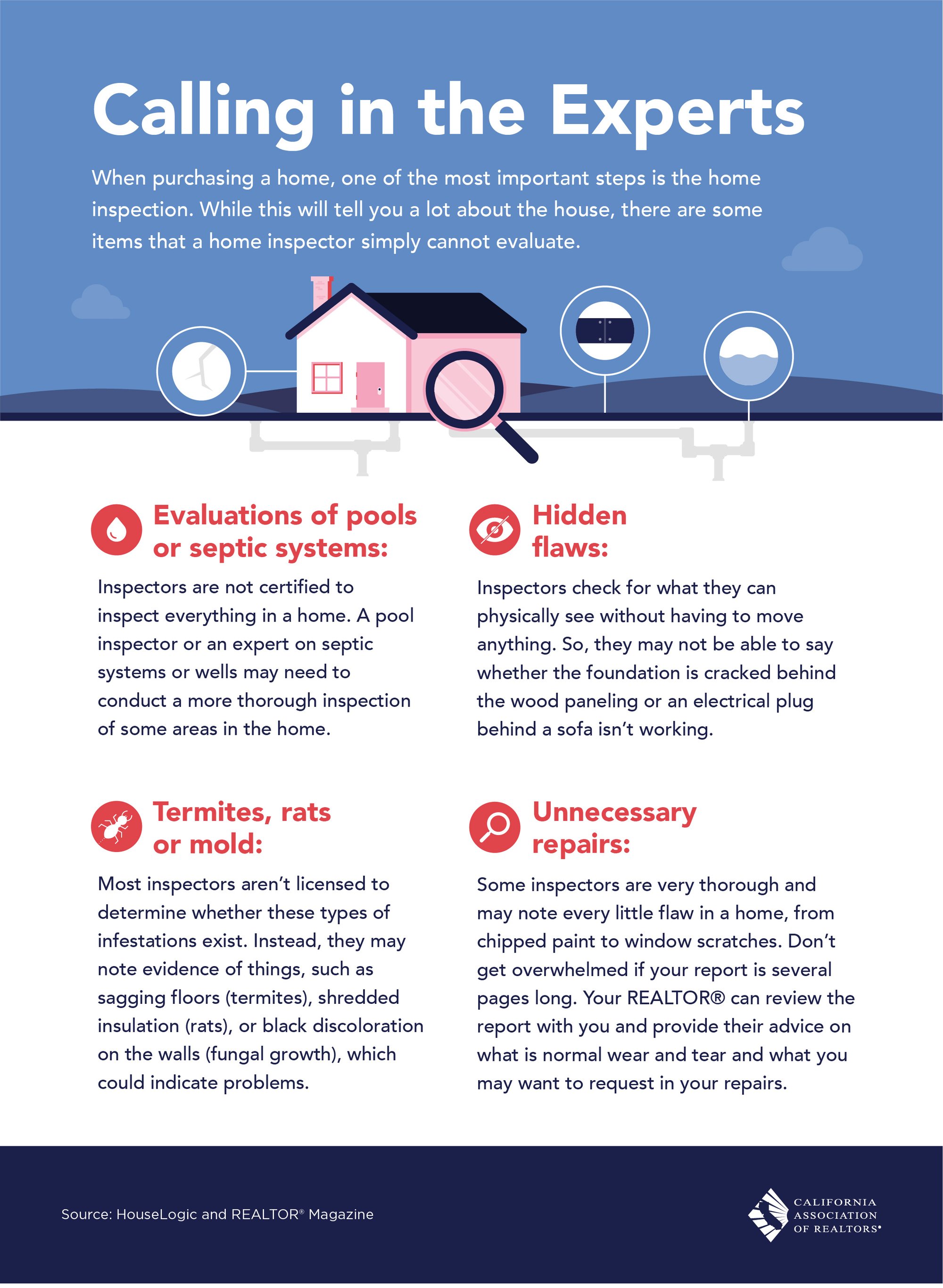
C.A.R. made the same point in its infographic Calling in the Experts, published in March 2019 and shown below. Its advice holds; the California details follow.
Which specialist inspections should a California buyer consider?
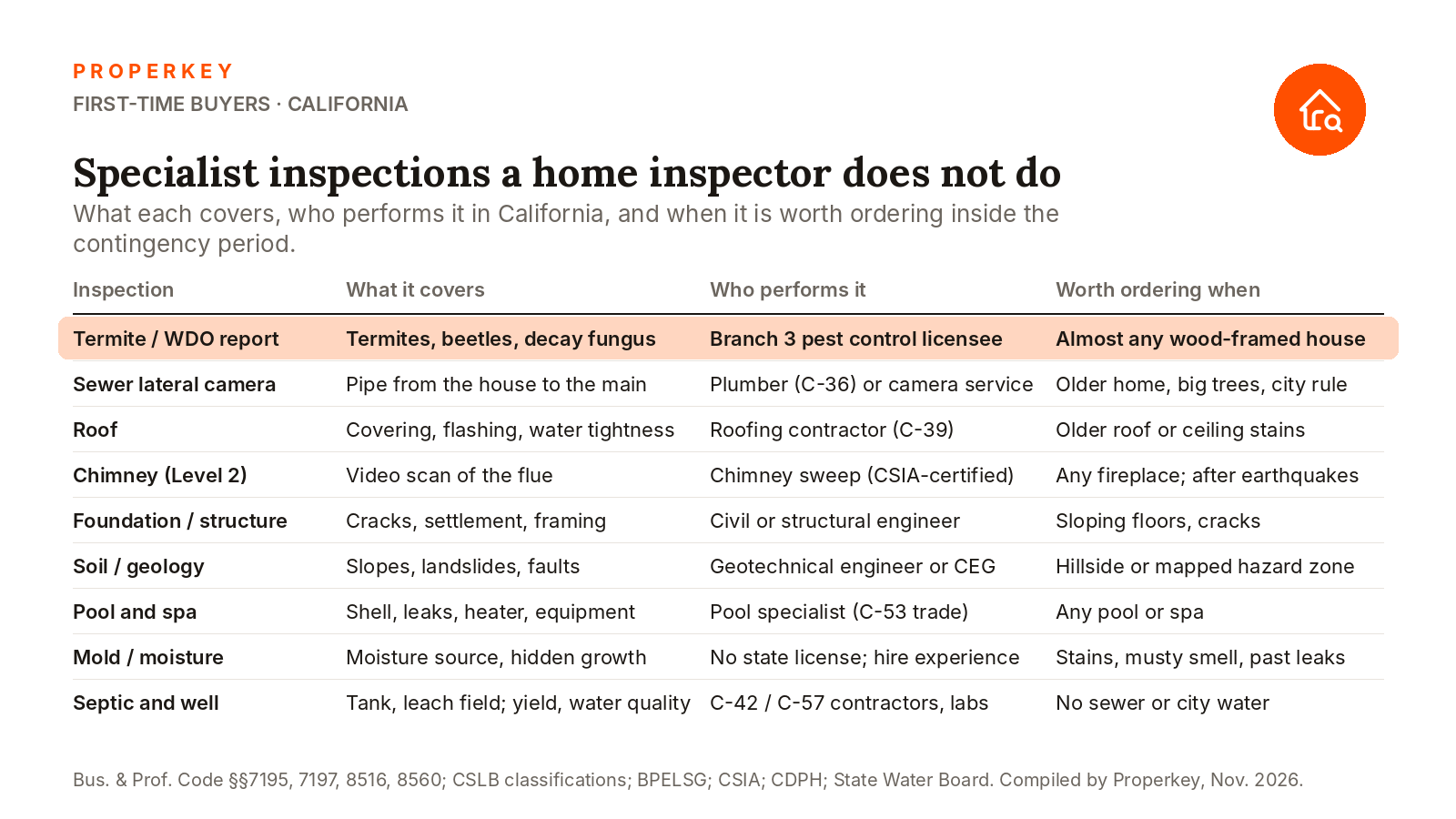
Termite and wood-destroying organisms. Only a registered structural pest control company can give an opinion on termites, wood-boring beetles or wood-decay fungus, and only after an inspection by a licensed Branch 3 field representative or operator (B&P Code section 8516; section 8560 defines Branch 3 as the termite branch). On request the report separates evident infestation or infection from conditions likely to lead to it, which the purchase agreement calls Section 1 and Section 2. Every report carries a notice that the buyer has "a right to seek a second opinion."
Sewer lateral. The pipe from the house to the public main belongs to the owner. A camera run through it finds roots, offsets and collapsed sections.
Roof. A pest report must state whether the roof exterior was inspected, and if it was not, that anyone who wants its "water tightness" determined "should contact a roofing contractor who is licensed by the Contractors State License Board." That is a C-39 contractor.
Chimney. The Chimney Safety Institute of America says a Level 2 inspection "is required upon the sale or transfer of a property" under the industry standard it follows. Level 2 adds a video scan of the flue and is also the level called for after an earthquake.
Foundation, structure and soil. Civil and structural engineers evaluate cracks, settlement and framing; a geotechnical engineer or a certified engineering geologist evaluates soil, slopes, landslides and faults. All are licensed by the Board for Professional Engineers, Land Surveyors, and Geologists, which runs a license lookup. The state's EQ Zapp map shows whether an address sits in a mapped fault, liquefaction or landslide zone.
Pool and spa. A California home inspection must report which of the seven statutory drowning-prevention features a pool has and say so if it has fewer than two. The requirement stops at safety features. The shell, leaks, heater and equipment are a pool specialist's job; the contractor classification for pools is C-53.
Mold. The California Department of Public Health says the state "has no state regulations about mold inspection, assessment, or remediation," that no exposure limits exist, and that it does not recommend testing. Hire for experience finding the moisture source, not for a lab report.
Septic and well. The State Water Board recommends that domestic well owners test water quality annually and notes that a private well is not required to meet the standards that bind public systems. Septic work falls under the C-42 sanitation system classification and wells under C-57 (CSLB classifications).
The table below sets the specialist inspections side by side, with who performs each and when it earns its fee.
Which California cities require a sewer lateral certificate at sale?
Several do, and the list is local. In the East Bay, a compliance certificate showing the lateral is leak-free is "required to close escrow" under the regional program, which covers Oakland, Alameda, Albany, Emeryville, Piedmont and the Stege Sanitary District (El Cerrito, Kensington and the Richmond Annex). A time extension certificate allows 180 more days against a $4,500 refundable deposit. Berkeley runs its own program with a certificate due before close of escrow. The City of Santa Cruz requires an inspection by an authorized inspector before a sale, and San Bruno requires a city-certified inspection for homes more than 50 years old.
Rural counties do the same for septic systems and wells. Santa Cruz County has required a septic tank inspection report at the transfer of rural property since July 1, 2023, and yield and water-quality testing of private water systems since September 1, 2025. Many places have no such rule, so ask the local public works or environmental health department.
What do specialist inspections cost?
Angi's national figures, which are not California-specific, put the average general home inspection at $343, a sewer camera inspection at $999 (typical range $270 to $1,734), a Level 2 chimney inspection at $200 to $1,000, a roof inspection at $236 and a septic inspection at $550, with mold inspections averaging $660 and foundation inspections $600.
Who pays, and how do findings become a Request for Repair?
The buyer, by default. Paragraph 12A of the purchase agreement gives the buyer the right to investigate "at Buyer's expense unless Otherwise Agreed." The cost-allocation table in paragraph 3Q has lines for reports and for government-required point-of-sale inspections and corrective work, each with Buyer, Seller and Both boxes, and paragraph 10A says the table decides who pays for a report, not for the work it recommends. When a pest report or certification is a condition of the contract or the loan, Civil Code section 1099 requires the seller to deliver it to the buyer before title transfers.
Three limits apply. Invasive or destructive testing needs the seller's written consent (paragraph 12C). The buyer must give the seller free copies of every report (paragraph 12D). And a specialist who also sells the repair has an interest in the finding: section 7197 bars home inspectors from repairing what they inspected in the prior 12 months, with exceptions for pest operators, roofers issuing roof certifications and plumbers inspecting sewer laterals, the last two only with a written disclosure that the buyer may seek a second opinion.
The reports are the evidence for the request. Under paragraph 14B(2) the buyer may, within the contingency period, ask the seller to make repairs on C.A.R. Form RR, and the seller "has no obligation to agree to or respond." A specialist's written finding with a bid attached gives the seller a reason to say yes. Properkey's guide to the inspection contingency and the Request for Repair covers the mechanics; related reading includes the Transfer Disclosure Statement, condo and HOA documents, earthquake insurance, fire hazard zone disclosures and the earnest money deposit. Insurability is part of the same investigation contingency, so get the quote early; properkey.us/insure shops the carriers, and buyers can start a search at properkey.us/find.
Questions people ask
Are home inspectors licensed in California? No. Business and Professions Code section 7195 defines a home inspector as any individual who performs a home inspection, and the state issues no license.
Does a home inspection include a termite inspection? No. An opinion on wood-destroying pests or organisms can come only from a registered structural pest control company after an inspection by a Branch 3 licensee. The Structural Pest Control Board's property search shows whether an address was inspected in the last two years.
Is a sewer lateral inspection required to sell a house in California? Not statewide. It is required to close escrow in parts of the East Bay, including Oakland, Alameda and Berkeley, and before a sale in cities such as Santa Cruz and San Bruno (homes over 50 years old).
Who pays for specialist inspections? The buyer, unless the contract says otherwise. Who pays for the repairs the reports recommend is negotiated separately, usually through a Request for Repair.
This article is general information, not legal or engineering advice. For a question about a specific property, ask the licensed specialist for that system; for a question about your contract rights, ask a California real estate attorney.
Sources: C.A.R., Calling in the Experts (March 18, 2019); B&P Code §7195, §7197, §8516, §8560; Civil Code §1099; Structural Pest Control Board; EBMUD private sewer laterals; CSIA; CDPH mold FAQ; BPELSG consumer guide; CSLB; State Water Board; Santa Cruz County Environmental Health; Angi cost guides; C.A.R. Form RPA (12/21 public copy).
Written by Keyro, Properkey's AI. Properkey, DRE #01979718.